

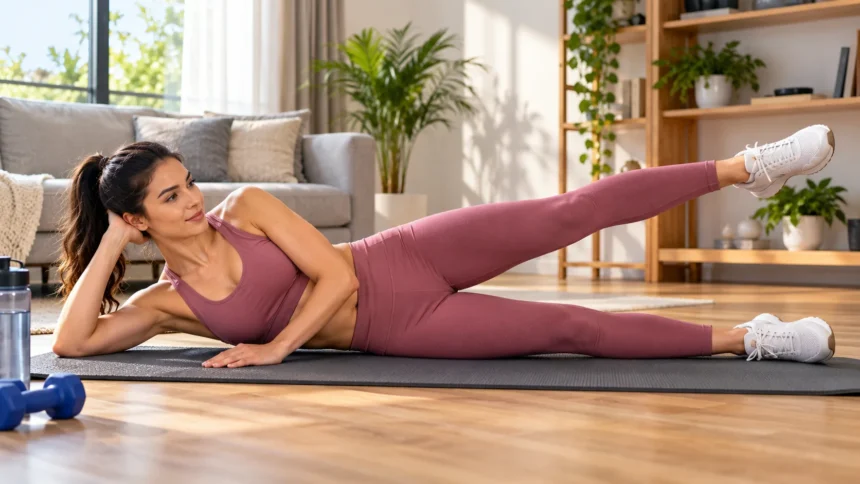
Side leg raises are a simple lower-body exercise that can strengthen the muscles around your hips, thighs, and glutes without requiring much equipment. They are commonly used in home workouts, rehabilitation routines, warm-ups, and strength programs because the movement is easy to learn and can be adjusted for different fitness levels.
The exercise mainly targets the hip abductors, especially the gluteus medius and gluteus minimus. These muscles help move the leg away from the body and support pelvic stability during walking, climbing stairs, running, and standing on one leg. Proper form matters because poor positioning can shift the work away from the target muscles.
This guide explains how to perform side leg raises correctly, which muscles they work, common mistakes to avoid, useful variations, and practical ways to include them in your routine. You will also learn how many repetitions to do and when the exercise may need to be modified.
What Are Side Leg Raises?
Side leg raises involve moving one leg away from the center of the body while keeping the rest of the body relatively stable. The exercise can be performed while lying on your side, standing, or using resistance equipment. Each version trains similar muscles but creates slightly different balance and stability demands.
The movement primarily involves hip abduction, which means lifting the leg outward to the side. This action is controlled by muscles around the outer hip, including the gluteus medius and gluteus minimus. These muscles also help keep the pelvis level when you walk or stand on one leg.
Side leg raises are useful because they can be performed almost anywhere. Beginners can start with body weight, while more experienced exercisers can add resistance bands, ankle weights, or cable resistance. The goal is controlled movement rather than lifting the leg as high as possible.
What Muscles Do Side Leg Raises Work?
The gluteus medius is one of the primary muscles targeted during side leg raises. It sits on the outer part of the hip and helps move the leg sideways. It also plays an important role in stabilizing the pelvis during everyday movement.
The gluteus minimus also contributes to hip abduction. Although it is smaller and lies deeper than the gluteus medius, it helps support hip stability and control. Strong outer hip muscles can improve balance and lower-body coordination.
The tensor fasciae latae, or TFL, may also assist during the movement. Your core muscles contribute by keeping your torso stable while the leg moves. If you perform the exercise while standing, the muscles of the supporting leg also work to maintain balance.
How to Do a Side-Lying Leg Raise
Start by lying on one side with your legs extended and stacked on top of each other. Support your head with your lower arm or a pillow, and keep your body in a straight line from your shoulders to your feet. Place your top hand on the floor for balance if needed.
Gently tighten your abdominal muscles and keep your hips stacked. Slowly lift the top leg upward without rotating your pelvis backward. Keep the knee straight but relaxed and avoid pointing the toes sharply toward the ceiling.
Raise the leg only as high as you can while maintaining control. Pause briefly, then lower it slowly toward the starting position. Complete your repetitions on one side before turning over and repeating the movement on the opposite leg.
How High Should You Lift Your Leg?
You do not need to lift your leg extremely high for side leg raises to be effective. In most cases, lifting to a moderate height is enough to challenge the gluteus medius and other hip abductors. Higher is not always better if your pelvis begins to rotate.
Stop the movement when you feel your outer hip muscles working while your torso remains stable. If your toes turn upward excessively or your waist begins collapsing toward the floor, you may be lifting beyond your controlled range.
A smaller, controlled range usually provides more benefit than a large movement performed with poor technique. Over time, improved strength and mobility may allow you to increase the height slightly without losing alignment.
How to Position Your Feet and Toes
Foot position can influence which muscles you feel during side leg raises. Keeping the toes facing mostly forward helps maintain a neutral hip position and can reduce excessive involvement of the hip flexors.
If the toes rotate strongly toward the ceiling, the leg may turn outward and shift the movement pattern. Some people then feel the front of the hip working more than the side of the glutes.
Think about leading slightly with the heel rather than the toes. This small cue can help keep the hip in a better position. Avoid forcing the foot into an uncomfortable angle and focus instead on keeping the entire leg controlled.
Common Side Leg Raise Mistakes
One common mistake is lifting the leg too high. When this happens, the pelvis often rotates backward and the movement becomes less focused on the hip abductors. Keep the range smaller if you cannot maintain a stable torso.
Another mistake is using momentum. Swinging the leg up quickly makes the exercise easier because speed does some of the work. Slow repetitions increase control and keep the target muscles under tension for longer.
Some people also bend at the waist or allow the lower back to arch excessively. Keep your core gently engaged and your hips stacked. Good alignment makes the exercise more effective and can reduce unnecessary strain.
Benefits of Side Leg Raises
Side leg raises strengthen muscles that help stabilize the hips and pelvis. This is useful during everyday activities such as walking, stepping sideways, climbing stairs, and standing on one leg.
Stronger hip abductors can also support better lower-body control during squats, lunges, and running. The outer hip muscles help manage the position of the pelvis and knees during movement.
Another benefit is accessibility. Side leg raises can be performed without equipment and adjusted easily. This makes them useful for beginners, home workouts, warm-ups, and people who want a low-impact hip-strengthening exercise.
Side Leg Raises for Hip Strength
Hip strength matters because the hips transfer force between the upper and lower body. Weakness around the outer hip can make certain movements feel less stable and may increase reliance on other muscles.
Side leg raises specifically target muscles that are not always challenged heavily by forward-and-back movements. Adding lateral exercises can create a more balanced lower-body routine.
For better overall hip development, combine side leg raises with bridges, squats, step-ups, and other controlled strength exercises. Training the hips in multiple directions supports broader movement capacity.
Side Leg Raises and Pelvic Stability
The gluteus medius helps keep the pelvis level when one foot leaves the ground. This happens with every step you take while walking or running. If the muscle is not working effectively, the pelvis may shift more than necessary.
Side leg raises can help improve awareness and strength in these stabilizing muscles. This makes them useful in routines focused on balance, hip control, and lower-body coordination.
Pelvic stability depends on more than one muscle, however. Core strength, foot control, and overall lower-body coordination also matter. Side leg raises work best as one part of a broader strengthening program.
Standing Side Leg Raises
Standing side leg raises add a balance challenge compared with the side-lying version. Stand next to a wall, chair, or sturdy surface and use it lightly for support. Keep your body upright and your feet facing forward.
Shift your weight onto one leg and slowly lift the opposite leg out to the side. Avoid leaning your torso away from the moving leg. Keep your hips facing forward and move only as far as you can control.
Pause briefly, then lower the leg slowly. Standing variations strengthen the moving leg while also challenging the supporting hip and ankle. They can be useful when progressing toward more functional weight-bearing exercises.
Resistance Band Side Leg Raises
Adding a resistance band makes side leg raises more challenging. Place the band around the thighs, ankles, or feet depending on your strength level and the type of band you are using.
Begin with light resistance so you can maintain proper alignment. Lift the leg slowly against the band’s tension while keeping the pelvis stable. Avoid allowing the band to pull the leg back down quickly.
Resistance bands can increase muscle tension without requiring heavy equipment. They are useful for progressing the exercise gradually. If your technique changes significantly after adding resistance, return to a lighter band.
Side Leg Raises With Ankle Weights
Ankle weights can also increase the difficulty of side leg raises. Because the weight is positioned far from the hip joint, even a small amount can noticeably increase the challenge.
Start with very light weights and focus on slow movement. Heavy ankle weights can encourage swinging or make it harder to control the pelvis. Good form should remain the priority.
If you feel discomfort around the hip, knee, or lower back, remove the weight and return to body-weight repetitions. Resistance should make the muscles work harder without creating joint pain.
How Many Side Leg Raises Should You Do?
Beginners can often start with 8–12 controlled repetitions per side. One or two sets may be enough while learning the exercise and developing better hip control.
As the movement becomes easier, you can increase to 12–20 repetitions or add another set. You can also make the exercise harder by slowing the tempo or adding light resistance.
There is no need to perform extremely high repetition numbers if your form begins to break down. Stop the set when you can no longer control the movement. Quality repetitions are more valuable than simply reaching a large number.
How Often Should You Do Side Leg Raises?
Many people can include side leg raises two or three times per week. The right frequency depends on your total lower-body training volume, fitness level, and recovery.
If the exercise is part of a light mobility or rehabilitation-style routine, it may be performed more frequently when appropriate. However, heavier resistance versions may require more recovery between sessions.
Pay attention to muscle soreness and performance. If your outer hips remain very fatigued, allow additional rest. Consistency over time is more important than doing the exercise every day.
Side Leg Raises vs Clamshells
Side leg raises and clamshells both target muscles around the outer hip, but the movements are different. Side leg raises involve lifting the entire leg away from the body, while clamshells involve rotating the top knee upward with the feet staying together.
Side leg raises generally require more direct hip abduction. Clamshells place greater emphasis on external rotation and can feel easier for some beginners. Both can be useful depending on your goals.
You do not necessarily need to choose one over the other. They can be used together in a hip-strengthening routine because they train related muscles through different movement patterns.
Can Side Leg Raises Help With Lower-Body Control?
Side leg raises can improve strength in muscles that contribute to knee and hip alignment. These muscles help control the position of the leg during walking, stepping, and single-leg movements.
Better outer hip strength may make exercises such as lunges, step-downs, and squats feel more stable. However, side leg raises alone are unlikely to address every movement problem.
Use them as one part of a balanced routine that also includes core strength, leg strength, mobility, and functional movement. A combination of exercises usually provides more complete results.
Side Leg Raises and Hip or Back Discomfort
Side leg raises should create muscular effort around the outer hip rather than sharp pain in the joint or lower back. If the exercise causes discomfort, reduce the range of motion and review your alignment.
Hip and lower-back pain can have many causes, so not every symptom should be treated with strengthening alone. If you are exploring related symptoms, this guide to lower back and hip pain explains several possible causes and warning signs worth understanding.
Persistent pain, numbness, weakness, or symptoms that spread down the leg should be evaluated professionally. Stop any exercise that clearly makes symptoms worse rather than repeatedly pushing through discomfort.
How to Make Side Leg Raises More Effective
Slow down the movement. Take two or three seconds to lift the leg, pause briefly, and lower it with similar control. This removes momentum and increases muscular tension.
Keep the range of motion honest. Do not lift higher just to make the movement look larger. A moderate lift with stable hips usually targets the intended muscles more effectively.
You can also add progressive resistance over time. Bands, ankle weights, slower repetitions, and longer pauses are all ways to increase difficulty. Change one variable at a time so you can maintain proper form.
When Should You Modify or Avoid the Exercise?
Modify side leg raises if you feel pinching in the hip, sharp pain, or significant lower-back discomfort. A smaller range, bent knee, lighter resistance, or different variation may feel more comfortable.
People recovering from hip surgery, major injury, or severe joint problems should follow guidance from a healthcare professional or physical therapist. Exercise selection may need to match healing stage and current mobility.
Stop and seek assessment if symptoms include worsening weakness, significant numbness, inability to bear weight, or severe pain. Side leg raises are simple, but they are not appropriate for every condition.
Conclusion
Side leg raises are a simple and effective way to strengthen the gluteus medius, gluteus minimus, and other muscles around the outer hip. They can support pelvic stability, balance, and lower-body control while requiring very little equipment.
Proper form matters more than how high you lift the leg. Keep your hips stacked, move slowly, avoid using momentum, and stop the movement before your pelvis begins to rotate. Beginners can start with body weight and progress gradually.
Use side leg raises as part of a broader routine that includes other hip, core, and leg exercises. If the movement causes persistent pain, numbness, weakness, or radiating symptoms, seek professional guidance before continuing.
FAQs
What muscles do side leg raises work?
Side leg raises primarily work the gluteus medius and gluteus minimus. The tensor fasciae latae and core muscles also help stabilize the hips and torso during the movement.
How many side leg raises should beginners do?
Beginners can start with 8–12 controlled repetitions per side for one or two sets. Increase repetitions or resistance gradually once you can maintain good form consistently.
Are side leg raises good for hip strength?
Yes. Side leg raises strengthen the outer hip muscles that support pelvic stability, balance, and lower-body control during walking, stairs, and many other movements.
Should I use a resistance band for side leg raises?
A resistance band can make the exercise more challenging once body-weight repetitions feel easy. Start with light resistance and make sure the band does not cause you to lose control.
Why do I feel side leg raises in the front of my hip?
You may be rotating the leg outward, lifting too high, or allowing the hip flexors to take over. Reduce the range and keep your toes facing mostly forward.
