

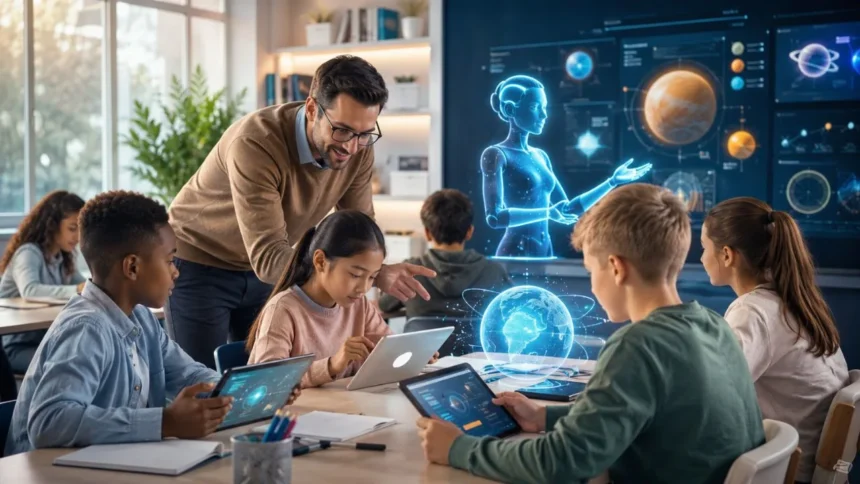
The biggest change may not come from replacing classrooms with machines. Instead, AI could make education more responsive to the needs of individual learners. A student who needs extra practice may receive additional support, while another who understands the lesson quickly may move to a more challenging activity without waiting for the entire class.
However, the use of AI in education also raises serious questions about accuracy, cheating, privacy, bias, and unequal access. Schools cannot simply introduce artificial intelligence tools and assume that learning will automatically improve. Technology needs clear rules, trained teachers, suitable infrastructure, and strong human oversight to produce positive results.
Understanding how AI could change education requires looking at both its opportunities and its limitations. Used responsibly, AI may help teachers deliver more personalized, accessible, and engaging learning experiences. Used carelessly, it could weaken critical thinking, expose student data, and widen existing educational inequalities.
Why Artificial Intelligence Matters in Education
Traditional education systems often expect students of different abilities to learn the same material at the same speed. Teachers may have limited time to give every learner individual attention, particularly in large classrooms. Artificial intelligence in education could help address this challenge by analyzing learning patterns and providing support tailored to each student.
AI-powered education tools can identify where students are struggling, recommend suitable exercises, and adjust the difficulty of learning activities. This does not mean that an algorithm fully understands a learner. It means that technology can help teachers notice patterns that may otherwise be difficult to recognize quickly.
Artificial intelligence can also make educational resources easier to create and update. Teachers may use generative AI to prepare examples, quizzes, lesson outlines, vocabulary exercises, or differentiated reading materials. This support may give educators more time to focus on discussion, mentoring, feedback, and meaningful interaction.
The importance of AI extends beyond classroom convenience. Students will enter workplaces where artificial intelligence is used for research, communication, design, analysis, and decision-making. Schools therefore need to teach learners how to use AI responsibly rather than treating it only as a shortcut or threat.
AI Could Make Learning More Personalized
Personalized learning is one of the most promising applications of AI in education. Instead of giving every student identical exercises, an AI learning platform can adjust content according to performance, confidence, and previous answers. This may help learners practise the exact skills they need rather than repeating material they have already mastered.
A student struggling with fractions, for example, may receive simpler explanations, visual examples, and additional practice. Another student who understands the topic may be given more complex problems or real-life applications. Both students can work toward the same learning goal through different pathways.
Personalized education technology may also adapt to how a learner prefers to engage with information. Some students understand a concept through text, while others benefit from diagrams, demonstrations, examples, or spoken explanations. AI tools could present the same lesson in several formats without creating a completely separate course.
Personalization should not place students inside narrow digital categories. Learners change, make unexpected progress, and respond differently depending on their health, confidence, environment, and relationships. Teachers must remain involved so that automated recommendations support students without limiting their opportunities.
AI Tutors Could Provide Support Beyond School Hours
AI tutoring systems could give students access to academic support when a teacher or human tutor is unavailable. Learners may ask questions after school, request another explanation, or practise a subject at their own pace. This can be especially useful for students who feel uncomfortable speaking in front of a class.
A well-designed AI tutor can guide students through a problem instead of immediately providing the final answer. It may ask questions, identify misunderstandings, and offer hints that encourage the learner to think. This approach is more educational than simply generating completed homework for the student to copy.
AI tutors could also support learners in areas where qualified teachers or tutoring services are limited. A student in a remote location might receive help with mathematics, science, language learning, or exam preparation through an internet-connected device. This could expand access to educational support across different regions.
However, an AI tutor cannot fully replace the encouragement, empathy, and judgment of a human teacher. It may misunderstand a question, provide incorrect information, or fail to recognize emotional distress. Students should learn to verify important answers and ask a teacher when an explanation remains unclear.
Teachers Could Spend More Time Teaching
Teachers often spend many hours on administrative duties that are necessary but do not involve direct interaction with students. These tasks may include preparing worksheets, organizing resources, writing routine messages, recording results, and creating different versions of the same activity. AI could help reduce some of this workload.
For example, a teacher might use artificial intelligence to produce a first draft of a lesson plan or generate sample questions for review. The educator could then check, improve, and adapt the material according to the curriculum and the needs of the class. AI would support preparation rather than control it.
Technology may also help teachers summarize student performance and identify common areas of difficulty. If many learners make the same mistake, the system could highlight the pattern. The teacher could then revisit the topic, change the explanation, or create a targeted classroom activity.
Reducing repetitive work could give teachers more time for personal feedback, creative instruction, and student support. The quality of education depends heavily on relationships, trust, and professional judgment. AI is most valuable when it helps teachers strengthen these human parts of learning.
The Teacher’s Role Could Become Even More Important
Some people fear that artificial intelligence will eventually replace teachers. In reality, the spread of AI may make effective teachers even more important. Students will need guidance to evaluate information, question automated answers, manage distractions, and use powerful tools without becoming dependent on them.
Teachers may increasingly act as learning designers, mentors, discussion leaders, and critical-thinking coaches. Instead of only delivering information, they can help students investigate ideas, compare viewpoints, solve problems, and apply knowledge. These skills become more valuable when information can be generated within seconds.
Educators will also need to decide when AI supports a learning goal and when it interferes with it. A writing assistant may help students revise a draft, but it could prevent learning if it produces the entire assignment. Teachers must create activities that use technology without removing the thinking students need to practise.
Professional development will therefore become essential. Teachers need practical training in AI tools, data privacy, bias, academic integrity, and instructional design. They should not be expected to adopt new technology without time, guidance, technical support, and a voice in how it is introduced.
AI Could Transform Lesson Planning
Lesson planning requires teachers to balance curriculum goals, student ability, available time, and classroom resources. Generative AI could help educators brainstorm activities, simplify complex texts, create examples, or produce questions at different difficulty levels. This may make preparation faster and more flexible.
A teacher could ask an AI tool to explain the water cycle for several age groups or create vocabulary activities for language learners. The generated material would still need review because it may contain errors, unsuitable wording, or content that does not match the local curriculum.
AI could also help teachers connect lessons with student interests and real-world situations. A mathematics exercise might use examples related to sport, shopping, construction, or environmental issues. Relevant examples can make abstract ideas easier to understand and encourage learners to participate.
The best lesson plans will continue to reflect the teacher’s knowledge of the students. An algorithm does not fully understand classroom relationships, local culture, previous discussions, or individual emotional needs. AI-generated teaching materials should therefore remain drafts that educators evaluate and improve.
Classroom Assessment Could Change
Traditional assessments often measure what students can remember during a limited examination period. When AI can answer factual questions and generate polished essays, schools may need to reconsider what they assess. Greater attention may shift toward reasoning, explanation, creativity, communication, and practical application.
Teachers may use more oral discussions, classroom demonstrations, projects, portfolios, and reflective activities. Students could be asked to explain how they reached an answer or defend the choices they made. These methods make it easier to assess understanding rather than the ability to reproduce information.
Artificial intelligence may also help provide faster low-stakes feedback on practice exercises. Students could learn about common mistakes before submitting a final assignment. Immediate feedback can support improvement, but automated systems should not make important grading decisions without teacher review.
Assessment policies will need to distinguish between acceptable AI assistance and academic dishonesty. Using AI to understand a concept is different from submitting machine-generated work as personal effort. Clear instructions should explain which tools are permitted, how they may be used, and when their use must be disclosed.
Homework May Focus More on the Learning Process
Generative AI has made it easier for students to produce essays, solutions, summaries, and presentations with limited effort. As a result, homework that only asks for a finished product may no longer show what a student understands. Schools may place greater value on the steps taken during the task.
Students could be asked to submit outlines, notes, drafts, source evaluations, or short reflections alongside completed work. They may explain which AI tools they used, what suggestions they accepted, and which errors they corrected. This approach encourages transparency and helps teachers observe the learning process.
More work may also be completed during supervised classroom time. Teachers can watch students discuss ideas, develop arguments, solve problems, and revise their thinking. Homework may then reinforce the lesson rather than acting as the main proof of individual ability.
The goal should not be to catch every student who uses AI. A purely punitive approach may create secrecy without improving learning. Schools need assignments that remain meaningful in an AI-rich environment and policies that encourage honest, thoughtful, and responsible technology use.
AI Could Improve Support for Students With Disabilities
Artificial intelligence could make education more accessible for students with different physical, sensory, communication, and learning needs. Speech-to-text tools can convert spoken lessons into written captions, while text-to-speech systems can read digital material aloud. Translation and simplification tools may also improve understanding.
Students who struggle with reading may use AI-supported tools to adjust text size, spacing, vocabulary, or presentation. Learners with hearing difficulties may benefit from real-time captions, and students with limited mobility may use voice controls. These features can reduce barriers that prevent full participation.
AI may also help teachers adapt resources without lowering academic expectations. A complex instruction can be rewritten more clearly, or an activity can be presented in a different format. The objective remains the same, but the path to completing it becomes more accessible.
Accessibility tools must be chosen carefully because individual needs vary greatly. An automated system should not label a learner, make medical judgments, or decide what the student can achieve. Families, teachers, specialists, and students should remain involved in decisions about educational support.
Language Learning Could Become More Interactive
AI language tools can provide instant opportunities to practise speaking, writing, pronunciation, grammar, and vocabulary. Learners may hold simulated conversations, receive corrections, or request explanations in their first language. This makes regular practice possible outside formal classes.
Students can also explore different communication situations, such as ordering food, attending an interview, asking for directions, or writing a professional email. AI-generated role-playing exercises may increase confidence before learners use the language with real people.
Translation tools can support understanding when students are learning through a language they have not fully mastered. Teachers may use these tools to communicate with families or provide temporary language support. However, students still need opportunities to develop independent reading, writing, listening, and speaking skills.
Language is more than grammar and vocabulary. It includes culture, humor, emotion, politeness, and social context. Human teachers and real conversations remain necessary because AI may produce unnatural wording or fail to recognize how meaning changes across communities.
AI Could Make Learning More Engaging
Interactive AI tools can turn passive lessons into conversations, simulations, and problem-solving activities. Students might question a virtual historical character, explore a scientific scenario, or receive feedback while building a project. These experiences may encourage curiosity when they are connected to clear learning goals.
Artificial intelligence could also work with virtual reality and augmented reality to create immersive educational environments. Learners may explore a model of the human body, visit a reconstructed historical site, or observe a simulated chemical reaction without facing physical danger.
Gamified learning systems can adjust challenges and rewards according to student progress. When used carefully, these features may motivate learners to practise difficult skills. However, constant points, badges, and digital stimulation can distract students from developing deeper interest in a subject.
Engagement should not be measured only by how entertaining a tool appears. A student may enjoy an activity without learning much from it. Teachers need to evaluate whether AI-supported experiences improve understanding, retention, collaboration, and the ability to apply knowledge.
Schools Will Need to Teach AI Literacy
AI literacy means understanding how artificial intelligence works, what it can do, and where it can fail. Students do not need to become programmers to develop this knowledge. They do need to recognize that AI outputs are generated from patterns and may not be accurate, neutral, or original.
Learners should be taught how to write effective instructions, review generated answers, check reliable sources, and identify possible bias. They also need to understand privacy, copyright, deepfakes, misinformation, and the environmental costs associated with digital systems.
AI literacy should include responsible decision-making rather than only technical skills. Students need to ask whether using AI is appropriate for a particular task, who may be affected, and what information should remain private. These questions help turn tool use into informed digital citizenship.
Teaching AI literacy across subjects may be more effective than limiting it to computer classes. History students can examine generated claims, science students can verify explanations, and language students can evaluate machine-written text. This approach shows how AI affects many areas of knowledge.
Critical Thinking Will Become More Valuable
When information can be generated instantly, the ability to evaluate it becomes increasingly important. AI may produce an answer that sounds confident even when it contains invented details, weak reasoning, or outdated information. Students must learn that clear writing is not proof of accuracy.
Critical thinking involves asking where information came from, what evidence supports it, and whether another explanation is possible. Students should compare sources, identify assumptions, recognize emotional manipulation, and separate fact from opinion. These skills protect learners from both human and machine-generated misinformation.
Teachers may design activities in which students review an AI response and locate its weaknesses. They could correct inaccuracies, improve an argument, or compare several generated answers. Such exercises teach students to work with technology actively rather than accepting its output passively.
Independent thinking also requires time without AI assistance. Students need opportunities to struggle with ideas, remember information, develop personal opinions, and solve problems on their own. Productive difficulty is part of learning and should not be removed from every task.
Creativity Could Grow or Become More Passive
AI tools can help students generate ideas, experiment with styles, create images, compose music, and test different approaches. A learner facing a blank page may use artificial intelligence to brainstorm possibilities before developing an original project. This can make creative work feel more approachable.
Technology can also help students produce work that previously required expensive equipment or advanced technical skills. A class may create animations, simulations, podcasts, or interactive stories using accessible tools. This gives more learners the chance to communicate ideas through different media.
The risk is that students may accept the first generated result instead of developing their own creative voice. Creativity involves making choices, revising imperfect work, taking risks, and learning from failure. A polished automated output can hide these important parts of the process.
Teachers can protect creativity by asking students to explain their decisions and show how their work developed. AI should support experimentation rather than make every artistic choice. The learner’s intention, judgment, and personal contribution should remain central to the final result.
Higher Education Could Become More Flexible
Universities and colleges may use AI to support students throughout their academic journey. Digital assistants could answer routine questions about courses, deadlines, campus services, or study requirements. This may help learners receive basic information without waiting for office hours.
AI-powered learning platforms may also recommend resources based on a student’s progress. Learners could receive additional practice, writing support, or explanations connected to difficult course topics. Academic staff would still need to monitor whether these recommendations are suitable and accurate.
Research practices will also change as AI helps scholars summarize information, organize data, generate code, or explore possible questions. Universities need clear policies about disclosure, authorship, verification, confidentiality, and intellectual property. Different disciplines may require different standards.
Higher education should prepare graduates to work alongside artificial intelligence while maintaining professional responsibility. Future doctors, lawyers, engineers, teachers, and researchers must understand when AI assistance is useful and when a human expert must make the final decision.
Career and Technical Education Could Evolve
Artificial intelligence is changing the skills required in many industries, including healthcare, finance, manufacturing, marketing, transportation, and construction. Career education will need to update courses more frequently so that learners understand the tools they are likely to encounter at work.
Students may practise with AI-powered simulations before handling expensive equipment or entering high-risk environments. A trainee could work through a virtual repair, customer interaction, medical scenario, or safety procedure. Simulations allow repeated practice without some of the costs associated with physical training.
Technical programs may also teach students how to supervise automated systems, interpret their results, and recognize failures. Workers will need more than the ability to operate a machine. They must understand when the system is producing unreliable information or behaving unexpectedly.
Human skills will remain important even in highly automated workplaces. Employers will continue to value communication, teamwork, adaptability, ethics, leadership, and problem-solving. Education should combine digital competence with the personal abilities that machines cannot easily reproduce.
AI Could Support Lifelong Learning
Education is no longer limited to childhood, university, or the beginning of a career. Workers often need to update their skills as industries and technologies change. AI-powered learning systems could create shorter, more flexible courses for adults with limited time.
A learner might receive a personalized study plan based on existing knowledge, career goals, and available hours. The system could recommend exercises, explain difficult concepts, and adjust the schedule when progress changes. This may make professional development easier to manage.
AI could also help people explore unfamiliar careers by identifying transferable skills and suggesting learning pathways. Someone moving from retail to digital marketing, for example, may discover that customer communication and sales experience remain valuable in the new field.
However, automated career advice should not make major decisions for individuals. Job markets, personal responsibilities, motivation, and local opportunities are complex. AI can organize information, but human advisers, employers, educators, and personal judgment remain important.
Student Data Privacy Will Be a Major Concern
Educational AI systems may collect information about student performance, behavior, interests, mistakes, and communication. Some tools may also process voices, images, writing patterns, or accessibility needs. This data can be highly sensitive, especially when it concerns children.
Schools need to know what information an AI platform collects, why it is needed, where it is stored, and who can access it. A free or convenient tool should not be introduced without reviewing its privacy terms and security practices.
Students should not be required to share unnecessary personal information to complete ordinary learning activities. Schools also need procedures for deleting data, responding to security incidents, and preventing educational records from being used for unrelated advertising or profiling.
Parents, teachers, and students deserve clear explanations written in understandable language. Privacy protection should not depend on families reading complicated technical policies. Educational institutions are responsible for choosing tools that respect learner rights from the beginning.
Bias Could Affect Educational Decisions
Artificial intelligence learns from data that may contain social, cultural, or historical bias. As a result, an automated system may treat students differently because of language, background, disability, location, or other characteristics. These effects may be difficult to notice when the technology appears objective.
Bias can become particularly harmful when AI is used for admissions, discipline, grading, student placement, or predictions about future performance. A learner should not lose an opportunity because an algorithm misunderstood their work or relied on an unfair pattern.
Human review is essential whenever an automated decision could significantly affect a student. Schools should test systems across different groups, examine complaints, and allow students to challenge outcomes. Technology providers should also explain how their tools reach recommendations.
Educators must avoid using AI predictions as permanent labels. A student who struggled in the past may improve with the right support. Education should expand possibilities rather than use incomplete data to decide what a learner is capable of achieving.
Incorrect AI Answers Could Harm Learning
Generative AI can produce explanations that appear professional but contain false information. It may invent sources, confuse historical events, make calculation errors, or misunderstand a question. Students who lack background knowledge may struggle to recognize these mistakes.
Incorrect answers are especially concerning in subjects where small errors can create major misunderstandings. Science, health, law, finance, and technical education require careful verification. An AI response should not become a substitute for textbooks, qualified teachers, and reliable evidence.
Schools should teach students to cross-check important claims and examine the quality of supporting sources. Learners can ask an AI system to explain its reasoning, but that explanation may also be inaccurate. Verification must happen outside the tool that produced the original answer.
Teachers should also review AI-generated lesson materials before using them in class. Automation can save preparation time, but it does not remove professional responsibility. Educational content must remain accurate, age-appropriate, inclusive, and connected to learning objectives.
The Digital Divide Could Become Wider
AI education tools require suitable devices, internet access, electricity, technical support, and digital skills. Students who lack these resources may not benefit equally. Introducing advanced technology without addressing basic access could deepen existing educational inequality.
The divide is not only about owning a phone or computer. A learner may share one device with several family members, rely on expensive mobile data, or study in an environment without quiet space. These conditions affect how consistently technology can support learning.
Schools in wealthier areas may gain access to better platforms, training, and technical staff. Less-resourced institutions may receive lower-quality tools or struggle to maintain them. Responsible AI adoption must therefore include funding, infrastructure, and long-term support.
Technology should expand access rather than become another requirement that excludes students. Schools need offline options, accessible materials, device-lending programs, and alternatives for learners who cannot use a particular platform. Equal educational opportunity must remain the priority.
Human Relationships Must Remain at the Center
Learning is not only the transfer of information from one source to another. Students develop through encouragement, discussion, collaboration, trust, and a sense of belonging. These human experiences influence confidence, motivation, curiosity, and emotional well-being.
A teacher may notice that a student is unusually quiet, frustrated, anxious, or disconnected. An AI system may interpret activity data, but it does not understand the student’s life in the same way. Human attention is essential when learners need emotional or social support.
Classrooms also teach students how to cooperate with people who hold different ideas. Group discussions, shared projects, disagreements, and friendships develop communication and empathy. Excessive individual learning through screens could reduce these important social experiences.
The future of education should therefore combine useful technology with strong relationships. AI can provide practice, information, and administrative support, but teachers and classmates create the community in which meaningful learning happens.
How Schools Can Prepare for AI
Schools should begin with clear educational goals rather than buying technology because it is popular. Leaders need to identify the problem they want AI to solve and determine whether the proposed tool offers a genuine improvement. A small, carefully evaluated trial may be safer than rapid school-wide adoption.
Teachers, students, parents, administrators, and technical specialists should be involved in decisions. Each group sees different risks and benefits. Including their perspectives can reveal practical problems before a system becomes difficult or expensive to change.
Schools also need written policies covering acceptable use, privacy, assessment, disclosure, accessibility, and human oversight. These policies should be reviewed regularly because AI technology changes quickly. Rules must be understandable enough for students and families to follow.
Finally, schools should measure whether AI actually improves learning. Success should not be based only on the number of tools adopted or the amount of time saved. Institutions need evidence that technology supports understanding, inclusion, teacher capacity, and student well-being.
How Students Can Use AI Responsibly
Students should use AI to support thinking rather than avoid it. Helpful uses may include requesting an explanation, practising questions, comparing ideas, receiving feedback, or brainstorming a starting point. The learner should still understand and take responsibility for the final work.
Personal information, private school records, passwords, and confidential documents should not be entered into public AI systems. Students need to understand that online tools may store or process the information they provide. When uncertain, they should ask a teacher before uploading content.
AI-generated claims should be checked against reliable educational sources. Students should pay particular attention to dates, quotations, statistics, and references because these details may be invented. Verification is part of responsible research, not an optional extra.
Learners should also follow the rules set for each assignment. Some teachers may allow AI for brainstorming but not final writing, while others may require disclosure. Honest use builds trust and allows students to benefit from technology without misrepresenting their abilities.
How Parents Can Support Children Using AI
Parents can begin by asking children how they use AI rather than immediately banning or encouraging it. Open conversations help adults understand whether the technology is supporting learning, creating confusion, or completing work that the child should attempt independently.
Families can encourage children to question AI answers and compare them with trusted sources. A useful discussion might ask what evidence supports the answer, whether another view exists, and what the tool may have misunderstood. These habits strengthen digital literacy.
Parents should also review privacy settings and age requirements before children use educational platforms. Young learners may not understand what information is safe to share. Devices should be used in ways that protect personal details and maintain healthy boundaries.
Balance remains important. Children need time for reading, handwriting, outdoor activity, sleep, conversation, and face-to-face play. AI can become one learning resource among many, but it should not replace the varied experiences that support healthy development.
Will AI Replace Traditional Education?
AI is unlikely to remove the need for schools, teachers, or structured education. It may change how lessons are delivered, how progress is measured, and how students access support. Traditional practices that remain effective can continue alongside new technology.
Some classroom routines may become less common. Students may spend less time memorizing information that can be easily retrieved and more time applying knowledge, evaluating evidence, and solving unfamiliar problems. Assessment may also become more practical and process-focused.
Physical schools provide services that extend beyond academic instruction. They offer social interaction, meals, sports, creative activities, professional support, and a stable community. These functions cannot be fully reproduced through an AI tutor or online platform.
The more realistic future is a blended education system in which human teachers use AI selectively. Technology may personalize practice and reduce administration, while educators guide discussion, relationships, ethics, creativity, and deeper understanding.
Final Thoughts on How AI Could Change Education
Artificial intelligence could make education more personalized, flexible, accessible, and responsive. Students may receive immediate support, while teachers may spend less time on repetitive preparation and administration. New tools could also expand learning opportunities beyond the traditional classroom.
These benefits will not happen automatically. AI systems can provide incorrect answers, reinforce bias, misuse personal data, and create new forms of academic dishonesty. Educational institutions need strong safeguards, transparent policies, trained teachers, and ongoing evaluation.
The most successful schools will not be those that use the greatest number of AI tools. They will be the ones that select technology carefully and connect it to genuine educational needs. Human judgment should remain responsible for important decisions affecting students.
AI could change education significantly, but people will determine the direction of that change. When technology strengthens teaching, protects learner rights, and encourages independent thinking, it can become a valuable educational partner rather than a replacement for human learning.
Frequently Asked Questions
How will AI change education in the future?
AI may personalize lessons, provide tutoring, automate routine teacher tasks, improve accessibility, and change how students are assessed. Human teachers will still be needed for guidance, judgment, motivation, and emotional support.
Can artificial intelligence replace teachers?
AI can assist teachers, but it cannot fully replace their empathy, classroom understanding, professional judgment, and ability to build relationships. Its best role is supporting educators rather than taking control of teaching.
What are the benefits of AI in education?
The main benefits include personalized learning, faster feedback, accessible educational resources, reduced administrative work, and additional support outside school hours. The results depend on responsible design and teacher supervision.
What are the risks of using AI in schools?
Key risks include inaccurate information, student data exposure, algorithmic bias, cheating, excessive dependence, and unequal access. Schools need clear policies and human oversight to manage these concerns.
How can students use AI responsibly for learning?
Students can use AI for explanations, practice, feedback, and brainstorming while checking its answers and completing their own thinking. They should follow school rules, disclose required use, and avoid sharing private information.