

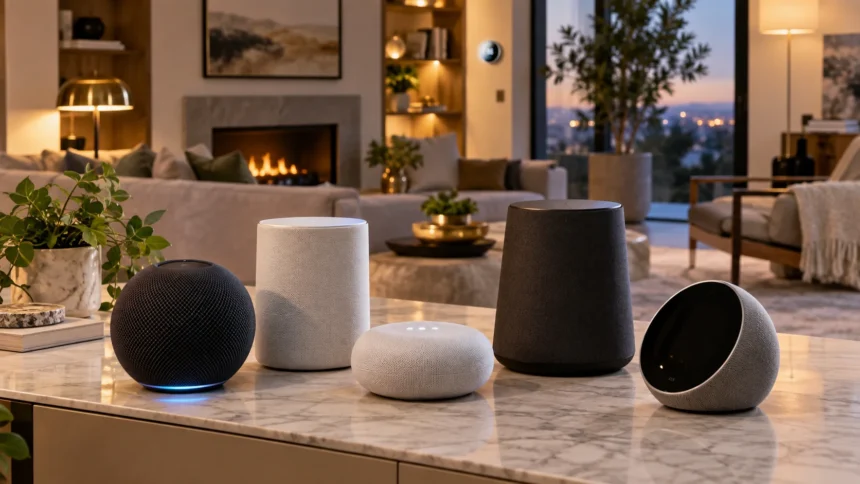
Smart speakers have evolved from simple music players into central control points for connected homes. In 2026, the best smart speakers can manage lights, thermostats, plugs, locks, sensors, routines, entertainment, reminders, and other compatible devices through voice commands. Support for newer standards such as Matter and Thread also makes it easier to connect products from different manufacturers.
Choosing a smart speaker for home automation requires more than comparing sound quality. Your preferred ecosystem, voice assistant, compatible smart-home devices, privacy controls, wireless protocols, and room size all influence which model will work best. A speaker that fits naturally into your existing phones, streaming services, and connected devices is generally easier to live with.
Current options from Amazon, Google, Apple, and Sonos cover everything from affordable room-by-room automation to premium music and smart-home setups. Amazon’s newer Echo models emphasize Alexa+, Google now integrates Gemini into its latest home speaker, while Apple’s HomePod lineup remains deeply connected to Apple Home. Understanding those differences can help you build a more useful automated home.
What to Look for in a Smart Speaker for Home Automation
Start with ecosystem compatibility because your speaker becomes much more useful when it communicates directly with the devices already in your home. Check whether your lights, thermostats, plugs, locks, cameras, and sensors work with Alexa, Google Home, Apple Home, or Matter. Choosing around compatibility can prevent you from managing separate apps for every accessory.
Matter support is increasingly valuable because the standard is designed to improve interoperability between different smart-home ecosystems. Thread is also worth considering because compatible low-power accessories can communicate through a mesh network instead of depending entirely on traditional Wi-Fi. Speakers with built-in Matter controller or Thread border-router functionality can simplify larger smart-home installations.
Sound quality, microphone performance, privacy controls, and automation features matter as well. A speaker positioned in a kitchen or living room should hear commands reliably while music is playing, while a bedroom speaker may benefit more from compact dimensions and physical microphone controls. Think about where the speaker will live before deciding which specifications matter most.
Amazon Echo Studio for Alexa Home Automation
The 2025-generation Echo Studio is one of Amazon’s strongest options for people who want home automation and more substantial room-filling audio from the same device. It works with Alexa+ and can function as part of Amazon’s connected-home environment. Amazon also lists the current Echo Studio among Echo devices supporting Matter, Thread border-router functionality, and a built-in Zigbee smart-home hub.
Those connectivity options are useful when your home contains different types of smart accessories. Zigbee can connect compatible lights, switches, plugs, and locks, while Matter improves interoperability with newer products. Thread support gives compatible low-power Matter devices another reliable networking option, potentially reducing the need to purchase separate hubs for every smart-home platform you introduce.
The Echo Studio also makes sense when entertainment is important alongside automation. Current models can participate in Alexa Home Theater configurations with compatible Fire TV hardware, allowing several speakers to work together. This combination makes the Studio especially attractive for living rooms where one device needs to handle music, voice commands, routines, and connected entertainment.
Amazon Echo Dot Max for Compact Smart Homes
The Echo Dot Max is a more compact Alexa option for users who want strong smart-home functionality without placing a large speaker in every room. Amazon introduced the model in 2025, and it supports Alexa+ features while fitting easily on side tables, kitchen counters, desks, or shelves. Its smaller footprint makes multi-room deployment more practical.
Despite its compact design, the Echo Dot Max includes significant home-automation capabilities. Amazon lists it as a Zigbee hub, Matter-compatible Echo device, and Thread 1.3 border router. This allows it to play a more important role in a connected home than a speaker used only for music and simple cloud-based voice commands.
The Dot Max can also support presence-based routines, giving users another way to automate rooms beyond fixed schedules or spoken commands. For example, compatible routines may react when presence is detected in a particular area. That can make the speaker useful for automatically controlling lights or other devices as household members move through different rooms.
Google Home Speaker With Gemini for Smarter Voice Control
Google’s 2026 Google Home Speaker is an important update for people who prefer the Google Home ecosystem. It uses Gemini for Home rather than relying solely on the older Google Assistant experience. The speaker includes a 58mm full-range driver, three far-field microphones, Wi-Fi 6, Bluetooth 5.4, and hardware controls for muting the microphones.
Smart-home connectivity is one of its main strengths. Google lists the speaker as a Matter hub with a built-in Thread 1.3 border router, helping compatible accessories connect through Google Home. Users can control connected devices through voice commands and create automations within the Google Home app, making the speaker a natural center point for Google-oriented households.
Gemini also changes how users interact with the speaker. Google promotes more conversational assistance, follow-up questions, and more advanced automation creation through its Home Premium features. Some enhanced Gemini capabilities require a subscription, so buyers should distinguish between functions included with the speaker and additional capabilities tied to Google’s paid smart-home services.
Apple HomePod for Apple Home Users
The second-generation HomePod remains one of the most complete smart-speaker choices for households already invested in Apple’s ecosystem. It combines Siri voice control with high-quality audio, room sensing, Spatial Audio support, and Apple Home integration. Once configured, it can act as a home hub for compatible HomeKit and Matter accessories and support remote automation.
Apple equips the HomePod with Thread networking, allowing it to support compatible Thread-based smart-home accessories. It also includes built-in temperature and humidity sensing, which can become useful in automations. For example, users can configure compatible connected devices to react when the room reaches a particular temperature or other environmental condition.
HomePod is particularly appealing when the household primarily uses iPhones, iPads, Macs, Apple TV, and Apple Music. AirPlay supports multiroom listening, while Siri can control connected lights, blinds, thermostats, locks, and scenes. Users outside the Apple ecosystem may find Amazon or Google speakers easier to integrate, but Apple households benefit from tighter platform continuity.
Apple HomePod Mini for Affordable Multi-Room Automation
The HomePod mini offers many of Apple’s smart-home capabilities in a much smaller package. It includes Siri, a full-range driver, 360-degree audio, temperature and humidity sensing, and Thread networking. Because it occupies little space, users can place multiple units around a home without the cost or physical footprint of buying full-size HomePods for every room.
Like the larger HomePod, the mini can function as an Apple home hub. That allows compatible HomeKit and Matter accessories to participate in automations and be controlled remotely through the Home app. Thread support also makes it useful for building out networks of compatible sensors, lights, locks, blinds, and other low-power accessories.
Its smaller speaker system naturally cannot deliver the same scale or bass as the full-size HomePod, but audio performance is not always the main priority for home automation. A HomePod mini in a hallway, bedroom, or office can provide convenient Siri access while extending voice control throughout the house. Multiple units can also support intercom and multiroom audio features.
Sonos Era 100 for Music-First Smart Homes
The Sonos Era 100 is worth considering when sound quality and multi-room music are more important than having the speaker itself serve as your primary Matter or Zigbee hub. It supports both Sonos Voice Control and Amazon Alexa, allowing users to manage supported voice functions while benefiting from Sonos’ established multi-room audio platform.
Connectivity includes Wi-Fi 6, Bluetooth 5.3, AirPlay 2, and optional USB-C accessories for line-in or Ethernet connections. The Era 100 also has separate controls for voice services and a physical microphone switch that disconnects power from the microphones. These privacy controls are useful for anyone who wants an easy hardware-level way to disable listening features.
For home automation, however, think of the Era 100 primarily as a premium audio speaker with Alexa support rather than the central connectivity hub for a Matter-heavy installation. It can fit beautifully into a home already using Alexa-compatible automation, particularly when music quality matters. Dedicated Echo, HomePod, or Google Home hardware may provide broader hub functionality.
Matter, Thread and Zigbee Explained
Matter is a smart-home interoperability standard created to make compatible devices work across major ecosystems more consistently. Instead of purchasing every accessory from one brand, users can choose Matter-certified lights, plugs, locks, sensors, and other devices that support compatible platforms. Amazon, Google, and Apple all support Matter within their respective smart-home environments.
Thread is a low-power mesh networking technology commonly used with newer Matter accessories. Devices on a Thread network can communicate through nearby compatible devices, helping expand coverage and improve resilience. A Thread border router, such as certain Echo, HomePod, Google Home, or other supported devices, connects that mesh network with the broader IP-based home network.
Zigbee is an older but still widely used low-power smart-home protocol. Many lights, sensors, plugs, switches, and locks already rely on it, which is why built-in Zigbee support remains useful in devices such as Echo Studio and Echo Dot Max. Before buying a speaker, check which protocols your existing accessories use instead of assuming every smart speaker connects directly to every product.
Building a Whole-Home Automation Setup
Begin with a few automations that solve everyday problems instead of trying to automate every appliance at once. A morning routine might gradually turn on lights, adjust the thermostat, and provide useful information, while an evening scene could dim lighting and secure compatible doors. Simple routines are easier to troubleshoot and more likely to remain useful over time.
Place smart speakers where voice control naturally makes sense, such as the kitchen, living room, bedroom, and home office. You can then use multiple speakers to access connected devices without shouting commands across the house. If you also manage computers from different locations, understanding how remote desktop works can complement a broader connected-home and remote-work setup.
Give devices clear names when configuring rooms and accessories. Calling a lamp “Living Room Lamp” is usually easier to remember than leaving it with a manufacturer’s default product name. Group related lights or devices into rooms and scenes so one command can control several accessories, reducing the need to issue a separate instruction for every individual device.
Privacy, Security and Smart Speaker Best Practices
Smart speakers contain microphones because they need to detect wake words and voice commands, so privacy controls deserve attention. Look for physical microphone buttons or switches and learn how the manufacturer’s voice-history settings work. Google’s latest Home Speaker includes a hardware microphone mute control, while Sonos provides a physical switch that disconnects microphone power on the Era 100.
Secure your smart home with a strong Wi-Fi password, current router firmware, and updated smart-home devices. Enable account protections such as two-factor authentication where available. Avoid leaving unsupported connected devices on your network indefinitely because old hardware that no longer receives security updates can become a weak point in an otherwise carefully configured home.
Finally, prioritize useful automation over complexity. Do not create dozens of routines that perform almost identical actions or depend on obscure triggers you will forget later. Keep device names organized, remove unused accessories, review automations periodically, and choose Matter-compatible products when they genuinely improve interoperability rather than replacing functioning devices simply because a newer standard exists.
Conclusion
The best smart speaker for home automation depends largely on the ecosystem you want to build around. Amazon’s Echo Studio and Echo Dot Max provide extensive connectivity for Alexa users, while Google’s new Home Speaker introduces Gemini alongside Matter and Thread. Apple’s HomePod models remain strong choices for households centered on iPhone, Apple Home, and Siri.
Sound quality should still influence your choice, particularly when the speaker will be used regularly for music or entertainment. Full-size HomePod and Echo Studio models suit larger rooms, while compact options such as Echo Dot Max and HomePod mini are easier to distribute throughout the home. Sonos Era 100 is especially attractive when multi-room music takes priority.
Before purchasing, check your existing accessories for Matter, Thread, Zigbee, Alexa, Google Home, or Apple Home compatibility. Building around one main ecosystem while using Matter for broader interoperability can simplify daily control. A thoughtfully planned network of speakers, sensors, lights, locks, and routines can make home automation genuinely convenient instead of unnecessarily complicated.
FAQs
What is the best smart speaker for home automation?
The strongest choice depends on your ecosystem. Echo devices suit Alexa homes, Google Home Speaker works naturally with Google Home and Gemini, while HomePod is designed around Apple Home and Siri.
Do smart speakers work with Matter devices?
Many current smart speakers support Matter, including selected Amazon Echo, Google Home, and Apple HomePod models. Compatibility still varies by device category and ecosystem, so check each accessory before purchasing.
Do I need a smart-home hub if I have a smart speaker?
Not always. Some speakers include Matter controller, Thread border-router, or Zigbee hub functionality. Other accessories may still require their manufacturer’s dedicated bridge or hub depending on the protocol they use.
Is Thread better than Wi-Fi for smart-home devices?
Thread is particularly useful for low-power devices such as sensors and locks because it creates a mesh network. Wi-Fi remains useful for higher-bandwidth devices such as cameras and multimedia products.
Can I use different smart-speaker brands in the same home?
Yes, although managing several ecosystems can become complicated. Matter improves cross-platform compatibility for supported devices, but voice assistants, routines, music services, and certain proprietary features may still behave differently between brands.
