

Wolf Spider Bite: Symptoms, Pictures and Treatment
A wolf spider bite can look alarming, especially because wolf spiders themselves are relatively large, hairy and fast-moving. Despite their intimidating appearance, wolf spiders are not considered medically dangerous to most people. Their bites usually happen only when the spider feels trapped, handled or pressed against the skin, and the resulting symptoms are generally limited to local pain, redness, itching and swelling. Cleveland Clinic notes that wolf spider venom is not considered dangerous to humans and that most bites improve with simple home care. Still, identifying a spider bite from appearance alone is difficult, making it important to pay attention to how the skin changes and whether any whole-body symptoms develop.
Understanding wolf spider bite symptoms, pictures and treatment can help you distinguish a typical minor reaction from a situation that needs medical attention. A bite may initially resemble a mosquito bite, small inflamed bump or other insect bite, and tiny puncture marks from the spider’s fangs may occasionally be visible. Most symptoms gradually improve within several days, although skin irritation can sometimes last longer. More severe pain, spreading redness, difficulty breathing, muscle cramping, fever or a growing wound should not simply be assumed to come from a harmless wolf spider. Mayo Clinic emphasizes that many skin sores resemble spider bites and that it can be difficult to identify the responsible spider unless it was actually seen.
What Is a Wolf Spider?
Wolf spiders belong to the family Lycosidae, a very large group containing thousands of species distributed across much of the world. Unlike spiders that sit in elaborate webs waiting for prey, wolf spiders generally hunt insects actively on the ground. Their hunting behavior is what inspired the name “wolf spider,” although they do not hunt people and do not seek out humans as prey. They are commonly found in gardens, grass, leaf litter, woodland edges, sheds, garages, basements and other places where insects are available. Cleveland Clinic notes that wolf spiders live on every continent except Antarctica and may occupy both outdoor environments and sheltered indoor spaces.
Wolf spiders are usually brown, gray or a mixture of earthy colors that help them blend into soil, bark and dried vegetation. Their bodies may have stripes or mottled markings, and many species appear noticeably hairy. Size varies greatly between species, with some relatively small and others large enough to appear threatening when encountered indoors. One distinguishing feature is their eye arrangement, which includes eight eyes, with two relatively prominent eyes that can reflect light. Their camouflage is helpful while hunting but can make them difficult to identify accurately from a quick glance or blurry photograph.
People frequently confuse wolf spiders with brown recluse spiders because both may have brown coloration. The distinction matters because brown recluse venom can cause more serious tissue injury, while wolf spider bites generally produce only localized symptoms. Cleveland Clinic notes that brown recluse spiders have six eyes rather than eight and may display the characteristic violin-shaped marking commonly associated with the species. However, attempting to identify a spider solely through color or one marking is unreliable for most people. If the spider can be photographed safely without handling it, a clear image may be more useful to a professional than attempting to capture the animal directly.
Wolf spiders are not generally aggressive toward humans. They are far more likely to run away when disturbed than deliberately move toward someone to bite them. Bites tend to happen when a spider is trapped against the body, accidentally grabbed while moving wood or rocks, stepped on, or caught inside clothing or shoes. Gardeners, hikers, outdoor workers and people handling stored materials may therefore encounter them more often. Checking shoes, gloves, blankets and clothing stored in garages or sheds can reduce accidental contact without requiring extreme pest-control measures.
The presence of a wolf spider in the home does not mean an infestation of dangerous spiders is developing. Individual spiders may wander indoors while searching for prey or shelter, particularly as environmental conditions change. Wolf spiders also consume insects and other small arthropods, so they play a useful ecological role. Preventive measures such as sealing gaps, reducing clutter and keeping outdoor debris away from entrances can make encounters less frequent. The goal should be avoiding accidental contact rather than assuming every wolf spider represents a serious health threat.
What Does a Wolf Spider Bite Look Like?
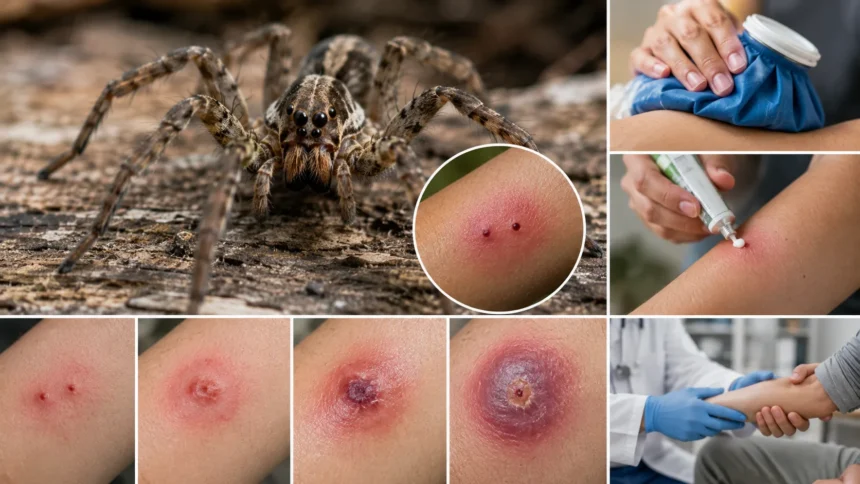
A wolf spider bite often looks similar to many other minor bug bites. The most typical appearance is a small red or pink bump surrounded by mild localized swelling. The area may feel tender, warm or itchy and can become slightly raised shortly after the bite. Cleveland Clinic describes a wolf spider bite as potentially producing a red bump with swelling, pain and itching. Because wolf spiders have fangs capable of puncturing human skin, very small fang-like puncture marks may occasionally be noticeable, although their absence does not rule out a bite.
Immediately after the bite, the surrounding skin may develop a small area of inflammation. Redness can become more obvious over the first several hours as the body’s inflammatory response develops. The center may appear slightly darker or have a tiny puncture where the skin was broken. This appearance is not unique to wolf spiders, however. Mosquito bites, flea bites, other spider bites, skin infections, inflamed hair follicles and allergic skin reactions can all produce a red swollen bump that looks remarkably similar.
This is why wolf spider bite pictures should not be used as a definitive diagnostic tool. Mayo Clinic explains that many insect bites and skin sores cause redness, swelling and pain and may look essentially the same as a spider bite. Unless a person actually sees the spider bite them or reliably identifies the spider immediately afterward, confirming the species from the skin lesion alone is usually impossible. Even clinicians may diagnose a suspected spider bite based largely on symptoms, history and examination rather than a laboratory test identifying the spider.
A normal wolf spider bite generally should not progress into a rapidly enlarging area of dead or blackened skin. A blister that develops into a dark blue or purple center with surrounding tissue breakdown is more concerning for other causes, including certain medically significant spider bites or bacterial infection. Mayo Clinic describes brown recluse bites as potentially developing a pale center that becomes blue or purple and eventually forms an open ulcer. Such changes do not fit the expected uncomplicated course of a typical wolf spider bite and deserve medical evaluation.
The safest way to judge a suspected bite is to watch its progression rather than focusing exclusively on its appearance at one moment. A small bump that gradually becomes less painful and swollen over several days generally fits a mild local reaction. A lesion that rapidly expands, becomes increasingly painful, develops drainage or red streaks, or produces fever and other systemic symptoms deserves attention. Taking a clear photograph once or twice daily under similar lighting can help document whether the affected area is improving or spreading. Avoid repeatedly squeezing or scratching the lesion simply to see whether something emerges.
Common Wolf Spider Bite Symptoms
Pain is one of the most common immediate wolf spider bite symptoms. Because some wolf spiders are relatively large, their fangs can mechanically puncture the skin and create a brief sharp or stinging sensation. The discomfort is generally localized around the bite rather than causing severe whole-body pain. It may feel similar to a bee sting or other minor insect injury and gradually become less intense. Cleveland Clinic notes that the size of wolf spiders means their bites can cause pain and swelling, but symptoms usually resolve without medical treatment.
Redness and swelling typically develop around the puncture site as the immune system responds to skin injury and venom proteins. The swollen area should usually remain relatively localized rather than continuously spreading across a large portion of the limb. Mild warmth may occur as blood flow to the affected tissue increases. These symptoms can be uncomfortable but are generally not dangerous when they remain mild and steadily improve. A cold compress can reduce swelling and provide temporary pain relief during the first day or two.
Itching may develop as the bite begins to settle. Scratching should be avoided because broken skin creates an opportunity for bacteria to enter and produce a secondary infection. Cleveland Clinic recommends antihistamine treatment for itching when appropriate and specifically advises avoiding scratching for this reason. A mild itchy bump can persist after the initial tenderness has decreased. The fact that a bite becomes itchy does not mean venom is spreading through the body or that parasites are present beneath the skin.
Some people notice two tiny puncture points, although this feature is much less reliable than online spider-bite images often suggest. Many punctures are too small to see, and scratches, pores or scabs can mimic paired fang marks. Conversely, seeing two marks does not prove that a spider caused the lesion. Diagnosis becomes much more convincing if someone clearly saw the spider during the actual bite and could identify it accurately. Otherwise, clinicians must consider other insect bites and skin conditions as well.
Whole-body symptoms are unusual following an ordinary wolf spider bite. Severe muscle cramps, widespread sweating, vomiting, profound weakness or significant neurological symptoms are not typical and should raise concern that the spider may have been misidentified or that another medical problem is occurring. Cleveland Clinic recommends medical evaluation for symptoms such as significant cramping, severe headache, dizziness, widespread rash, sweating, nausea, vomiting, breathing difficulty, weakness or paralysis. These signs move the situation beyond routine home treatment.
Wolf Spider Bite Pictures: What Changes to Look For
When people search for wolf spider bite pictures, they are usually trying to determine whether a particular red mark matches a known pattern. Unfortunately, there is no single characteristic visual pattern that reliably identifies a wolf spider bite. A mild bite can look like one small red papule, a slightly swollen pink area or a bump with a tiny central puncture. Lighting, skin tone, scratching, previous skin conditions and the time since the bite can all change its appearance. This variation is why matching a skin lesion to an online photo can create false reassurance or unnecessary anxiety.
During the first several hours, mild redness and swelling may become more noticeable around the bite. A person may also notice localized tenderness and a small central mark where the fangs punctured the skin. Over the following day or two, an uncomplicated reaction should stabilize and then begin improving. The exact color may vary considerably across skin tones, with inflammation appearing bright red on some people and darker red, brownish, violet or otherwise subtly discolored on others. Symptom progression is therefore often more useful than one standardized color description.
A bite that is healing normally should become less painful and swollen rather than progressively larger and more destructive. Cleveland Clinic states that wolf spider bite symptoms generally resolve on their own within several days. Mayo Clinic similarly notes that most ordinary spider bites heal on their own, commonly within about a week. A tiny residual mark or mild itching can sometimes remain longer, especially if the skin was scratched or irritated.
Changes that deserve closer attention include rapidly expanding redness, a growing open wound, pus-like drainage, red streaks extending away from the lesion or increasing warmth and tenderness. Mayo Clinic recommends medical assessment when a spider-bite wound enlarges or when surrounding redness, discoloration or swelling continues spreading. These changes may represent infection or another type of bite rather than a simple wolf spider reaction.
Dark purple or blue tissue, extensive blistering or skin breakdown also should not simply be labeled a wolf spider bite based on an internet photograph. Recluse bites can sometimes produce progressive tissue injury, while bacterial infections can create lesions that are mistakenly blamed on spiders. Mayo Clinic emphasizes that many skin sores resemble spider bites. If the lesion looks substantially worse from one day to the next, obtaining a medical diagnosis is more reliable than continuing to compare photographs.
How to Treat a Wolf Spider Bite at Home
The first step in wolf spider bite treatment is washing the area gently with mild soap and water. Cleaning reduces dirt and microorganisms on the skin and helps lower the possibility of secondary infection after the fangs have punctured the surface. There is no need to cut the bite, squeeze it or attempt to suck out venom. Those methods do not remove venom effectively and can create additional tissue injury. Mayo Clinic recommends cleaning spider bites with mild soap and water as part of basic first aid.
After cleaning, apply a cold compress to reduce discomfort and swelling. A clean cloth dampened with cool water or an ice pack wrapped in cloth can work. Mayo Clinic suggests applying a cool compress for around 15 minutes at a time, repeating periodically when needed. Ice should not be placed directly against bare skin for prolonged periods because excessive cold exposure can damage tissue. If the bite is on an arm or leg, keeping that area elevated can also help reduce swelling.
An over-the-counter pain reliever may help if the bite remains sore, provided that type of medication is safe for the individual. People with kidney disease, stomach ulcers, certain cardiovascular conditions, anticoagulant therapy or other medical considerations should be cautious with nonsteroidal anti-inflammatory medicines and follow professional advice. Itching may respond to an appropriate oral antihistamine, calamine lotion or an over-the-counter topical corticosteroid when suitable. Mayo Clinic includes pain relievers and anti-itch treatments among common first-aid options for uncomplicated spider bites.
Avoid repeatedly scratching, squeezing or picking at the bite. Scratching can damage the protective skin barrier and allow bacteria to enter. Keeping fingernails short and covering the area loosely may help when itching is difficult to ignore, particularly during sleep. The wound should not be tightly wrapped unless a healthcare professional has advised doing so. The goal is to keep it clean and protected while allowing the skin to recover naturally.
Continue watching the bite over the next several days. Mild symptoms should gradually trend in the right direction rather than requiring progressively stronger home remedies. If pain, swelling or redness continues to worsen or the lesion has not started improving after a few days, contact a healthcare professional. Cleveland Clinic specifically recommends evaluation when wolf spider bite symptoms persist or become more severe despite home care.
How Long Does a Wolf Spider Bite Take to Heal?
Most uncomplicated wolf spider bites improve relatively quickly. Cleveland Clinic states that symptoms such as pain and swelling generally resolve on their own within a few days. Mayo Clinic notes more broadly that ordinary spider bites often heal within approximately a week. The exact healing time depends on bite depth, individual skin response, location, scratching and whether secondary irritation develops. A larger wolf spider may create more noticeable mechanical injury than a small species even though the venom itself remains medically insignificant for most people.
During the first day, localized redness, tenderness and swelling may be most noticeable. The area can initially look somewhat worse as inflammation develops before improvement begins. By the following days, pain should generally decrease and swelling should start settling. Itching can become more noticeable as the surface heals. This transition from soreness toward mild itching is common in many superficial skin injuries and does not necessarily indicate a complication.
A small scab may form if the fangs broke the skin or if the bite was scratched. The scab should be allowed to separate naturally instead of being picked away. Removing it prematurely can reopen the wound and extend healing time. The surrounding discoloration may also take longer to disappear than the pain itself. People with sensitive skin can have visible marks after inflammation has otherwise resolved.
A bite that is not improving after several days deserves reassessment, particularly if the original spider identification was uncertain. Many presumed spider bites ultimately turn out to be bacterial infections, inflammatory lesions or other arthropod bites. Mayo Clinic points out that skin sores from several different causes can mimic spider bites. A worsening lesion therefore should not automatically be interpreted as an unusually strong wolf spider reaction.
Underlying conditions can also influence healing. Diabetes, circulation problems, immune suppression and certain medications can make skin wounds more difficult to heal or increase infection risk. People with these conditions may benefit from contacting a clinician earlier when a bite breaks the skin. The expected “few days to a week” recovery pattern applies mainly to healthy people experiencing a straightforward local reaction. Healing that clearly deviates from that pattern should be evaluated according to the individual circumstances.
Wolf Spider Bite vs. Brown Recluse Bite
Wolf spiders and brown recluses are often confused because both can have brown coloration, but their medical importance is very different. A wolf spider bite typically causes localized redness, mild-to-moderate pain, swelling and perhaps itching. The symptoms usually begin settling within several days and do not normally cause tissue destruction. Brown recluse bites, by contrast, can occasionally produce more significant local injury. Mayo Clinic notes that recluse bite pain may increase during the first several hours and that some lesions develop a pale center that becomes blue or purple before progressing to an open sore.
The spiders themselves also have physical differences. Wolf spiders generally have eight eyes, including two relatively large reflective eyes, and commonly have hairy, robust bodies with stripes or mottled markings. Brown recluses have six eyes arranged in pairs and are associated with a dark violin-shaped marking on the upper body, although the marking can be difficult for nonexperts to assess. Cleveland Clinic specifically notes the difference in eye number when discussing common confusion between the spiders.
Behavior and habitat can provide clues but are not sufficient for medical diagnosis. Wolf spiders commonly roam actively while hunting, whereas brown recluses generally prefer sheltered areas. Brown recluse distribution is also geographically limited compared with the enormous worldwide diversity of wolf spiders. People sometimes diagnose themselves with a brown recluse bite in locations where the spider is uncommon or absent. Conversely, assuming a concerning lesion must be a harmless wolf spider bite because a brown spider was seen nearby can also be risky.
The appearance of the skin lesion should be interpreted by its progression rather than by searching for an exact photo match. A small stable red bump fits an uncomplicated wolf spider reaction better than an enlarging lesion with significant discoloration or ulceration. However, bacterial skin infections can also produce progressive redness and tissue damage. This means a worsening “spider bite” requires medical evaluation regardless of which spider someone thinks was involved.
If the actual spider was safely photographed, the image may help identification, but no one should risk another bite trying to capture it. Mayo Clinic recommends seeking medical care when someone is uncertain whether a bite came from a dangerous spider, particularly if concerning symptoms appear. The clinical condition of the person matters more than proving the exact spider species after the fact.
Wolf Spider Bite vs. Black Widow Bite
A black widow bite has the potential to cause far more significant systemic symptoms than a typical wolf spider bite. Wolf spider reactions usually remain localized around the skin, while widow venom affects the nervous system and can produce severe muscle cramping and pain beyond the immediate bite area. Mayo Clinic describes black widow bite symptoms as including pain and swelling that may spread, severe abdominal cramping, nausea, vomiting, tremors and sweating. These symptoms are not expected from an uncomplicated wolf spider bite.
The skin appearance may not always reveal the distinction immediately. Both bites can start with a red or painful area, and some spider bites are barely noticeable at first. This is another reason relying on the wound alone can be misleading. Severe whole-body symptoms provide a stronger signal that something other than an ordinary wolf spider bite may be occurring. Muscle rigidity, intense abdominal pain and widespread sweating deserve urgent assessment rather than continued home observation.
Black widow spiders are commonly recognized by the red hourglass-shaped marking on the underside of the abdomen, although identification can vary among species and life stages. Mayo Clinic uses this marking as one of the classic identification clues. A person does not need to identify the spider perfectly before seeking treatment when severe symptoms are present. If a suspected dangerous spider can be photographed without physical contact, the image can be useful, but attempting to trap it by hand creates unnecessary risk.
Medical treatment for serious widow envenomation can include pain control, medication for muscle spasms and, in selected severe situations, antivenom. This is fundamentally different from the simple cleaning and cold-compress care appropriate for most wolf spider bites. Mayo Clinic notes that antivenom may be considered when black widow bites produce severe pain or life-threatening symptoms.
The practical takeaway is that a person experiencing only a small painful swollen bump after a confirmed wolf spider bite can generally begin with home care. A person developing severe muscle cramps, widespread pain, sweating, vomiting or significant systemic illness should not rely on the assumption that the spider was harmless. Identification mistakes happen, and symptoms should guide the urgency of care.
Can a Wolf Spider Bite Become Infected?
Any break in the skin can potentially become infected, including a wolf spider bite. The spider’s venom does not necessarily cause the infection; bacteria may enter through the puncture itself or after repeated scratching. The risk increases if the area is picked, squeezed or kept dirty. Washing the bite promptly with soap and water is therefore one of the most important parts of treatment. Maintaining normal skin hygiene is generally more useful than applying multiple harsh antiseptics that irritate surrounding tissue.
Signs of infection include increasing redness, warmth, swelling and tenderness rather than gradual improvement. Pus-like or cloudy drainage can also appear. Fever or feeling generally unwell can indicate that the problem is becoming more significant. Cleveland Clinic recommends contacting a healthcare provider when a suspected wolf spider bite develops fever or discharge, while Mayo Clinic advises evaluation for wounds with expanding redness or red streaking.
Red streaks moving away from the lesion should be taken seriously because they can occur with spreading bacterial infection involving lymphatic vessels. Rapidly expanding redness or increasing pain can also indicate cellulitis. These conditions may require prescription antibiotics depending on the clinical assessment. Adding more antihistamine or repeatedly icing the area will not treat an established bacterial infection.
One challenge is that bacterial skin infections are sometimes mistaken for spider bites from the beginning. Mayo Clinic specifically notes that many skin sores can resemble spider bites, including bacterial infections. A person may never have been bitten by a spider at all. This is particularly relevant when a painful red lesion appears without anyone seeing a spider.
If the lesion enlarges despite reasonable home care, medical evaluation is appropriate. Do not attempt to drain a suspected abscess by puncturing it yourself. A clinician can determine whether the wound represents a bite reaction, cellulitis, abscess or another skin problem and select the appropriate treatment. Correct diagnosis becomes increasingly important when the skin is deteriorating rather than healing.
Allergic Reactions to Wolf Spider Bites
Severe allergic reactions to wolf spider bites appear to be uncommon, but allergic responses are possible after many types of bites and stings. A person can react not only to venom but also to other proteins introduced during an arthropod bite. Mild localized itching and swelling are not the same as anaphylaxis. The concern rises when symptoms extend well beyond the bite site or affect breathing, circulation or the face and throat.
Cleveland Clinic lists signs of a potentially serious allergic response to a spider bite as an enlarging hive-like reaction, facial or mouth swelling, difficulty breathing, dizziness or fainting. These symptoms require medical attention rather than ordinary home care. Difficulty breathing is particularly important because airway swelling can progress rapidly.
Mayo Clinic similarly advises emergency treatment for breathing or swallowing difficulty following a spider bite. Severe allergic reactions can also involve widespread hives, rapid pulse, gastrointestinal symptoms or loss of consciousness. Someone with a known history of anaphylaxis who has been prescribed an epinephrine auto-injector should follow their emergency action plan and seek urgent medical care afterward.
A large local reaction is different from anaphylaxis. Some people may develop significant swelling around the bite without having respiratory or circulatory symptoms. Even these reactions deserve evaluation if swelling continues expanding rapidly or becomes very painful. The clinician can determine whether the problem represents allergy, inflammation, infection or another bite entirely.
People who have previously tolerated spider or insect bites are not guaranteed never to experience an allergic reaction in the future. Conversely, mild redness after one bite does not mean subsequent bites will become progressively more severe. Allergic risk is highly individual. The practical rule is to focus on symptoms: breathing difficulty, facial or throat swelling, severe dizziness or collapse require emergency help regardless of what type of spider was involved.
When to See a Doctor for a Wolf Spider Bite
Most confirmed wolf spider bites can be managed at home when symptoms consist only of mild redness, tenderness, swelling and itching. Medical evaluation becomes appropriate when the reaction does not begin improving after several days. Cleveland Clinic recommends contacting a healthcare provider when symptoms persist or get worse despite home care. A prolonged reaction does not necessarily indicate dangerous venom, but it may mean the diagnosis or treatment needs reconsideration.
Increasing pain is another reason to seek care. A typical wolf spider bite should become less painful rather than dramatically more painful over time. Severe pain can occur with other medically important spider bites, infection or unrelated skin conditions. Mayo Clinic recommends prompt medical evaluation for severe pain or a wound that continues enlarging after a suspected spider bite.
Systemic symptoms should lower the threshold for medical attention substantially. Cleveland Clinic lists severe headache, dizziness, muscle cramping, spreading rash, sweating, nausea, vomiting, difficulty breathing, weakness and paralysis among symptoms that warrant professional evaluation after a suspected wolf spider bite. These symptoms are not typical of a straightforward mild wolf spider reaction.
Signs of infection also warrant evaluation. Fever, pus-like drainage, increasing warmth, spreading redness or red streaks suggest that bacteria may have entered the skin. Mayo Clinic specifically includes spreading discoloration and streaks among reasons for prompt spider-bite care. Antibiotics are not routinely needed for every bite, but they may be required when secondary infection develops.
Finally, seek care when you are uncertain what kind of spider caused a significant reaction. Mayo Clinic advises medical attention when a bite may have come from a medically dangerous spider or the spider cannot be confidently identified and symptoms are concerning. The need for treatment should be based on the clinical situation rather than certainty about species. A photograph can help, but worsening symptoms matter far more than obtaining a perfect identification.
How to Prevent Wolf Spider Bites
Most wolf spider bites can be prevented by reducing accidental contact. Because wolf spiders commonly occupy leaf litter, firewood, rocks, garden debris and sheltered outdoor areas, wearing gloves during yard work can provide a useful physical barrier. Closed shoes and long pants are also sensible when working in environments where spiders or other arthropods may be present. Cleveland Clinic recommends gloves when gardening, moving rocks or carrying wood as part of wolf spider bite prevention.
Shake out shoes, boots, gloves and outdoor clothing before putting them on, especially if they have been stored in garages, sheds, basements or other undisturbed locations. A spider hidden in a shoe may bite when suddenly compressed against the skin even though it had no intention of attacking. This simple habit can prevent encounters with several kinds of spiders, not only wolf spiders. Clothing stored outdoors should receive similar attention.
Keep firewood outdoors rather than storing large piles inside the home. Inspect individual pieces before bringing them indoors. Wood piles provide sheltered spaces for spiders as well as insects that serve as prey. Moving firewood with bare hands can accidentally trap a spider between the skin and wood. Wearing work gloves makes this less likely.
Reducing clutter in basements, garages and storage areas can also make indoor hiding places less attractive. Seal obvious gaps around doors, windows, foundations and utility openings where practical. Regular cleaning and reducing insect populations can indirectly reduce spider activity because spiders follow their food sources. These measures are generally more useful than repeatedly applying pesticides throughout living areas without understanding where spiders are entering.
If a wolf spider is found indoors, avoid handling it with bare hands. It can be guided outside with a container and stiff card if this can be done safely, or removed using another appropriate method. Children should be taught not to pick up unfamiliar spiders even when they appear motionless. Wolf spiders generally prefer escape over confrontation, so giving the spider space is often enough to avoid a bite.
The Bottom Line on Wolf Spider Bites
A wolf spider bite is usually painful but medically minor. The most common symptoms are a small red bump, localized swelling, mild-to-moderate pain, itching and occasionally visible puncture marks. Cleveland Clinic states that wolf spider venom is not considered dangerous to humans and that most bites resolve with home treatment. The large, hairy appearance of the spider therefore tends to be more frightening than the medical effects of its bite.
The appearance of the bite cannot reliably confirm which spider was responsible. Many insect bites, bacterial infections and inflammatory skin conditions produce similar red swollen lesions. Mayo Clinic emphasizes that spider bites can be difficult to diagnose unless the spider was actually observed during the event. For this reason, searching through dozens of wolf spider bite pictures can be helpful for general education but should not replace evaluation of a worsening wound.
Home treatment generally involves washing the area with mild soap and water, using a cool compress, elevating the affected limb when practical and using appropriate over-the-counter pain or anti-itch treatment if needed. Avoid scratching, squeezing or cutting the bite. Most symptoms should begin improving within a few days, and ordinary spider bites commonly heal within about a week.
A bite needs greater attention when the expected healing pattern changes. Rapidly expanding redness, worsening pain, drainage, fever, red streaks, a growing wound or darkening tissue may indicate infection, misidentification or another medical condition. Severe muscle cramping, vomiting, widespread sweating, significant weakness or other whole-body symptoms also do not fit the usual wolf spider pattern. These changes justify medical evaluation rather than repeatedly applying home remedies.
Emergency care is appropriate for difficulty breathing or swallowing, facial or throat swelling, severe dizziness, fainting or other signs of a serious allergic reaction. The same applies when a suspected dangerous spider caused the bite or severe systemic symptoms develop. Most wolf spider encounters will never reach this point, but knowing the warning signs makes it possible to treat minor bites calmly while responding appropriately to the uncommon situation that needs urgent care.
Frequently Asked Questions
What does a wolf spider bite look like?
A wolf spider bite usually looks like a small red or swollen bug bite and may be painful or itchy. Tiny puncture marks can sometimes be visible, but appearance alone cannot reliably identify the responsible spider.
Is a wolf spider bite poisonous?
Wolf spiders are venomous in the biological sense because they use venom to subdue prey, but their venom is not considered dangerous to most humans. Their bites generally cause only mild localized symptoms.
How long does a wolf spider bite last?
Pain and swelling usually improve within several days, and many uncomplicated spider bites heal within roughly a week. Seek medical care if the wound continues worsening rather than improving.
What should I put on a wolf spider bite?
Wash the bite with mild soap and water and use a wrapped cold compress to reduce pain and swelling. Appropriate over-the-counter pain or anti-itch medicines may also help, depending on your health and medication history.
When is a wolf spider bite dangerous?
Seek prompt medical care for severe or increasing pain, a rapidly expanding wound, fever, spreading redness, muscle cramps, vomiting or neurological symptoms. Difficulty breathing, swallowing, facial swelling, severe dizziness or fainting requires emergency medical attention.