

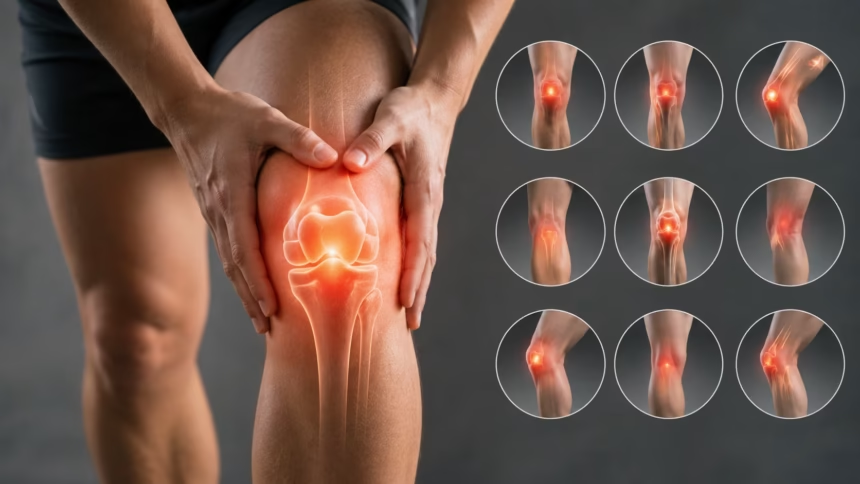
Knee Pain Location Chart: Use It to Narrow Down the Cause
Knee pain can appear in the front, inside, outside, back or deep within the joint. The exact location may provide useful clues about which tissue is irritated, but it cannot confirm a diagnosis on its own. Your symptoms, recent activities, injuries, age and medical history must also be considered before deciding what may be causing the discomfort.
A Knee Pain Location Chart helps you organise those clues. Pain around the kneecap may behave differently from pain along the inner joint line, while a lump behind the knee points toward different possibilities than tenderness below the kneecap. Noticing these differences can help you explain your symptoms clearly during a medical or physiotherapy appointment.
The knee contains bones, cartilage, menisci, ligaments, tendons, muscles, nerves and fluid-filled bursae. Any of these structures can become injured, irritated or affected by disease. Because several conditions can produce similar symptoms, pain location should be treated as a starting point rather than a reliable self-diagnosis.
Use this guide to identify the painful area, observe what movements trigger it and check for swelling, stiffness, locking or instability. Seek professional care when pain is severe, persistent or accompanied by warning signs. A clinician can examine the joint and determine whether imaging, rehabilitation, medication or another treatment is appropriate.
Quick Knee Pain Location Chart
| Pain location | Possible causes | Common clues |
|---|---|---|
| Front or around kneecap | Patellofemoral pain, bursitis, kneecap irritation | Pain on stairs, squatting or prolonged sitting |
| Inner knee | Medial meniscus injury, MCL sprain, pes anserine bursitis, arthritis | Tender inner joint line or pain below it |
| Outer knee | IT band syndrome, lateral meniscus injury, LCL irritation | Pain during running, cycling or repeated bending |
| Back of knee | Baker cyst, tendon strain, meniscus problem, joint swelling | Tightness, fullness, swelling or pain when straightening |
| Above kneecap | Quadriceps tendon irritation or injury | Pain when extending the leg or climbing stairs |
| Below kneecap | Patellar tendon irritation, bursitis, Osgood-Schlatter disease | Pain during jumping, running or kneeling |
| Deep or throughout knee | Osteoarthritis, inflammatory arthritis, cartilage damage | Stiffness, swelling, aching or reduced movement |
Start by touching the knee gently and identifying whether the discomfort is on the surface, along the joint line or deeper inside. Then notice whether it is sharp, dull, burning, throbbing or tight. Sharp pain after twisting may suggest a different problem from a gradual ache that becomes worse after sitting or repeated activity.
The timing of your symptoms is equally important. Pain that begins after increasing your running distance may indicate an overuse problem, whereas sudden pain following a pivot, fall or direct impact raises greater concern for an acute injury. Swelling that appears quickly after trauma should be assessed more carefully than mild soreness after an unfamiliar workout.
Mechanical symptoms provide additional clues. Catching, painful clicking, locking or a sensation that the knee is giving way may occur with meniscus or ligament injuries. A meniscus tear can also cause stiffness, swelling and difficulty moving the knee through its normal range.
This Knee Pain Location Chart is most useful when combined with an activity and symptom record. Write down where it hurts, when it started, which movements trigger it and whether the knee swells afterward. These details help a doctor or physical therapist separate temporary overuse pain from an injury that may require targeted treatment.
Front Knee Pain
Front knee pain commonly develops around or behind the kneecap. One frequent cause is patellofemoral pain syndrome, sometimes called runner’s knee. It often produces a dull ache that becomes more noticeable during running, jumping, squatting, climbing stairs or sitting for a long period with the knee bent.
Patellofemoral pain may be linked to a sudden increase in exercise, repeated knee loading or reduced control from the hip and thigh muscles. The kneecap may not move smoothly within its groove as the knee bends. People sometimes notice grinding, popping or crackling, although painless knee sounds alone do not always indicate an injury.
Pain directly over the kneecap with visible, soft swelling may point toward prepatellar bursitis. This condition involves irritation of the small fluid-filled sac between the kneecap and skin. It is more common after repeated kneeling, a direct blow or activities that place prolonged pressure on the front of the knee.
Sudden front knee pain following a fall or collision needs more caution. A kneecap fracture, tendon tear or dislocation may cause immediate swelling, bruising, deformity or an inability to straighten the leg. Avoid testing the injured knee repeatedly when these symptoms are present, and arrange urgent medical assessment instead.
Inner Knee Pain
Inner knee pain occurs on the side closest to your other leg and is often called medial knee pain. Possible causes include a medial meniscus injury, medial collateral ligament sprain, osteoarthritis and pes anserine bursitis. The exact tender spot and the way the pain began can help distinguish between these possibilities.
A medial meniscus problem may cause pain directly along the inner joint line, especially after twisting while the foot remains planted. Swelling may develop gradually, and the knee may catch, lock or feel unstable. Meniscus symptoms can overlap with arthritis and ligament injuries, so a physical examination is often needed for an accurate diagnosis.
Pain slightly below the inner knee joint may be related to pes anserine bursitis. This condition generally causes tenderness around two to three inches below the inner joint line. Symptoms may increase while exercising, climbing stairs or standing after sitting with the knees bent for an extended period.
An MCL injury is more likely when inner knee pain starts after the knee is pushed sideways, twisted or struck from the outside. The area may feel tender and unstable. Mild sprains can improve with rehabilitation, but significant swelling, difficulty walking or a feeling that the joint will collapse should be professionally assessed.
Outer Knee Pain
Outer knee pain is felt on the lateral side of the joint, away from your other leg. It may develop from iliotibial band syndrome, lateral meniscus irritation, a lateral collateral ligament injury or arthritis. Runners and cyclists frequently experience outer knee pain related to repetitive bending and training-load changes.
IT band syndrome commonly causes activity-related aching, burning or stiffness along the outside of the knee. The discomfort may begin after a predictable running distance and improve with rest. Some people also experience snapping, clicking or pain that travels upward along the outside of the thigh.
A lateral meniscus injury may be more likely when the pain feels deeper along the outer joint line and follows a twisting movement. Swelling, restricted motion, catching or locking may accompany the pain. A clinician may use movement tests to determine whether the symptoms come from the meniscus, ligament, tendon or surrounding muscles.
Do not assume every case of outer knee pain is caused by a tight IT band. Training errors, hip weakness, footwear changes, running surfaces and previous injuries may contribute to the problem. Reducing the aggravating activity temporarily and receiving a movement assessment may be more useful than repeatedly stretching the painful area without knowing the cause.
Pain Behind the Knee
Pain behind the knee may feel like tightness, pressure, aching or a pulling sensation. Possible causes include a Baker cyst, hamstring or calf tendon strain, meniscus injury and swelling arising from inside the joint. The symptoms may become stronger when the knee is fully bent or straightened.
A Baker cyst is a fluid-filled growth that forms behind the knee, often because arthritis or cartilage damage causes the joint to produce excess fluid. It may create a noticeable lump, fullness, stiffness or swelling that becomes worse after activity or prolonged standing.
Muscle and tendon injuries can also cause posterior knee pain. These problems may appear after sprinting, jumping, hiking downhill or suddenly increasing exercise intensity. The discomfort may extend into the lower hamstring or upper calf and usually becomes more noticeable when contracting or stretching the affected tissue.
Increasing calf pain, swelling, skin discolouration or warmth should not automatically be blamed on a Baker cyst. Similar symptoms can occur with a blood clot, which requires urgent medical evaluation. Seek prompt care when swelling spreads into the calf, appears without a clear reason or is accompanied by shortness of breath or chest pain.
Pain Above the Kneecap
Pain above the kneecap often involves the quadriceps muscles or quadriceps tendon. This tendon connects the powerful muscles at the front of the thigh to the kneecap. Repeated jumping, running, heavy lifting or sudden increases in training may irritate the tendon and cause pain during knee extension.
Mild quadriceps tendon irritation usually develops gradually. The area directly above the kneecap may feel tender, stiff or painful when climbing stairs, standing from a chair or performing a squat. Symptoms may settle as the tissue warms up, only to return later after activity or the following morning.
A complete quadriceps tendon tear produces more serious symptoms. People may feel or hear a pop, develop significant bruising or swelling and lose the ability to straighten the knee. A visible or touchable gap may sometimes appear above the kneecap. This type of injury requires urgent orthopaedic assessment.
Pain above the knee can occasionally come from the lower thigh rather than the joint itself. Muscle strains, bruising or referred pain from the hip may create discomfort near the knee. Identifying whether the pain changes with hip movement, thigh contraction or direct knee bending can help a clinician locate the affected structure.
Pain Below the Kneecap
Pain below the kneecap frequently involves the patellar tendon, which connects the kneecap to the shinbone. Patellar tendon irritation is common in activities involving repeated jumping, landing, sprinting or rapid direction changes. The painful point is usually located between the bottom of the kneecap and the upper shin.
Early symptoms may occur only after exercise, while more persistent cases can hurt during warm-ups, stairs, squatting or ordinary walking. Continuing to increase training despite worsening pain may reduce the tendon’s ability to tolerate load. A gradual rehabilitation programme is generally more appropriate than complete inactivity or repeatedly exercising through sharp pain.
In growing children and teenagers, pain at the bony bump below the kneecap may be related to Osgood-Schlatter disease. It develops where the patellar tendon attaches to the shinbone and is especially common during growth periods in active adolescents. Tenderness usually increases during running, jumping, kneeling or direct pressure.
A sudden patellar tendon tear is different from gradual tendon irritation. It may cause a tearing or popping sensation, rapid swelling, bruising, buckling and an inability to straighten the knee. These symptoms should be treated as an urgent injury rather than managed with home exercises.
Deep or All-Over Knee Pain
Deep knee pain may be difficult to pinpoint with one finger. It can feel as though the discomfort sits inside the joint or affects the entire knee. Osteoarthritis, inflammatory arthritis, cartilage damage and joint swelling are common possibilities, particularly when pain develops gradually rather than after one specific movement.
Knee osteoarthritis often causes aching, stiffness, swelling and reduced movement. Symptoms may feel worse after waking, sitting or resting, although vigorous activity can also trigger a flare. Some people notice grinding, creaking, weakness or difficulty bending and straightening the joint.
Inflammatory conditions may affect one or several joints and can cause prolonged morning stiffness, warmth and swelling. Gout may produce sudden, severe pain with marked tenderness and redness. Because infections can create similar symptoms, a hot and swollen knee—particularly with fever or illness—requires prompt medical assessment.
Pain throughout the knee after trauma may indicate more than one damaged structure. Ligament, meniscus and cartilage injuries can occur together, especially during sports collisions, falls or forceful twisting. Rapid swelling, instability or an inability to bear weight should not be dismissed as ordinary soreness.
Knee Pain During Movement
Knee pain when bending is common because bending places pressure on several structures at once. Pain around the kneecap during squatting, stairs or prolonged sitting often follows a patellofemoral pattern. Deep bending can also irritate an injured meniscus, arthritic joint or swollen bursa, depending on the exact location.
Knee pain when walking may arise from arthritis, a mild sprain, tendon overload or poor control from surrounding muscles. Observe whether the pain appears immediately, after a certain distance or only on hills and stairs. A predictable pattern provides useful information about how much load the knee currently tolerates.
Pain during twisting or changing direction raises concern for a meniscus or ligament injury, especially when accompanied by swelling, instability or a popping sensation. Catching and locking are more important than harmless clicking because they may indicate that normal joint movement is being mechanically interrupted.
Knee pain at night can occur after an active day, with arthritis or when inflammation remains irritated at rest. Persistent night pain that is worsening, unexplained or associated with fever, weight loss or significant swelling should be medically assessed. Location alone cannot explain symptoms that continue regardless of movement or position.
What to Do First
Begin by reducing activities that clearly increase your pain, but avoid remaining completely inactive for long periods unless a clinician advises it. Temporary activity modification gives irritated tissue time to settle. Low-impact movement may be better tolerated than running, jumping, deep squatting or repeated stair climbing during an early flare.
For a minor recent injury, rest, protected movement, ice, compression and elevation may reduce pain and swelling. Wrap ice or a cold pack in a cloth and limit each application to approximately 15 to 20 minutes. Do not apply ice directly to the skin or use a tight bandage that affects circulation.
As pain settles, gradually restore comfortable movement and strength. The quadriceps, hamstrings, hips and calf muscles all help control forces passing through the knee. A structured strengthening programme can improve support and reduce joint stress, but exercises should be selected according to the suspected condition and current ability.
Speak with a pharmacist or healthcare professional before using pain medicines, particularly if you have stomach, kidney, heart or bleeding problems or take other medication. Avoid using pain relief simply to push through worsening symptoms. The purpose is to support comfortable movement while the underlying problem is identified and addressed.
When to Seek Medical Care
Seek urgent care after an injury if the knee appears deformed, swells suddenly, cannot support your weight or cannot bend or straighten normally. A loud pop followed by severe pain, rapid swelling or instability may indicate a significant ligament, tendon, bone or cartilage injury.
A hot, red and swollen knee with fever, chills or a general feeling of illness may indicate an infection. This requires prompt assessment because joint infections should not be managed with home treatment alone. Increasing warmth or skin-colour changes around one knee also deserve urgent attention.
Arrange a routine medical or physiotherapy appointment when pain keeps returning, affects sleep, limits everyday activities or fails to improve with sensible activity changes. Persistent swelling, locking, painful clicking or repeated giving way should also be assessed, even when you can still walk.
Children and teenagers with recurring knee pain should be evaluated when symptoms cause limping, swelling, night pain or withdrawal from normal activities. Older adults should seek advice when stiffness and pain progressively reduce mobility. Early assessment can guide safe exercise and prevent unnecessary avoidance of movement.
How Knee Pain Is Diagnosed
A clinician normally begins by asking when the pain started, where it is located and which movements make it better or worse. They may also ask about swelling, previous injuries, training changes, medical conditions and medication. A clear symptom history often narrows the possible causes before any imaging is ordered.
During the examination, the clinician may inspect the knee for bruising, warmth, swelling and visible changes. They can test movement, strength, stability and tenderness while comparing the painful knee with the other side. Specific manoeuvres may help assess the menisci, ligaments, kneecap and tendons.
X-rays are useful when arthritis, bone changes or fractures are suspected. Ultrasound can examine certain tendons, fluid collections and cysts, while MRI provides detailed images of soft tissues such as ligaments, cartilage and menisci. Imaging is selected according to examination findings rather than ordered automatically for every case.
Bring your notes from the Knee Pain Location Chart to the appointment. Include the exact location, pain quality, triggering movements, swelling pattern and any locking or instability. This information helps the clinician connect what you feel with the physical examination and choose an appropriate treatment plan.
Knee Pain Location Chart: Find the Cause of Your Pain
A knee pain diagram can help you identify patterns, but one location can still have several possible causes. Front pain may involve the kneecap or bursa, inner pain may involve the meniscus or MCL, and outer pain may involve the IT band or lateral joint structures.
Pain behind the knee may come from a Baker cyst, tendon problem or internal joint swelling. Pain above or below the kneecap is more likely to involve the quadriceps or patellar tendon. Deep aching, stiffness and swelling may suggest arthritis, cartilage irritation or a broader inflammatory problem.
Your next step should be based on severity and function rather than location alone. Minor activity-related discomfort may improve with temporary load reduction, cold therapy and gradual strengthening. Sudden swelling, deformity, instability, locking or an inability to bear weight needs professional assessment.
Use the chart to communicate more clearly—not to replace medical care. Track your symptoms, protect the knee from aggravating activity and seek help when improvement stalls. The earlier the underlying pattern is understood, the easier it becomes to choose safe exercises and return confidently to everyday movement.
Frequently Asked Questions
Can knee pain location reveal the exact cause?
The location can narrow down possible causes, but it cannot confirm one condition. A diagnosis also depends on how the pain started, triggering movements, swelling, stability and physical examination findings.
What commonly causes pain on the inner knee?
Inner knee pain may come from a medial meniscus injury, MCL sprain, pes anserine bursitis or arthritis. The exact tender point and presence of locking, swelling or instability help separate these conditions.
What causes pain behind the knee?
Possible causes include a Baker cyst, hamstring or calf tendon strain, meniscus injury and joint swelling. Sudden calf swelling, warmth or discolouration requires urgent assessment to exclude a blood clot.
Why does my knee hurt when I bend it?
Bending increases pressure around the kneecap and inside the joint. Patellofemoral pain, meniscus irritation, arthritis, tendon problems and bursitis can therefore become more noticeable during squatting or stair use.
When is knee pain an emergency?
Seek urgent care for deformity, intense pain, rapid swelling, inability to walk, a locked knee or loss of movement. A hot, red knee with fever or unexplained calf swelling also requires prompt medical evaluation.
