

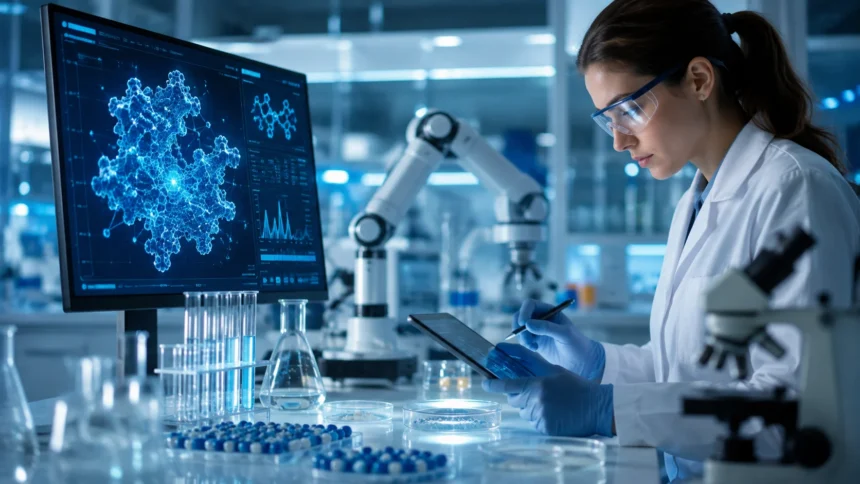
Can AI Discover New Medicines?
Artificial intelligence is changing the way scientists search for new medicines. Traditional drug discovery involves studying disease biology, identifying possible targets, screening large collections of molecules, optimizing promising compounds, conducting laboratory experiments, and eventually testing candidates in humans. The process is difficult because researchers must make decisions across enormous amounts of biological and chemical information. AI can analyze these datasets quickly and identify patterns that would be difficult for people to detect manually, giving researchers new ways to prioritize promising possibilities.
So, can AI discover new medicines? The most accurate answer is yes—but not completely by itself. AI can help identify drug targets, predict molecular behavior, generate potential drug structures, estimate toxicity, repurpose existing medicines, and improve several stages of clinical development. AI-designed and AI-discovered drug candidates have already progressed into human clinical testing, demonstrating that the technology has moved well beyond purely theoretical research.
That does not mean computers can simply press a button and produce a safe medicine. A molecule suggested by an algorithm still needs to be synthesized, studied in laboratories, tested for safety, evaluated in animals or alternative preclinical systems where appropriate, and investigated through controlled human trials. Regulatory authorities must also evaluate the evidence before a medicine can reach patients. AI accelerates and improves parts of this process, but scientific validation remains essential.
The exciting part is that AI can help researchers explore possibilities much more efficiently than older trial-and-error approaches alone. Machine learning, generative AI, protein-structure prediction, virtual screening, multi-omics analysis, and predictive modeling are increasingly being combined with laboratory science. The future of medicine discovery is therefore unlikely to be humans versus machines. It is more likely to involve scientists using AI as a powerful research partner to make better decisions earlier in the development process.
What Does AI Drug Discovery Actually Mean?
AI drug discovery refers to using machine learning and related computational techniques to solve problems involved in finding and developing medicines. Algorithms can analyze chemical structures, proteins, genes, disease pathways, medical literature, experimental data, and clinical information. Instead of replacing the scientific process, these systems help researchers filter enormous datasets and identify patterns worth investigating through real experiments.
One important application involves predicting which biological targets may be connected to a disease. A target might be a protein or pathway that contributes to disease progression and could potentially be influenced by a medicine. Identifying the wrong target early can waste years of development, so computational approaches that improve target selection could have significant value. AI can integrate several types of biological information to generate and rank potential targets for further investigation.
AI can also evaluate enormous numbers of molecules virtually before researchers begin expensive laboratory testing. Models can estimate whether a compound is likely to interact with a particular biological target and whether it has properties suitable for becoming a drug. This process, often called virtual screening, allows researchers to narrow an enormous chemical search space into a more manageable group of promising candidates.
Generative AI goes another step by designing new molecular structures rather than only evaluating existing ones. A model can be optimized toward desired characteristics such as target binding, solubility, potency, or other drug-related properties. Scientists then synthesize and experimentally test the most promising designs. This combination of computational generation and laboratory validation is becoming an important area of modern pharmaceutical research.
Why Traditional Drug Discovery Takes So Long
Discovering a medicine is difficult because human biology is extraordinarily complex. A disease may involve multiple genes, proteins, cell types, environmental factors, and interacting biological pathways. Even when scientists identify an interesting target, influencing that target safely without disturbing other essential biological processes can be challenging. Many ideas that appear promising during early research eventually fail when tested more thoroughly.
Researchers must also explore enormous chemical possibilities. The number of theoretically possible drug-like molecules is vastly larger than anything scientists could physically synthesize and test individually. A 2026 Scientific Reports paper discussing generative AI highlighted estimates around (10^{60}) possible drug-like molecules, illustrating why computational prioritization can be valuable.
Promising molecules then require extensive optimization. Researchers must consider potency, absorption, distribution, metabolism, toxicity, stability, manufacturing, and many other characteristics. Improving one property can sometimes damage another, which means drug design becomes a complicated multi-objective problem. AI models can help predict these tradeoffs before every version of a molecule is physically produced.
Even after preclinical research, clinical trials must determine whether the treatment is safe and actually benefits patients. Human biology frequently produces results that cannot be predicted perfectly from laboratory models. AI may improve candidate selection and trial design, but clinical testing remains a crucial stage because a computational prediction cannot substitute for evidence showing how a medicine behaves in real patients.
How AI Helps Scientists Find Drug Targets
Before designing a medicine, scientists often need to identify what biological mechanism they should influence. This process is known as target identification. Researchers may examine genetic information, disease tissue, protein activity, cell behavior, and scientific literature to understand which biological changes appear to drive a condition. AI can help combine and analyze these different sources more efficiently.
Machine-learning models can search for relationships among genes, proteins, pathways, diseases, and previously studied compounds. A connection that is difficult to recognize manually may become more visible when large datasets are analyzed together. These predictions can help researchers create a prioritized list of potential targets rather than investigating every biological possibility equally.
Multi-omics approaches strengthen this process by combining information from genomics, transcriptomics, proteomics, metabolomics, and other biological layers. Researchers hope that AI can help turn these enormous datasets into more useful biological hypotheses. Recent work continues to explore AI for target identification, virtual screening, pharmacokinetic prediction, and safety assessment within integrated drug-discovery pipelines.
Predictions still need experimental confirmation. A statistical association between a protein and disease does not necessarily mean changing that protein will improve patient outcomes. Laboratory experiments are needed to establish biological mechanisms and determine whether the target can be influenced safely. AI can make target discovery faster and more focused, but experimental biology remains necessary to establish whether the hypothesis is genuinely useful.
How AI Can Design New Drug Molecules
Generative AI can create molecular structures according to specified objectives, somewhat like other generative models create text or images from learned patterns. In drug research, however, the output is a chemical structure that researchers hope will interact with a biological target while also meeting important pharmaceutical requirements. This creates a significantly more demanding scientific problem than generating a visually convincing image.
Models can be trained on chemical and biological datasets to learn relationships between molecular structure and properties. Researchers can then ask the system to propose compounds predicted to have specific characteristics, such as strong target binding or suitable physical properties. Large numbers of possibilities can be generated rapidly, allowing scientists to explore chemical regions that might otherwise receive little attention.
The best designs are not immediately considered drugs. Chemists must determine whether proposed molecules can actually be synthesized and whether the predicted characteristics survive laboratory testing. Researchers may then feed experimental results back into computational models, creating iterative cycles in which AI proposes molecules, laboratories test them, and the results guide the next generation of designs.
One prominent example of progress is rentosertib, formerly known as ISM001-055, a small-molecule TNIK inhibitor created through an AI-driven discovery and design process. Results from a Phase 2a trial in idiopathic pulmonary fibrosis were published in Nature Medicine in 2025, showing that an AI-generated candidate could advance into meaningful human clinical testing. The study did not prove that AI eliminates drug-development risk, but it provided important evidence of clinical translation.
How AlphaFold Changed AI-Assisted Drug Research
Proteins perform many essential functions inside living organisms, and understanding their three-dimensional structures can help researchers understand disease mechanisms and design molecules that interact with them. Determining protein structures experimentally can be difficult and time-consuming. AI-based structure prediction therefore became an especially important breakthrough for biological research.
Google DeepMind’s AlphaFold demonstrated that AI could predict protein structures with remarkable usefulness and has since made structural information available for millions of proteins. These predictions provide researchers with structural hypotheses that can guide experiments, biological interpretation, and drug-discovery efforts.
Knowing a protein’s structure can help scientists investigate pockets where a drug might bind or understand how mutations alter biological function. Computational drug-design methods can then use structural information to prioritize or design molecules. Structural prediction therefore connects naturally with virtual screening, molecular modeling, and generative chemistry.
Protein prediction does not remove the need for experimental structural biology. Proteins can change shape, interact dynamically with other molecules, and behave differently in cellular environments. Experimental measurements remain essential when precise structural understanding is required. AlphaFold’s importance lies in dramatically expanding the structural information researchers can use to generate better hypotheses and prioritize experiments.
Can AI Predict Whether a Drug Will Work?
AI can estimate whether a compound is likely to interact with a biological target or show certain properties, but predicting whether it will become an effective medicine is much harder. Human diseases involve networks of biological processes, and a compound that performs well in a simplified laboratory test may behave differently in an entire organism.
Models can analyze previous experimental results to predict potency, selectivity, solubility, permeability, metabolism, and other characteristics. These estimates allow scientists to identify weak candidates earlier and concentrate resources on compounds with stronger predicted profiles. Reducing unproductive experiments can make discovery programs more efficient.
AI can also support pharmacokinetic and safety prediction. Researchers want to understand how a potential medicine will be absorbed, distributed, metabolized, and eliminated, as well as whether it could create toxic effects. Computational models can identify warning signals earlier, helping teams redesign molecules before costly development stages.
Predictions remain probabilities rather than guarantees. AI models can be wrong because their training data may be incomplete, biased, noisy, or poorly representative of the new molecule being evaluated. That is why experimental confirmation remains central to pharmaceutical development. AI can improve which candidates researchers choose to test, but it cannot currently prove that a medicine will work safely in humans.
Can AI Find New Uses for Existing Medicines?
Drug repurposing involves finding new therapeutic uses for medicines or compounds that were originally developed for another condition. This approach can sometimes offer advantages because researchers may already know something about a compound’s chemistry, safety, manufacturing, or behavior in humans. AI can help search for connections between existing drugs and diseases that might otherwise be overlooked.
Machine-learning systems can analyze molecular information, gene-expression patterns, disease pathways, scientific publications, clinical data, and known drug-target interactions. By connecting these datasets, models can rank medicines that may influence biological pathways involved in another disease. Researchers can then test the strongest predictions experimentally.
Knowledge graphs are particularly useful for this type of research because they represent relationships among diseases, genes, proteins, drugs, and other entities. AI can search these networks for meaningful connections and generate repurposing hypotheses. Reviews of AI-driven drug-discovery platforms identify knowledge-graph repurposing as one of several important computational approaches currently being developed.
Repurposing predictions still require proper scientific testing. A medicine known to be safe for one condition may require different doses or treatment durations for another disease, and its benefits may not translate to the new population. AI can dramatically improve hypothesis generation, but clinical evidence is still needed before a repurposed treatment can be considered effective.
How AI May Improve Clinical Trials
Drug discovery does not end when scientists identify a promising molecule. Clinical trials must determine whether the candidate is safe, how it behaves in humans, what dose should be used, and whether it actually improves meaningful outcomes. These trials are complex, expensive, and heavily regulated, creating another area where researchers are exploring AI assistance.
AI can potentially help identify appropriate trial participants by analyzing eligibility criteria and patient characteristics. Better patient stratification may be particularly useful when diseases contain biologically different subgroups. A treatment could work strongly in one subgroup but appear ineffective if trial participants are treated as one uniform population.
Researchers are also exploring AI for protocol design, outcome prediction, trial monitoring, and analysis. Application-specific language models and other AI tools have been proposed as ways to improve aspects of trial design, although strong validation and governance are necessary because errors in clinical research can directly affect patient safety and scientific conclusions.
AI will not eliminate randomized controlled trials simply because a model predicts that a drug should work. Human clinical evidence remains necessary for establishing safety and efficacy. The practical opportunity is using AI to design more informative trials, select better candidates, identify suitable participants, and reduce avoidable inefficiencies while maintaining rigorous clinical standards.
Could AI Make Drug Discovery Faster?
Speed is one of the biggest motivations behind AI-assisted drug discovery. Traditional programs can spend years exploring targets and optimizing compounds before entering human trials. AI can reduce some of this search time by prioritizing targets and molecules computationally before scientists commit substantial laboratory resources.
Generative models can rapidly propose potential molecules, while virtual screening can examine large chemical libraries without physically testing every compound. Protein-structure prediction can provide structural information that might otherwise require lengthy experimental work. Combined, these technologies can compress parts of the early research cycle considerably.
Real-world programs have begun demonstrating shorter early-development timelines. AI-discovered and AI-designed candidates have reached clinical testing, supporting the idea that computational approaches can accelerate the progression from biological hypothesis toward investigational drug candidates. However, individual success stories should not be interpreted as proof that every AI program will move faster.
Later development still takes time because safety studies, manufacturing, dose optimization, clinical trials, and regulatory evaluation cannot simply be skipped. AI’s biggest immediate impact may therefore come from improving early decisions and reducing the number of weak candidates that consume resources before failing. Faster discovery is valuable, but better selection may ultimately be even more important.
Can AI Make Medicines Cheaper to Develop?
Drug research is expensive partly because enormous amounts of time and laboratory work are invested in candidates that never become approved treatments. If AI can identify weak targets or compounds earlier, companies may avoid spending resources on programs with low probability of success. Computational screening can also reduce the number of molecules that need to be synthesized physically.
Automation can make certain research processes more efficient as well. AI can work alongside robotic laboratories to design experiments, interpret results, and select the next compounds to test. These closed-loop systems could reduce repetitive manual work and allow researchers to explore more hypotheses within the same period.
However, AI technology itself has costs. High-quality datasets, computing infrastructure, laboratory validation, specialist researchers, regulatory documentation, and clinical trials remain expensive. Building sophisticated models also requires substantial expertise. AI should therefore be viewed as a way to improve productivity rather than a guarantee that developing every medicine will suddenly become inexpensive.
Even if development costs decrease, this does not automatically mean medicine prices will fall by the same amount. Pharmaceutical pricing depends on many factors beyond discovery expenses, including manufacturing, competition, healthcare systems, market exclusivity, reimbursement, and commercial strategy. AI may improve research economics, but its effect on what patients ultimately pay will depend on much broader market forces.
How AI Could Help Develop Personalized Medicines
People with the same diagnosed disease can respond differently to treatment because of genetics, age, lifestyle, disease subtype, other medical conditions, and many additional biological factors. Precision medicine attempts to account for these differences rather than assuming that every patient should receive exactly the same treatment.
AI is well suited to analyzing complex datasets containing many variables simultaneously. Researchers can combine genomic information, medical imaging, laboratory results, molecular measurements, and clinical histories to identify patient subgroups that may respond differently to particular treatments. This may help researchers design more targeted medicines or select therapies more intelligently.
Multi-omics analysis is particularly promising because it allows researchers to examine several biological layers together. AI can help identify patterns across genes, proteins, metabolites, and other measurements that may define disease subtypes invisible through traditional clinical classification. Recent research continues to investigate these approaches for precision drug discovery and treatment selection.
Personalized medicine also creates challenges. Large, diverse, high-quality datasets are required to prevent models from working well only for particular populations. Privacy and data governance become especially important when genetic and medical information is involved. AI may make precision medicine more practical, but responsible implementation requires careful validation and protection of patient information.
AI and Rare Disease Drug Discovery
Rare diseases create a special challenge because individual conditions may affect relatively small populations. Limited patient numbers can produce smaller datasets, fewer commercial incentives, and less accumulated research compared with common diseases. AI could potentially help researchers extract more insight from the limited information that does exist.
Models can combine genetic data, molecular pathways, scientific publications, and information from related diseases to identify potential therapeutic targets. Drug repurposing may also be valuable because an existing medicine could interact with a pathway involved in a rare disease. Computational analysis allows researchers to examine possibilities that would be difficult to explore individually.
Generative approaches may eventually help design highly targeted molecules for rare genetic disorders when the disease mechanism is known. AI-supported protein modeling can also help researchers understand how specific mutations change protein structure or function, potentially revealing therapeutic strategies.
The main limitation remains data availability. Machine-learning systems learn from examples, so extremely rare conditions may provide relatively little information. Researchers therefore need methods that can work responsibly with small datasets while incorporating biological knowledge. AI may be particularly valuable in rare-disease research, but human scientific interpretation becomes even more important when data are scarce.
Can AI Help Discover New Antibiotics?
Antibiotic resistance is an important area where researchers have explored machine learning because traditional screening approaches may repeatedly examine similar chemical families. AI can search chemical spaces differently and identify molecules whose structures may not resemble familiar antibiotics.
Researchers can train models using compounds with known antibacterial properties and then apply those models to large chemical libraries. Promising candidates can be tested experimentally against bacteria. This workflow allows researchers to prioritize unusual compounds that conventional screening rules might overlook.
Generative AI could further expand this approach by designing new candidate structures optimized for antimicrobial activity and other necessary properties. Researchers could then synthesize the strongest candidates and test whether they kill harmful bacteria without unacceptable toxicity to human cells.
The challenge is that discovering an antibacterial molecule is only the beginning. A useful antibiotic must reach the infection, behave predictably in the body, avoid serious toxicity, and remain effective against resistant organisms. AI can help identify starting points, but extensive experimental development is still necessary before a potential antibiotic becomes a medicine.
What Role Does Generative AI Play in Medicine Discovery?
Generative AI has attracted attention because it can create new candidates rather than merely classify existing data. In pharmaceutical research, generative models can propose chemical structures, proteins, or other biological designs optimized toward particular objectives. This expands AI from a prediction tool into a design tool.
A model might search for molecules expected to bind strongly to a disease-related protein while maintaining properties associated with drug development. Researchers can specify several objectives simultaneously, allowing the system to navigate tradeoffs among potency, selectivity, solubility, and other characteristics.
Generative AI can potentially explore areas of chemical space humans have never investigated. This is especially valuable because the number of possible drug-like molecules is unimaginably large. Instead of searching randomly, models can direct exploration toward regions with characteristics relevant to a particular therapeutic problem.
The outputs still depend on the quality of training information and modeling assumptions. A molecule can appear promising computationally but fail during synthesis or biological testing. Generative AI is therefore most powerful when tightly integrated with medicinal chemistry, structural biology, laboratory experimentation, and iterative feedback rather than used as an isolated molecule generator.
Why High-Quality Data Matters So Much
AI models learn patterns from data, which means poor-quality information can produce unreliable predictions. Pharmaceutical datasets may contain inconsistent experimental methods, missing information, duplicated results, publication bias, or measurements collected under different conditions. These imperfections can influence model behavior in ways that are difficult to recognize.
Quantity also matters. Some biological problems have enormous datasets, while others have relatively few high-quality examples. Models trained on narrow chemical families may perform poorly when asked to predict molecules very different from anything they have previously seen. This problem is sometimes described as poor generalization outside the training distribution.
Negative experimental results are especially valuable but may be underrepresented because unsuccessful experiments are less likely to be published. Knowing that a molecule did not work can teach a model just as much as knowing that another molecule succeeded. More systematic sharing of high-quality experimental data could improve AI drug-discovery performance.
Recent scientific discussions have emphasized that better biological and chemical datasets are necessary if AI is to reach its full potential in medicine discovery. Powerful algorithms cannot compensate indefinitely for incomplete or unreliable scientific information. Better AI drug discovery therefore depends partly on better experimental science and data infrastructure.
What Are the Biggest Limitations of AI Drug Discovery?
One limitation is that biological systems are more complex than most computational models can represent completely. Cells interact with tissues, organs, immune systems, environments, and countless molecular pathways. A model focused on one target may miss downstream effects that become important in an actual patient.
Another limitation is explainability. Some sophisticated AI systems can generate useful predictions without providing a simple mechanistic explanation for why they reached a particular conclusion. In pharmaceutical research, scientists and regulators often need to understand the evidence supporting critical decisions, especially when model outputs influence safety or efficacy assessments.
Bias is another concern. If training datasets overrepresent particular chemical classes, disease populations, laboratories, or demographic groups, model predictions may perform less reliably elsewhere. Careful validation across independent datasets and relevant populations is therefore essential before relying heavily on an AI system.
Finally, AI cannot replace experimental validation. Models can suggest which experiments are most worthwhile, but the physical world determines whether those predictions are correct. Molecules must still be synthesized, biological mechanisms tested, safety assessed, and clinical benefits demonstrated. AI reduces uncertainty; it does not eliminate it.
Can AI Replace Scientists in Drug Discovery?
AI is unlikely to replace scientists across the entire medicine-discovery process because drug research requires experimental design, biological reasoning, clinical judgment, creativity, interpretation, and ethical decision-making. Algorithms are excellent at processing large datasets, but scientists still need to decide which questions matter and how predictions should be tested.
Medicinal chemists, biologists, computational scientists, pharmacologists, clinicians, toxicologists, and other specialists contribute different knowledge throughout development. AI can help each group work faster by narrowing possibilities or generating hypotheses. The strongest research systems are therefore likely to combine computational power with multidisciplinary human expertise.
Scientists also recognize when a model’s prediction conflicts with biological reality or when an experiment reveals something genuinely new. Unexpected results are often where major discoveries begin, and understanding them requires context that may extend beyond a model’s training data. Human reasoning remains especially important when existing knowledge is incomplete.
The role of researchers may nevertheless change. Scientists may spend less time manually screening enormous datasets and more time designing experiments, evaluating AI-generated hypotheses, and integrating complex evidence. AI could automate parts of discovery while increasing the importance of scientific judgment in deciding what should happen next.
How Regulators Are Responding to AI in Drug Development
As AI becomes more important in pharmaceutical research, regulators need ways to evaluate when model-generated information can be trusted. The U.S. Food and Drug Administration published draft guidance in January 2025 addressing AI models used to produce information or data supporting regulatory decisions for drug and biological products. The framework emphasizes evaluating credibility according to a model’s specific context of use.
This context-specific approach is important because not every AI use creates the same level of risk. A model used to prioritize early laboratory experiments has different consequences from a model generating evidence directly supporting a decision about drug safety or effectiveness. Validation expectations therefore need to reflect how important the model’s output is to the regulatory decision.
Regulatory agencies are also exploring computational and alternative approaches more broadly. In April 2026, the FDA reported qualifying its first AI-based drug-development tool as part of broader efforts involving human-relevant models and computational methods. This signals growing institutional acceptance of AI when tools are appropriately validated for defined purposes.
Regulation does not mean slowing innovation unnecessarily. Reliable standards can increase confidence by helping companies understand what evidence they need when AI contributes to development. As technology evolves, regulators, researchers, and pharmaceutical developers will need continued collaboration to ensure that faster innovation does not compromise patient safety or scientific credibility.
Could AI Reduce the Need for Animal Testing?
AI and computational models are increasingly being investigated as part of broader efforts to develop alternatives to certain animal experiments. Predictive toxicology models, organoids, organ-on-chip systems, cell-based assays, and other new approach methodologies can sometimes provide information more directly relevant to human biology.
AI can support these methods by analyzing complex experimental datasets and predicting potential toxicity or biological effects before more resource-intensive studies are performed. Better computational screening may help researchers eliminate problematic compounds earlier and focus experiments on candidates with more favorable profiles.
Regulatory interest in alternative approaches has also increased. The FDA reported progress in 2026 on efforts involving new approach methodologies, computational toxicology, and the qualification of an AI-based drug-development tool.
It is unlikely that AI alone will immediately replace every form of animal testing because different safety questions require different evidence. The more realistic development is a gradual shift toward combinations of computational prediction, advanced human-relevant laboratory models, and carefully selected additional studies. AI may help reduce unnecessary animal experiments while improving how early safety questions are investigated.
Has AI Already Discovered a Medicine?
AI-assisted medicines have progressed significantly, but the phrase “AI discovered a medicine” needs careful interpretation. AI can contribute to target discovery, molecule design, optimization, and candidate selection, but development still involves scientists, laboratories, clinical investigators, manufacturers, and regulators.
One important milestone is rentosertib, an AI-generated small-molecule TNIK inhibitor investigated for idiopathic pulmonary fibrosis. A Phase 2a randomized clinical trial published in Nature Medicine in 2025 evaluated its safety and efficacy, providing a prominent example of a generative-AI-derived candidate reaching mid-stage clinical testing.
The trial represents meaningful evidence that AI-designed molecules can move beyond computer simulations and early laboratory studies into human research. Subsequent analyses have highlighted it as an important proof of concept while also emphasizing that larger validation studies and regulatory evidence remain necessary.
It is therefore better to say AI is already contributing to real investigational medicines rather than claiming that autonomous AI has independently produced approved cures. The technology has demonstrated genuine drug-discovery capability, but the ultimate test remains whether AI-assisted candidates can repeatedly show safety and meaningful clinical benefit through full development programs.
Will AI Cure Diseases That Currently Have No Treatment?
AI could help researchers identify therapeutic approaches for diseases that currently lack effective treatments, particularly when scientific information already exists but is too complex to analyze manually. Rare diseases, neurodegenerative disorders, cancers, infectious diseases, and genetically defined conditions are all areas where computational methods may contribute.
AI can accelerate hypothesis generation by linking genes, proteins, pathways, compounds, and clinical information. It can also design molecules against targets previously considered difficult and help researchers search for patient subgroups most likely to respond. These abilities increase the number of ideas scientists can evaluate.
However, some diseases remain difficult because their underlying biology is still poorly understood. AI cannot create reliable answers from nonexistent knowledge. If researchers do not understand the mechanisms driving a disease, computational models may generate interesting possibilities without enough evidence to know which direction is correct.
The greatest promise comes from combining AI with better biological research. As scientists generate more detailed molecular, genetic, cellular, and clinical data, AI can help transform that information into testable therapeutic ideas. The technology could contribute to breakthroughs, but cures will still depend on understanding biology and demonstrating that treatments work safely in patients.
How AI Could Change the Pharmaceutical Industry
Pharmaceutical companies may increasingly organize drug discovery around integrated computational and experimental platforms. Instead of using AI only for isolated predictions, researchers can connect target identification, protein modeling, molecular generation, property prediction, laboratory automation, and clinical analytics within continuous workflows.
This approach could make research more iterative. An AI system generates a hypothesis, laboratories test it, experimental results return to the model, and the next round becomes more informed. Faster feedback loops could allow researchers to learn more from each experiment while reducing unnecessary work.
AI may also change which organizations can participate in drug discovery. Smaller biotechnology companies and academic groups can potentially use computational tools to explore therapeutic ideas that once required extremely large screening infrastructure. At the same time, advanced AI platforms can require substantial computing resources and proprietary datasets, creating new competitive advantages for organizations with access to these assets.
The industry will still depend heavily on human scientific expertise. Successful organizations will likely be those that combine AI capabilities with strong biology, chemistry, clinical development, data quality, and experimental infrastructure. AI is becoming another foundational research technology rather than a separate industry operating independently from pharmaceutical science.
What Could AI Drug Discovery Look Like in the Future?
Future drug-discovery platforms may begin with enormous biological datasets and use AI to identify disease mechanisms automatically. Structural models could predict how proteins interact, while generative systems create molecules tailored to specific targets. Predictive models could then estimate pharmacological and safety properties before chemists synthesize the strongest candidates.
Automated laboratories may speed up the feedback process even further. Robotic systems could synthesize compounds, perform experiments, collect measurements, and return results to AI models. Each round would improve the next set of predictions, creating a continuous design-make-test-learn cycle.
Clinical development could become more data-driven as well. AI may help identify patient populations, predict disease progression, optimize trial designs, and detect treatment-response patterns earlier. Digital biomarkers and increasingly detailed biological measurements could provide richer information about how treatments affect individual patients.
The realistic future is not instant computer-generated medicine. Instead, AI could make every stage of pharmaceutical research more informed and connected. The ultimate advantage may come from reducing the number of bad decisions scientists make while allowing researchers to explore more promising ideas with the same time and resources.
What Needs to Happen Before AI Reaches Its Full Potential?
Better data is one of the most important requirements. AI models need reliable chemical, biological, toxicological, and clinical information collected under sufficiently consistent conditions. Improving data-sharing systems and experimental standards could make future models more reliable across different therapeutic areas.
Independent validation is equally important. Drug-discovery models should be tested on data they have never seen and in real experimental environments. Impressive performance on historical benchmark datasets does not necessarily mean a system will succeed when asked to design genuinely new medicines.
Researchers also need better ways to understand uncertainty. Instead of presenting one confident prediction, models should help scientists understand how reliable a result is and where the system may be operating outside familiar data. This makes it easier to decide which predictions deserve experimental resources.
Finally, scientific, regulatory, ethical, and clinical expertise must develop alongside the technology. AI systems used in medicine need strong governance because mistakes can affect patients, research investment, and public trust. Innovation will be most valuable when faster discovery is combined with rigorous validation rather than treated as a substitute for it.
Final Thoughts
So, can AI discover new medicines? Yes, AI can already contribute meaningfully to finding biological targets, designing molecules, predicting properties, repurposing drugs, and improving clinical development. AI-generated drug candidates have entered human trials, showing that the technology is capable of producing ideas that survive far beyond computer simulations.
The technology is particularly powerful because drug discovery involves enormous search problems. Scientists cannot manually examine every possible biological target, chemical structure, or interaction. Machine learning and generative AI can narrow those possibilities and help researchers choose experiments more intelligently.
However, AI does not eliminate the difficult parts of medicine development. Every promising candidate still needs rigorous experimental validation, safety assessment, clinical testing, manufacturing development, and regulatory review. Biology remains complex, and even sophisticated models cannot perfectly predict what will happen inside a human patient.
The most realistic future is therefore collaborative. AI will increasingly act as a powerful scientific tool while researchers provide biological understanding, experimental evidence, clinical judgment, and ethical oversight. If that combination continues improving, AI could help scientists discover medicines faster, explore diseases that have received too little attention, and expand the range of therapeutic possibilities available to future patients.
Frequently Asked Questions
Can AI create a completely new drug?
Yes. Generative AI can propose entirely new molecular structures designed around specific biological targets and desired pharmaceutical properties. However, those molecules still require laboratory testing and clinical validation before they can become medicines.
Has an AI-designed drug reached clinical trials?
Yes. AI-discovered and AI-designed drug candidates have entered human trials, including rentosertib, which reached a randomized Phase 2a study for idiopathic pulmonary fibrosis.
Can AI replace scientists in drug discovery?
No. AI can analyze data, generate hypotheses, and design molecules, but scientists are still needed for experimental design, biological interpretation, validation, safety assessment, clinical research, and regulatory decision-making.
Can AI make drug discovery faster?
AI can speed up several early stages by identifying targets, screening molecules virtually, predicting properties, and generating new compounds. Clinical trials and safety evaluation still require substantial time because predictions must be validated in humans.
Will AI make medicines safer?
AI may help identify toxicity risks and weak drug candidates earlier, potentially improving which compounds progress into development. It cannot guarantee safety, so laboratory studies, clinical trials, and regulatory evaluation remain essential.
