

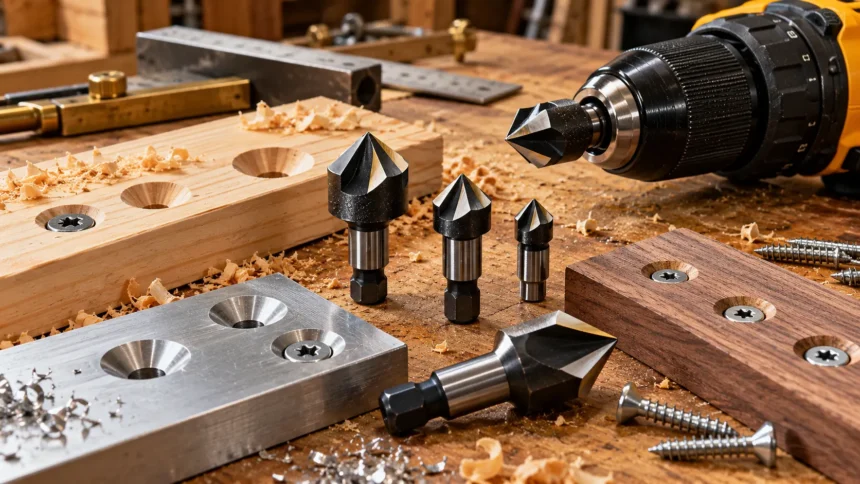
A countersink drill bit is a specialized tool used to create a cone-shaped recess around a drilled hole. This recess allows certain screw heads to sit flush with or slightly below the material surface, creating a smooth and professional-looking finish. Countersink drill bits are commonly used in woodworking, furniture assembly, cabinet installation, and selected metalworking applications.
Unlike ordinary drill bits, countersink bits are designed to shape the opening around a hole rather than simply create a straight cylindrical opening. They are available in different sizes, angles, materials, and designs. Some models combine drilling and countersinking functions, while others are intended only for creating the countersink recess.
Understanding countersink drill bit uses and choosing tips can help homeowners, DIY enthusiasts, and workshop professionals select suitable tools. This guide explains what countersink drill bits are, how they work, their common applications, available types, and important buying considerations. It also covers sizing, countersink angles, tool materials, and common mistakes to avoid.
What Is a Countersink Drill Bit?
A countersink drill bit is a cutting tool designed to produce a conical recess at the opening of a drilled hole. The recess accommodates compatible screw heads, particularly flat-head screws designed to sit flush with a surface. This helps create a neat appearance and reduces protruding fastener heads. Countersinking is widely used in woodworking and mechanical assembly.
Countersink bits usually feature angled cutting surfaces that remove material around an existing hole. The resulting recess is wider at the surface and becomes narrower toward the hole. Different products are designed for different materials and screw head geometries. The correct bit must match the intended application and fastener specifications.
Although countersink bits are often associated with wood screws, they also have applications in metalworking and manufacturing. Their design differs from that of standard twist drill bits, which primarily create cylindrical holes. Some combination tools incorporate both functions. Understanding these differences helps buyers choose suitable equipment for their projects.
How Does a Countersink Drill Bit Work?
A countersink drill bit creates a tapered opening that corresponds to the underside of a compatible screw head. Its cutting edges remove material around the entrance of a hole. The finished shape allows the screw head to sit within the recess rather than projecting above the surface. This can improve appearance and clearance in suitable assemblies.
The countersink angle is an important feature because different screw standards use different head geometries. A mismatched angle may produce uneven contact or an unsuitable recess. The cutting tool’s diameter also influences which fasteners it can accommodate. Manufacturers commonly provide specifications identifying compatible angles and materials.
Countersinking should not be confused with ordinary drilling or counterboring. Traditional drilling produces a cylindrical opening, while countersinking creates a conical recess. Counterboring produces a larger cylindrical recess for suitable fastener heads. Understanding these distinctions helps prevent confusion when comparing drilling accessories and fastening designs.
Common Uses of Countersink Drill Bits
Countersink drill bits are frequently used in woodworking projects where flat-head screws should sit flush with a finished surface. Furniture assembly, cabinet construction, and decorative woodwork are common applications. A properly matched recess helps accommodate the screw head without leaving an unwanted projection. This can contribute to a cleaner overall finish.
In metalworking, countersink tools may be used for compatible fasteners or certain finishing operations. Manufacturing processes sometimes require precise recess dimensions to accommodate standardized hardware. Some countersink designs can also assist with removing burrs from suitable holes. However, not every countersink bit is intended for every metal or deburring application.
Countersinking can be important when components need to fit together without interference from protruding screw heads. It is also useful for certain decorative assemblies and products requiring smooth exposed surfaces. The correct tool depends on the fastener, workpiece material, and application. Manufacturer specifications should guide tool selection.
Different Types of Countersink Drill Bits
Countersink drill bits are available in several designs, each intended for particular applications. Common categories include fluted countersink bits, single-flute countersinks, combination drill-and-countersink bits, and adjustable countersink systems. These products differ in cutting geometry, construction, and compatibility. Understanding their features helps buyers compare suitable options.
Some countersink bits are intended for wood, while others are designed for metalworking or specialized industrial applications. Cutting-edge arrangement influences performance and surface finish. Certain tools are optimized for producing precise recesses, while others emphasize general-purpose convenience. Product descriptions should identify suitable materials and intended uses.
The most appropriate type depends on how frequently countersinking is required and which materials are involved. Occasional woodworking may call for different equipment from precision metal manufacturing. Tool quality, shank compatibility, and available sizes also matter. Comparing technical specifications helps buyers avoid unnecessary purchases.
1. Fluted Countersink Drill Bits
Fluted countersink drill bits feature cutting grooves designed to remove material from the workpiece. They are commonly used for producing conical recesses in compatible materials. Different models feature different numbers of flutes and cutting geometries. These characteristics influence cutting performance and the quality of the finished recess.
High-speed steel fluted countersinks are commonly available for workshop applications. Some are intended for metalworking, while others may be suitable for certain plastics or wood-based materials. The number of cutting edges varies depending on the manufacturer’s design. Material compatibility should always be confirmed before purchasing.
Fluted countersinks are available in multiple diameters and angles. Some products are intended for general-purpose applications, while others target precision manufacturing. Buyers should consider the required surface finish, workpiece material, and fastener specifications. A well-matched tool is more useful than selecting one based solely on the number of flutes.
2. Single-Flute Countersink Bits
Single-flute countersink bits use one primary cutting opening to remove material. Their relatively simple cutting geometry makes them recognizable among common countersinking tools. They are available in different sizes and designs for selected materials. Some manufacturers offer these products for woodworking and general workshop applications.
One potential advantage of certain single-flute designs is their ability to produce smooth recesses in compatible materials. However, finished quality depends on tool construction, material properties, and operating conditions. Single-flute bits are not automatically superior to multiple-flute products. Different applications may benefit from different cutting geometries.
When comparing single-flute countersinks, buyers should review diameter range, included angle, and supported materials. Shank design and manufacturer quality are also important. A tool intended for soft wood may not be suitable for demanding metalworking applications. Product specifications provide a better comparison than appearance alone.
3. Combination Drill and Countersink Bits
Combination drill and countersink bits incorporate two cutting functions within one tool assembly. They are commonly used in woodworking applications involving screws that require both a pilot hole and a countersunk recess. Their integrated design can reduce the need to change between separate tools. However, compatibility depends on screw dimensions and workpiece requirements.
Some combination products include adjustable components that accommodate different screw lengths or drilling requirements. Others have fixed configurations designed for specific applications. These features can be useful when preparing repeated fastener locations in furniture or cabinet components. The available adjustment range varies between manufacturers.
Combination tools may cost more than basic individual countersinks, but they can offer practical convenience. Buyers should compare component quality, compatible screw sizes, and replacement part availability. Not every combination bit supports every fastener type. Selecting the correct product helps avoid unsuitable recess dimensions and unnecessary material damage.
4. Adjustable Countersink Drill Bits
Adjustable countersink drill bits offer features that allow certain dimensions or tool settings to be changed. These products are commonly found in woodworking systems designed for repeated fastening tasks. Some incorporate adjustable collars or replaceable cutting components. Their flexibility can be useful for workshops handling different project requirements.
Not every adjustable countersink tool works in the same way. Some allow changes in drilling depth, while others accommodate different pilot drill components. The exact capabilities depend on the manufacturer’s design. Buyers should distinguish between genuine countersink size adjustments and accessories that control other aspects of the tool.
Adjustable products may be useful when several compatible fastener sizes are used regularly. However, they can require additional maintenance and careful component matching. More complex construction may also increase the purchase price. Evaluating the expected workload helps determine whether an adjustable system provides worthwhile value.
Countersink Drill Bit Sizes Explained
Countersink drill bits are manufactured in different diameters to accommodate various screw head sizes and workpiece requirements. A countersink diameter generally refers to the tool’s maximum cutting diameter. Common workshop products may range from approximately 1/4 inch to more than 1 inch. Specialty industrial tools are available in additional sizes.
The required countersink diameter depends on the screw head dimensions and the desired finished recess. Screw nominal diameter alone does not always determine the correct countersink size. Different head designs may require different recess dimensions. Matching the fastener manufacturer’s specifications helps produce an appropriate fit.
Metric countersink bits are also widely available, with common products measured in millimeters. Some tool sets include several diameters for different applications. Buyers should compare the full size range rather than focusing only on the largest advertised measurement. Exact compatibility is more important than purchasing the widest possible assortment.
Countersink Drill Bit Size Chart
Countersink drill bit sizes vary depending on intended materials, screw specifications, and product design. The following chart provides examples of commonly available cutter diameters and their general applications. It is not a universal screw-to-countersink compatibility chart. Appropriate recess dimensions should always be verified against the selected fastener.
| Example Cutter Diameter | General Application |
|---|---|
| 1/4 inch | Small countersinking tasks |
| 3/8 inch | Small woodworking fasteners |
| 1/2 inch | General woodworking applications |
| 5/8 inch | Medium-size recesses |
| 3/4 inch | Larger screw head recesses |
| 1 inch | Larger countersinking applications |
| 6–20 mm | Various metric countersinking tasks |
These measurements describe general cutter sizes rather than guaranteed compatibility with particular screws. Different countersink angles and head geometries influence the required recess. Some manufacturers publish compatibility charts for their products. Reviewing those details can help prevent oversized or undersized countersinks.
Understanding Countersink Angles
The countersink angle describes the included angle between the sloping sides of the conical recess. This angle should correspond to the underside of the intended fastener head. Different screw standards and applications require different included angles. Choosing an incorrect angle may prevent the fastener from seating as designed.
An 82-degree countersink is commonly associated with many American flat-head screw designs. Ninety-degree countersinks are widely used with compatible metric flat-head fasteners. Other angles, including 60, 100, and 120 degrees, appear in specialized applications. The correct choice depends on the relevant fastener standard.
Countersink angle is particularly important for mechanical and structural assemblies where fastener seating affects performance. Visual similarity between screw heads does not guarantee identical geometry. Buyers should verify the included angle using product documentation. Proper compatibility supports accurate fastening and prevents unnecessary damage to the workpiece.
Countersink Drill Bits for Wood
Wood countersink drill bits are designed for producing recesses in suitable wood and wood-based materials. They are commonly used in furniture assembly, cabinetry, and decorative woodworking. Some products feature specialized cutting geometry intended to reduce rough edges. Material characteristics and tool quality influence the finished appearance.
Softwood, hardwood, plywood, and engineered wood products respond differently to cutting tools. A countersink suitable for one material may not produce identical results in another. Wood grain, surface finish, and material density can affect appearance. Manufacturers may provide recommendations for different woodworking applications.
Woodworking countersinks are available as individual tools and combination drill-and-countersink systems. The best choice depends on fastener sizes and project requirements. Furniture makers may value adjustable systems, while occasional users may prefer simpler designs. Selecting tools based on compatibility helps support consistent results.
Countersink Drill Bits for Metal
Metalworking countersinks are designed for creating compatible conical recesses in metal components. They may be used with standardized flat-head fasteners or certain deburring applications. Different metals require different cutting tool properties. A product suitable for aluminum may not perform equally well in harder alloys.
High-speed steel and cobalt-alloy tools are commonly available for metalworking applications. Some premium products feature specialized coatings intended to improve wear resistance. However, material quality and cutting geometry remain important. Buyers should confirm which metals the manufacturer identifies as compatible.
Precision metalworking often requires close attention to fastener dimensions and component specifications. Countersink accuracy may influence assembly fit and surface clearance. Industrial applications can also have particular inspection requirements. Experienced technicians should follow the relevant engineering documentation rather than relying on general-purpose sizing assumptions.
Countersink vs. Counterbore: What’s the Difference?
Countersinking and counterboring are different machining processes used to create recesses around holes. Countersinking produces a conical opening, while counterboring creates a larger cylindrical recess. Both may allow fastener heads to sit below or level with a surrounding surface. However, they accommodate different head geometries.
Flat-head screws commonly require countersunk openings because their undersides are tapered. Certain socket head cap screws and other fasteners may require counterbored recesses. The selected recess must correspond to the fastener design. Choosing the wrong geometry may prevent proper seating.
Understanding the distinction is important when reading construction plans or shopping for drilling accessories. Products labeled countersink and counterbore are not automatically interchangeable. Some specialized tools combine multiple functions, but their specifications still matter. Correct terminology helps buyers communicate project requirements accurately.
Countersink vs. Chamfer: Key Differences
A chamfer is a beveled edge formed along the boundary of a hole or workpiece. Countersinking also creates an angled surface, but its primary purpose is often to accommodate a compatible fastener head. The two features may appear similar. However, their intended dimensions and functions can differ.
Chamfers are commonly used to remove sharp edges, improve assembly clearance, or prepare components for additional manufacturing operations. Countersinks usually follow the geometry required by a particular screw or fastening system. Some countersink tools can also perform selected chamfering tasks. Tool suitability depends on material and design specifications.
The distinction becomes important in precision manufacturing, where an apparently small difference in recess dimensions can affect assembly quality. Engineering drawings typically identify the required feature and measurements. Buyers should follow those specifications rather than relying on appearance alone. Choosing the correct cutting tool helps support accurate results.
Materials Used to Make Countersink Drill Bits
Countersink drill bits are manufactured from materials selected for cutting performance, hardness, and wear resistance. High-speed steel is one of the most common options for general workshop applications. It provides useful performance across many compatible materials. Different grades and manufacturing methods influence quality.
Cobalt-alloy high-speed steel countersinks are available for certain demanding metalworking applications. Carbide products may also be used in specialized industrial environments. These materials can offer different wear characteristics and performance capabilities. However, they may be more expensive and require equipment suited to their intended applications.
Protective coatings are another consideration when comparing countersink tools. Some products use titanium nitride or other surface treatments designed to improve wear resistance. Coatings do not guarantee compatibility with every material. Buyers should evaluate the complete tool specification rather than choosing based only on appearance or coating color.
How Much Does a Countersink Drill Bit Cost?
Countersink drill bit prices vary depending on size, material, cutting geometry, manufacturer, and intended application. Basic woodworking products are usually more affordable than specialized industrial countersinks. Combination tools and premium sets may cost more because they include additional components. Overall value depends on compatibility and expected usage.
The following table provides approximate US-dollar price ranges for common countersink drill bit categories. These are broad budgeting estimates rather than verified current retail quotations. Actual prices vary by manufacturer, retailer, region, and product specifications.
| Countersink Drill Bit Type | Approximate Price |
|---|---|
| Basic woodworking countersink | $5–$15 |
| Single-flute countersink | $8–$25 |
| Combination drill and countersink bit | $10–$35 |
| Adjustable countersink system | $15–$50 |
| High-speed steel metal countersink | $10–$40 |
| Premium industrial countersink | $30–$100+ |
| Multi-piece countersink set | $15–$80 |
An inexpensive countersink may be suitable for occasional compatible tasks, while regular professional use may justify higher-quality equipment. However, price alone does not guarantee better performance. Buyers should compare material compatibility, cutting-edge quality, and warranty support. Choosing the right specifications usually provides better value than purchasing unnecessary features.
How to Choose the Best Countersink Drill Bit
Choosing a suitable countersink drill bit begins with identifying the material and fastener involved in the project. Wood, metal, plastic, and other materials can require different cutting geometries. The intended screw head also determines the required countersink angle and size. These details should guide product selection.
Next, consider construction quality and compatibility with the available drilling equipment. High-speed steel may be appropriate for general applications, while demanding industrial work may require specialized materials. Shank dimensions and design should also match the tool system. Reviewing manufacturer specifications helps avoid unsuitable purchases.
Finally, compare available sizes, product durability, warranty coverage, and overall cost. A compact set may be useful when several countersink diameters are regularly needed. However, a single well-matched bit may be more economical for occasional work. The best countersink tool is one that meets actual project requirements without unnecessary complexity.
Common Countersink Drill Bit Buying Mistakes
One common mistake is choosing a countersink bit without checking the intended screw head angle. A mismatch can prevent the fastener from seating correctly. Different screw standards use different geometries, even when products appear similar. Reviewing the fastener specification helps avoid this problem.
Another mistake involves purchasing a tool that is unsuitable for the workpiece material. A countersink intended for general woodworking may not be appropriate for demanding metal applications. Cutter material, diameter, and construction influence compatibility. Product descriptions should be reviewed carefully before purchasing.
Buyers may also overlook the difference between countersinking and counterboring. These processes create different recess shapes and accommodate different fastener heads. Choosing the wrong tool can affect assembly fit. Understanding the intended application and checking technical documentation helps prevent unnecessary expenses.
Countersink Drill Bit Safety and Maintenance Tips
Countersink drill bits are sharp cutting tools that require appropriate equipment and careful handling. Rotating machinery, sharp metal chips, and unsecured workpieces can create injury risks. Approved eye protection and adherence to manufacturer safety instructions are important. Inexperienced users should seek guidance from a trained adult or qualified workshop professional.
Routine maintenance can help preserve countersink cutting edges and tool condition. Bits should be inspected for visible wear, damage, or corrosion before professional use. Keeping cutting tools clean and storing them in protective cases may help prevent deterioration. Damaged or excessively worn products should be replaced or professionally assessed.
Suitable storage also helps maintain an organized workshop. Individual tool holders can prevent cutting edges from contacting other metal equipment. Manufacturers may provide specific cleaning and maintenance recommendations for coated or specialized tools. Following those instructions can support longer service life and more consistent performance.
Conclusion
A countersink drill bit is a useful cutting tool designed to create conical recesses for compatible screw heads. It is commonly used in woodworking, furniture assembly, cabinet installation, and selected metalworking applications. Different types include fluted countersinks, single-flute designs, combination tools, and adjustable systems. Understanding these options helps buyers select suitable equipment.
Countersink drill bit sizes, angles, materials, and cutting geometry all influence compatibility. The 82-degree and 90-degree angles are common in different fastener systems, but other specifications also exist. Choosing the correct recess dimensions is important for proper screw seating. Comparing technical details is more reliable than selecting tools based only on appearance or price.
Before purchasing a countersink drill bit, consider the intended material, screw type, tool compatibility, and expected frequency of use. Review manufacturer specifications and choose products suited to the application. Proper storage and professional handling also help maintain tool condition. With thoughtful selection, countersink tools can support clean, accurate, and practical fastening applications.
Frequently Asked Questions
What is a countersink drill bit used for?
A countersink drill bit creates a cone-shaped recess around a hole so a compatible flat-head screw can sit flush with or below the surface. It is commonly used in woodworking and metalworking.
What is the difference between a countersink and a regular drill bit?
A regular drill bit primarily creates cylindrical holes, while a countersink bit produces a conical recess around the hole opening. Some combination tools perform both functions.
What size countersink drill bit do I need?
The required countersink size depends on the screw head diameter, head angle, and intended recess dimensions. Always check fastener specifications rather than choosing solely by nominal screw size.
What is the difference between an 82-degree and 90-degree countersink?
An 82-degree countersink commonly matches many American flat-head screw designs, while 90-degree countersinks are widely used for compatible metric fasteners. The correct angle depends on the screw specification.
Can you use a countersink drill bit on metal?
Yes, countersink bits designed for metalworking can create suitable recesses in compatible metals. Tool material, cutting geometry, and manufacturer specifications determine which applications are appropriate.
