

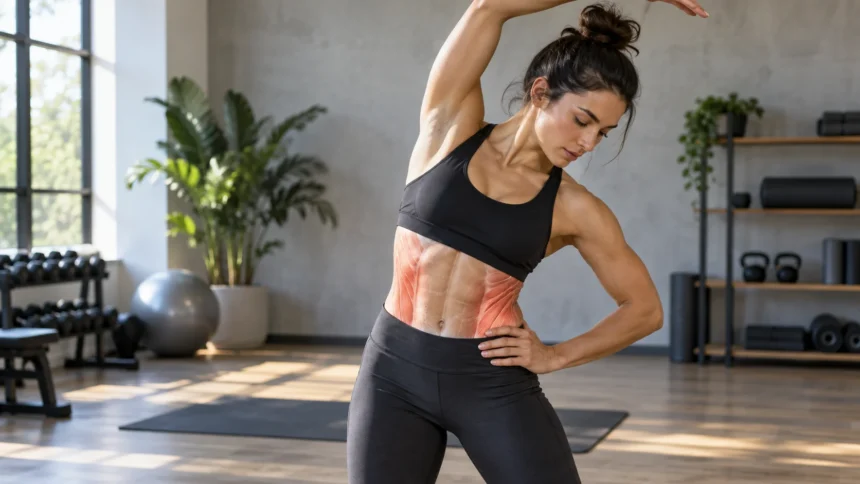
Your obliques are important abdominal muscles that help you twist, bend, stabilize your trunk, and control movement during everyday activities. They work when you turn to reach something, carry a heavy bag, walk, run, exercise, or simply maintain an upright posture. Although they are often discussed in fitness, their role extends far beyond creating a defined waistline.
The oblique muscles sit along the sides of your abdomen and form part of the larger core system. They work together with the rectus abdominis, transverse abdominis, back muscles, diaphragm, and pelvic floor to support your trunk. When these muscles coordinate well, they help transfer force between your upper and lower body efficiently.
Oblique discomfort can develop after sudden twisting, repetitive exercise, heavy lifting, coughing, or sports involving rotation. However, pain around the side of the abdomen does not always come from a muscle strain. Understanding where the obliques are located and what they do can help you recognize common problems and know when professional evaluation may be appropriate.
Where Are the Oblique Muscles Located?
The oblique muscles are positioned on both sides of the abdomen, extending from the ribs toward the pelvis. They form part of the abdominal wall and sit beside the more familiar rectus abdominis, sometimes called the “six-pack” muscle. Their broad positioning allows them to contribute to twisting, side bending, compression, and stabilization of the trunk.
There are two primary layers: the external obliques and the internal obliques. The external obliques are the more superficial layer and lie closer to the skin, while the internal obliques sit underneath them. Their muscle fibers run in different directions, which helps create coordinated movement when you rotate or bend your torso.
You have oblique muscles on both the left and right sides of your body. They rarely work completely alone because most trunk movements require several muscle groups to coordinate at once. This is why a problem that feels like “oblique pain” may sometimes involve nearby abdominal, rib, back, hip, or connective tissues as well.
External Obliques: What They Do
The external obliques help rotate your trunk, bend it sideways, and compress the abdominal wall. When both sides contract together, they can assist with flexing the trunk and supporting abdominal pressure. When one side works more strongly, it contributes to rotation and lateral bending depending on which muscles are active.
These muscles are involved in many everyday tasks, including getting out of bed, turning while driving, carrying groceries, and changing direction while walking. They also become active during sports such as tennis, golf, baseball, boxing, and swimming because these activities require repeated rotation and force transfer through the torso.
Strong external obliques do not mean constantly performing twisting exercises. Their function is closely linked with resisting unwanted movement as well as producing it. Exercises that require you to maintain trunk position while carrying weight, pressing, pulling, or moving your limbs can also challenge the external obliques effectively.
Internal Obliques: Function and Importance
The internal obliques lie underneath the external obliques and contribute to trunk rotation, side bending, and abdominal compression. Their fiber orientation differs from the external layer, allowing both muscle groups to work together in coordinated movement. This layered structure gives the abdominal wall strength while still allowing the torso to move in several directions.
Internal obliques also contribute to stabilizing the spine and pelvis during movement. They help manage forces when you walk, run, lift, or change direction. Rather than acting as isolated muscles, they coordinate with deeper core muscles to maintain abdominal pressure and prevent excessive movement when the body is under load.
Because the internal obliques are deeper, you usually cannot identify them visually the way you might see more superficial abdominal definition. Their importance is functional rather than cosmetic. Training that improves control, breathing, and overall core stability can strengthen these muscles without requiring aggressive or repetitive side-bending exercises.
How Obliques Support Core Stability
Core stability means your trunk can remain controlled while forces act on it from different directions. The obliques contribute by helping prevent excessive rotation, side bending, and unwanted movement of the pelvis. This becomes especially important when you carry something on one side, perform a single-leg movement, or reach away from your center of mass.
Your obliques also help transfer force between the lower and upper body. Imagine throwing a ball, swinging a racket, or pushing something heavy. Force generated by the legs travels through the pelvis and trunk before reaching the arms, and the abdominal muscles help make this transfer efficient while protecting the spine from uncontrolled movement.
Core stability should not be confused with keeping your abdomen rigid throughout every activity. Healthy movement requires both stability and flexibility. The obliques should be able to contract when support is needed and relax enough to allow normal breathing, rotation, and movement rather than remaining excessively braced at all times.
Common Causes of Oblique Muscle Strain
An oblique strain occurs when muscle fibers are overstretched or loaded beyond what they can comfortably tolerate. Sudden twisting, forceful coughing, awkward lifting, or rapid changes of direction can contribute to this type of injury. Sports involving repeated rotational movements can also increase the risk, especially when training volume or intensity rises too quickly.
Symptoms may include localized pain along the side of the abdomen, tenderness, stiffness, or discomfort when twisting, coughing, laughing, or bending. Some people notice pain immediately after a sudden movement, while others develop soreness gradually after repetitive activity. Severity varies depending on how much tissue has been irritated or damaged.
Not every pain near the obliques is a muscle strain. Rib injuries, hernias, digestive problems, kidney issues, and other conditions can sometimes produce discomfort in a similar region. If pain is severe, persistent, associated with swelling or a bulge, or accompanied by symptoms such as fever or vomiting, medical assessment is appropriate.
Signs Your Obliques May Be Overworked
Overworked obliques may feel sore, tight, or fatigued after unusually demanding exercise. This often happens when someone suddenly adds large amounts of twisting, side bends, weighted carries, or high-volume abdominal work. Delayed muscle soreness can appear several hours after training and may be most noticeable the following day.
Normal post-exercise soreness tends to improve gradually and usually does not cause sharp pain during basic daily movement. If discomfort becomes more intense, affects breathing, or continues worsening instead of settling, it may indicate more than ordinary training soreness. Resting briefly and reducing irritating movements can help clarify whether the problem is temporary fatigue.
Training balance matters as well. Performing hundreds of repetitions for the obliques while neglecting the rest of the core is unlikely to produce better function. A well-rounded program should include controlled flexion, anti-rotation, carries, lower-body strength, back strength, and movement patterns that train the trunk as part of the whole body.
Best Exercises for Strengthening the Obliques
Side planks are a straightforward exercise for training the obliques without repeated twisting. Support yourself on one forearm or hand, keep the body aligned, and prevent the hips from dropping. Beginners can bend their knees or shorten the lever, while more experienced people can increase duration or use harder variations.
Suitcase carries are another practical option. Hold a weight on one side and walk while keeping your torso upright instead of leaning toward or away from the load. This challenges the obliques to resist lateral bending and mirrors the type of stabilization required when carrying bags, tools, or other objects in everyday life.
Rotational presses, controlled cable rotations, and anti-rotation exercises can add variety. Lower-body exercises also challenge the core, particularly when they require balance and pelvic control. For example, movements such as monster walks can strengthen the hips while your trunk works to remain stable, supporting better coordination between the pelvis and core.
How to Stretch and Relax Tight Obliques
Gentle side bending can stretch the oblique region without requiring complicated equipment. Stand comfortably, reach one arm overhead, and lean slowly toward the opposite side until you feel a mild stretch along the ribs and side of the abdomen. Avoid forcing the movement or continuing if you feel sharp pain rather than gentle tension.
Controlled trunk rotation can also help restore comfortable movement after general stiffness. Sit or stand tall and turn gradually within a pain-free range instead of trying to achieve the largest possible twist. Slow breathing can reduce unnecessary tension and help you notice whether one side feels noticeably more restricted than the other.
Stretching should not be used to aggressively pull on a recently injured muscle. If you suspect a strain, early management often involves reducing painful movement before gradually restoring motion. Persistent tightness may also reflect workload, posture, breathing habits, or another issue, so stretching alone may not address the underlying cause.
Obliques and Lower Back Pain
The obliques contribute to controlling the spine and pelvis, which means they can influence how the lower back handles movement and load. Weakness, poor coordination, or fatigue may reduce trunk control during lifting, sports, or prolonged activity. However, lower back pain is complex and should not automatically be blamed on weak abdominal muscles.
Some people respond to back discomfort by constantly bracing their abdomen or performing excessive core exercises. This may not help if the underlying issue involves movement sensitivity, workload, sleep, stress, hip function, or another factor. A balanced approach usually involves gradually building strength and confidence rather than trying to keep the spine completely rigid.
If lower back pain persists, travels into a leg, causes numbness or weakness, or significantly limits daily activity, professional evaluation is appropriate. Exercise can be useful for many people, but the best program depends on the cause and individual situation. Oblique strengthening should be part of broader movement and strength work rather than treated as a universal cure.
When Oblique Pain Needs Medical Attention
Mild muscle soreness after unfamiliar exercise often improves with time and reduced intensity. However, severe or unexplained abdominal-side pain deserves more caution because several organs and structures are located near the same area. Pain that does not clearly relate to movement or exercise should not automatically be assumed to come from the oblique muscles.
Seek medical attention promptly for severe pain, significant swelling, a visible bulge, difficulty breathing, fainting, fever, persistent vomiting, blood in urine or stool, or pain after a major impact. Sudden abdominal pain that feels unusual or rapidly worsens also deserves urgent evaluation rather than self-treatment with stretches or exercise.
Even when symptoms appear muscular, consider assessment if they continue for more than several days without improvement or repeatedly return whenever you resume normal activity. A healthcare professional can assess your abdomen, ribs, spine, and surrounding structures and determine whether rehabilitation, further investigation, or another form of treatment is needed.
How to Keep Your Obliques Healthy
Gradual training progression is one of the simplest ways to reduce the risk of muscle strain. Increase resistance, repetitions, running volume, or rotational sports practice gradually rather than making dramatic jumps. Muscles adapt when they are challenged consistently, but sudden increases in workload can exceed what the tissue is currently prepared to tolerate.
Include several types of core training instead of relying only on crunches or twisting movements. Side planks, carries, dead bugs, controlled rotations, and full-body strength exercises challenge the trunk in different ways. Strong hips, legs, and back muscles also reduce the need for one area of the core to handle every stabilizing demand.
Recovery matters too. Adequate sleep, balanced nutrition, hydration, and reasonable rest between demanding sessions can support training adaptation. Pay attention to repeated pain rather than working through it indefinitely, and adjust exercises when necessary so you can maintain consistent long-term training instead of repeatedly stopping because of preventable flare-ups.
Conclusion
The obliques are important muscles located along the sides of the abdomen. The external and internal obliques help with rotation, side bending, abdominal compression, and trunk stability while working closely with other core and lower-body muscles. Their role is important during everyday movement as well as exercise and athletic activity.
Healthy obliques need both strength and movement capacity. Exercises such as side planks, carries, anti-rotation drills, and controlled rotational movements can build function without requiring excessive repetitions. Gradual progression and good technique are more useful than aggressively training the sides of the abdomen every day.
Most mild soreness improves with sensible activity modification, but persistent or severe pain should not be ignored. Side abdominal pain can come from several structures besides the oblique muscles. Understanding normal muscle function can help you train more effectively while recognizing when symptoms may require evaluation by a qualified healthcare professional.
FAQs
Where are your obliques located?
Your obliques are located along both sides of your abdomen between the ribs and pelvis. The external obliques form the outer layer, while the internal obliques sit underneath them.
What do the oblique muscles do?
The obliques help rotate and side-bend the trunk, compress the abdomen, stabilize the spine, and transfer force between the upper and lower body during everyday movement and exercise.
What does an oblique strain feel like?
An oblique strain may cause localized side-abdominal pain, tenderness, stiffness, or discomfort with twisting, coughing, laughing, and bending. More severe or unexplained abdominal pain should be medically evaluated.
What exercises strengthen the obliques?
Side planks, suitcase carries, anti-rotation presses, controlled cable rotations, and full-body strength exercises can train the obliques. Choose variations you can perform with stable, pain-free technique.
Can weak obliques cause back pain?
Poor trunk strength or coordination may contribute to some movement problems, but back pain has many possible causes. Weak obliques alone should not automatically be assumed to be the source.
