

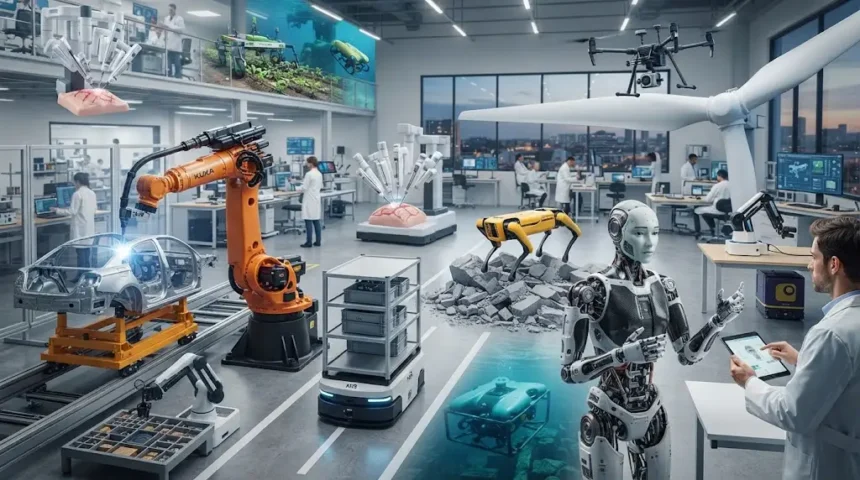
Types of Robots: 10 Examples & How They’re Used
Robots are no longer limited to science fiction, research laboratories, or giant factories. They now work in warehouses, hospitals, farms, homes, construction sites, restaurants, offices, and even dangerous environments that are difficult for people to enter safely. Some robots look like mechanical arms, while others resemble vehicles, drones, mobile carts, humanoids, or compact household appliances. Their designs differ because each robot is built around a particular task, environment, and level of autonomy. Advances in artificial intelligence, computer vision, sensors, batteries, and machine learning have made modern robots more capable and adaptable than earlier generations. Understanding the different types of robots helps explain where automation is heading and why robotics is becoming important across so many industries.
The word “robot” covers a surprisingly broad range of machines, which can make the topic confusing for beginners. A robotic arm assembling cars and an autonomous warehouse vehicle may look completely different, yet both can sense their surroundings, follow programmed instructions, and perform physical tasks. Some robots operate almost independently, while others require continuous human control or supervision. Industrial robots may repeat the same movement thousands of times, whereas service robots may need to respond to changing environments and unpredictable people. The most useful way to understand robotics is therefore to look at both robot categories and real-world applications. This guide explains 10 major types of robots, how they work, where they are used, their benefits, and the technologies shaping their future.
What Is a Robot and What Makes a Machine Robotic?
A robot is a programmable machine designed to perform physical tasks either automatically, semi-autonomously, or under human control. Most robots combine mechanical components with electronics, sensors, software, and some form of control system. Motors or actuators allow the machine to move, while sensors help it understand information such as distance, position, temperature, pressure, or visual surroundings. Software determines how the robot responds to that information and what actions it should perform next. A robot may repeat a fixed sequence or make decisions based on changing conditions. This ability to connect sensing, processing, and physical action is what separates many robots from ordinary machines.
Not every automated device is necessarily considered a robot. A traditional washing machine follows programmed cycles, but it generally does not move through an environment or physically interact with objects in the flexible way most robots do. A robotic vacuum, by comparison, can navigate rooms, detect obstacles, change direction, and respond to changing floor layouts. The difference becomes less obvious as ordinary machines become smarter and more connected. Modern industrial equipment increasingly includes sensors, software, and adaptive controls that resemble robotic systems. For practical purposes, robots are usually machines capable of performing physical actions while following programming or reacting to information from the environment.
Robots can be autonomous, semi-autonomous, or remotely controlled depending on their purpose. Autonomous robots can perform many tasks with limited direct human input once their objectives have been established. Semi-autonomous systems may handle routine actions while asking a person to intervene during complex or unusual situations. Remotely operated robots rely more heavily on human operators who control movement or make important decisions from a safe distance. Bomb-disposal robots and underwater remotely operated vehicles are common examples of this approach. The degree of autonomy is therefore not what determines whether something is a robot. Instead, autonomy describes how independently the robotic system can carry out its assigned work.
The physical form of a robot depends heavily on the environment where it must operate. Industrial robotic arms are designed for precise movement within fixed work cells, while delivery robots need wheels and navigation sensors to travel between locations. Drones use rotors to move through the air, and underwater robots require waterproof structures, propulsion systems, and pressure-resistant components. Humanoid robots may use legs, arms, hands, and cameras because they are intended to function in spaces originally designed for people. Agricultural robots may be built around wheels, tracks, cutting equipment, or harvesting tools. Robotics engineers select each physical design according to the specific problems the machine needs to solve.
Modern robots increasingly use artificial intelligence, but AI and robotics are not the same thing. Robotics focuses on machines that sense, move, and physically interact with their surroundings, while artificial intelligence focuses on systems that perform tasks involving perception, learning, reasoning, prediction, or decision-making. A traditional factory robot can operate successfully using fixed programming without advanced AI. Conversely, an AI chatbot can be highly sophisticated while having no physical body at all. When AI is combined with robotics, however, robots can become more flexible and responsive. Computer vision, machine learning, and advanced planning systems can help robots identify objects, navigate unfamiliar spaces, and adapt their behavior to changing conditions.
How Do Robots Work?
Most robots operate through a cycle of sensing, processing, deciding, and acting. Sensors gather information about the robot itself and the environment around it. A camera may identify objects, while proximity sensors detect obstacles and encoders measure the position of motors or joints. The robot’s controller processes this data and compares it with programmed goals or rules. Software then determines what action should occur, such as moving forward, stopping, picking up an object, or adjusting position. Actuators convert those digital instructions into physical movement. This feedback loop may happen many times per second, allowing a robot to react continuously while performing its task.
Sensors are essential because robots cannot interact effectively with a changing environment without information. Common robotic sensors include cameras, LiDAR, radar, ultrasonic sensors, infrared detectors, force sensors, gyroscopes, accelerometers, and GPS receivers. Industrial robots may use high-precision position sensors to repeat movements accurately, while autonomous mobile robots combine several sensors to navigate safely. Medical robots may include force feedback so surgeons can control delicate movements with greater precision. Agricultural robots can use cameras to distinguish crops from weeds or identify ripe produce. The exact sensor combination depends on what information the robot needs in order to complete its job reliably.
The controller acts as the robot’s central decision-making system. It may be a specialized industrial controller, an embedded computer, or a more powerful computing platform capable of running artificial intelligence models. Software tells the controller how different sensor readings should influence the robot’s behavior. In simple systems, the instructions may be fixed rules such as stopping when an obstacle is detected. More advanced robots can create maps, recognize objects, predict movement, or choose between several possible actions. Machine learning can allow some robotic systems to improve performance based on data. However, safety-critical robots generally require carefully defined limits even when AI contributes to decision-making.
Actuators produce the physical movement that makes robotics useful in the real world. Electric motors are common because they can be controlled precisely and integrated into compact systems. Hydraulic actuators provide high force and are often used in heavy machinery, while pneumatic systems use compressed air for fast repetitive actions. Robotic arms may contain several joints, each powered by its own motor or actuator. Mobile robots use drive motors to turn wheels or tracks, while drones change rotor speed to control flight. Grippers, suction cups, welding tools, cameras, drills, and other end effectors allow robots to perform specific work after they reach the correct position.
Many modern robots also rely on connectivity and software integration beyond the machine itself. A warehouse robot may receive tasks from inventory-management software and communicate its location to a central fleet-management system. Manufacturing robots can send performance data to maintenance platforms that monitor equipment health and predict possible failures. Cloud connectivity can provide access to updated maps, AI models, or large amounts of stored information. However, connected robots also create cybersecurity concerns because unauthorized access could affect operations or sensitive data. Successful robotic systems therefore require not only mechanical engineering but also software development, networking, cybersecurity, and ongoing maintenance.
Types of Robots: Examples 1–5
Industrial robots are one of the most established types of robots and are commonly found in manufacturing facilities. They usually perform repetitive tasks such as welding, painting, assembling components, packaging, machine loading, or moving heavy materials. A six-axis robotic arm can rotate through several joints, allowing it to reach different positions with impressive accuracy. Automotive factories have long used these robots because they can repeat demanding movements consistently over large production volumes. Modern industrial robots are also increasingly used in electronics, food processing, metalworking, and pharmaceutical manufacturing. Their main strengths include speed, precision, repeatability, and the ability to handle hazardous or physically demanding production tasks.
Collaborative robots, commonly called cobots, are designed to work more closely with human workers than traditional industrial robots. Conventional factory robots are often separated from people by fences or safety barriers because their movements can involve high speed and force. Cobots usually include force limiting, collision detection, speed controls, and other safety features that support closer interaction. A worker might position a component while a cobot handles repetitive fastening or lifting tasks beside them. Small manufacturers often find cobots attractive because they can be easier to program and redeploy than large dedicated automation systems. Their purpose is generally to assist human workers rather than completely remove them from the production process.
Autonomous mobile robots, or AMRs, navigate through warehouses, factories, hospitals, and other facilities without relying entirely on fixed tracks. They use sensors, mapping software, and navigation algorithms to determine their location and choose routes around obstacles. In warehouses, AMRs can transport shelves, boxes, components, or completed orders between workstations. Unlike older automated guided vehicles that often follow magnetic strips or predefined paths, AMRs can usually adapt their routes when people or objects block the way. This flexibility makes them useful in rapidly changing environments. Businesses use mobile robots to reduce repetitive walking, improve material flow, and help employees focus on picking, packing, inspection, or customer-facing tasks.
Service robots perform tasks for people outside traditional factory environments. This category includes robots used in hotels, restaurants, retail stores, hospitals, airports, offices, and public facilities. A service robot might deliver meals, transport supplies, guide visitors, clean floors, or move linens through a hospital. Some systems operate independently within mapped areas, while employees supervise them and handle situations that require human judgment. Service robotics has expanded as navigation technology has improved and organizations have looked for ways to automate repetitive physical work. The strongest applications usually involve clearly defined tasks where the robot can provide practical assistance without replacing complex interpersonal interaction.
Medical robots are designed to support diagnosis, surgery, rehabilitation, hospital logistics, and other healthcare activities. Surgical robotic systems allow trained surgeons to control specialized instruments through highly precise movements, particularly during minimally invasive procedures. Rehabilitation robots may help patients practice repeated movements after injury or neurological illness. Hospitals can also use mobile robots to transport medications, laboratory samples, supplies, or equipment between departments. Some robotic systems support disinfection or telepresence, allowing clinicians to interact remotely with patients. Medical robotics requires strict safety standards because errors can directly affect human health. These systems are therefore intended to assist qualified professionals rather than independently replace clinical judgment.
Types of Robots: Examples 6–10
Humanoid robots are designed with a body structure that resembles aspects of the human form, often including a head, torso, arms, hands, or legs. Their human-like design can be useful because buildings, tools, stairs, doorways, and workspaces were originally created around human bodies. Some humanoid robots are developed for research into balance, movement, manipulation, and human-robot interaction. Others are being explored for warehouses, manufacturing, customer assistance, inspection, and environments where human-shaped machines could use existing infrastructure. Building a reliable humanoid robot remains technically challenging because walking, grasping, perception, and safe interaction require complex coordination. Their future usefulness will depend heavily on cost, reliability, battery life, and practical task performance.
Agricultural robots are designed to automate tasks such as planting, weeding, crop monitoring, spraying, harvesting, and livestock management. Farmers increasingly use autonomous machines because agriculture involves repetitive work across large areas and often faces labor shortages during busy seasons. Camera-equipped robots can identify individual plants and distinguish weeds from valuable crops, allowing more targeted treatment. Robotic harvesters may use computer vision and gentle grippers to pick fruits or vegetables without causing unnecessary damage. Drones can monitor crop health from above and help identify irrigation or disease problems. Agricultural robotics aims to improve productivity while potentially reducing waste, chemical use, and unnecessary manual labor.
Drones, technically known as unmanned aerial vehicles, are flying robots used across photography, mapping, agriculture, inspection, public safety, construction, research, and delivery experiments. Most consumer and commercial drones use multiple rotors to remain stable and maneuver through the air. Cameras allow them to inspect rooftops, power lines, bridges, towers, crops, and other locations that may be difficult or dangerous for people to access. Surveying drones can create detailed aerial maps, while thermal cameras can identify heat loss or equipment problems. Some flights are controlled directly by pilots, while others follow automated routes. Regulations vary by location because drones can create safety, privacy, and airspace concerns.
Underwater robots operate beneath the surface of oceans, lakes, rivers, reservoirs, and industrial water systems. Remotely operated vehicles, or ROVs, are connected to operators who control them from ships or platforms, while autonomous underwater vehicles can complete programmed missions with less direct control. These robots inspect pipelines, underwater cables, shipwrecks, offshore energy equipment, and marine environments. Researchers also use them to study deep-sea ecosystems where pressure and darkness make human exploration difficult. Cameras, sonar, robotic manipulators, and specialized scientific instruments allow underwater robots to gather information or interact with objects. Their ability to work in hazardous environments makes them important for science, infrastructure inspection, defense, and offshore industries.
Consumer and household robots are designed to help individuals with everyday tasks in homes and personal environments. Robotic vacuum cleaners are the most familiar example, using sensors and mapping systems to navigate floors while collecting dust and debris. Other home robots can mow lawns, clean swimming pools, monitor properties, or perform simple entertainment and educational functions. As home robotics develops, manufacturers are exploring machines capable of manipulating objects, assisting older adults, and completing multiple household chores. These tasks are significantly harder than floor cleaning because homes contain unpredictable layouts and many different objects. For now, the most successful consumer robots generally focus on narrow tasks they can perform reliably with minimal supervision.
How Robots Are Used Across Different Industries
Manufacturing remains one of the largest areas of robotic adoption because production environments contain many repetitive and highly structured tasks. Robots can weld car bodies, assemble electronics, palletize products, apply adhesives, polish surfaces, and inspect finished goods. Machine vision allows some systems to identify defects or verify that parts are positioned correctly before assembly continues. Robots are particularly valuable for tasks involving heavy lifting, extreme heat, hazardous chemicals, or thousands of identical movements. Human employees can then focus more on maintenance, programming, quality control, and tasks requiring flexible judgment. The most effective manufacturing systems combine robotic consistency with human problem-solving rather than treating automation as a simple replacement for every worker.
Warehousing and logistics have become major growth areas for autonomous mobile robots and automated material-handling systems. Distribution centers must move enormous numbers of products between storage, picking, packing, and shipping areas every day. Robots can transport shelves or containers directly to workers, reducing the distance employees need to walk during each shift. Automated sorting systems can route parcels according to destination, while robotic arms increasingly handle packaging and palletizing. Software coordinates fleets of robots to reduce traffic congestion and assign tasks efficiently. As online shopping and rapid delivery expectations grow, robotics can help warehouses increase throughput without relying entirely on larger buildings or greater amounts of manual movement.
Healthcare uses robotics in both clinical and nonclinical settings. Surgical robots can help physicians perform controlled movements through small incisions, while rehabilitation systems support repetitive therapeutic exercises. Mobile hospital robots can transport medications, meals, linens, specimens, and supplies between departments, reducing time spent on routine delivery tasks. Telepresence robots allow healthcare professionals to communicate remotely with patients or staff in another location. Research is also exploring robotic assistance for older adults and people with mobility limitations. Because healthcare environments involve vulnerable patients and complex decisions, robotic systems must operate within carefully defined safety processes and remain under appropriate professional oversight.
Construction and infrastructure companies use robots for surveying, inspection, layout, demolition, and increasingly for selected building tasks. Drones can photograph large construction sites and provide aerial data for progress monitoring. Ground robots can enter hazardous structures after fires, earthquakes, or industrial accidents to inspect conditions before people go inside. Robotic systems are also being developed for bricklaying, concrete printing, drilling, painting, and repetitive installation work. Infrastructure operators use climbing or mobile inspection robots on bridges, pipelines, tunnels, and power facilities. These machines can reduce exposure to heights, unstable structures, traffic, and hazardous environments while helping engineers collect detailed information more frequently.
Retail, hospitality, and food service are experimenting with robots for customer support, inventory scanning, cleaning, delivery, and basic food preparation. A restaurant robot may transport dishes between kitchens and dining areas, while a hotel robot can deliver towels or small items to guest rooms. Retail robots can move through aisles to identify empty shelves or collect inventory information. Autonomous cleaning machines can handle large floor areas in supermarkets, airports, and shopping centers. These applications work best when the robot’s task is predictable and clearly separated from activities requiring nuanced human interaction. Customers still often prefer people for complex service problems, empathy, recommendations, and situations that require social judgment.
Benefits and Challenges of Using Robots
One major benefit of robotics is consistency. A properly programmed industrial robot can repeat the same movement thousands of times without becoming tired, distracted, or physically strained. This can improve production quality when tasks require highly precise positioning or uniform application of materials. Robots can also operate during long shifts when maintenance and production conditions allow it. In logistics, automated systems can move materials continuously and reduce delays caused by repetitive transportation tasks. Consistency does not mean robots never make mistakes, however, because programming errors, sensor failures, worn components, or unexpected environments can still cause problems. Regular monitoring and maintenance remain essential for dependable performance.
Safety is another important reason organizations adopt robotic technology. Robots can work near hazardous chemicals, extreme heat, radiation, unstable structures, deep water, or explosive materials where human exposure would create significant risk. Manufacturing robots can handle heavy components that could cause musculoskeletal injuries if lifted repeatedly by workers. Inspection drones reduce the need for people to climb towers or roofs simply to gather visual information. Bomb-disposal robots allow specialists to examine suspicious objects from a safer distance. However, robots also introduce new safety concerns, including collisions, equipment failures, cybersecurity threats, and improper human interaction. Effective deployment requires careful risk assessment rather than assuming automation is automatically safe.
Productivity can improve when robots take over repetitive tasks that create bottlenecks in a workflow. A robotic arm can load machines continuously, while autonomous mobile robots can move supplies between workstations without requiring employees to spend hours walking. Faster movement alone is not always the biggest advantage. Robots can also make production more predictable, allowing managers to plan schedules and inventory with greater confidence. Employees may gain time for quality improvement, customer support, troubleshooting, or other higher-value activities. The actual productivity benefit depends on whether the robot solves a real operational problem. Installing automation without redesigning the surrounding workflow can create expensive technology that delivers little improvement.
Cost is one of the biggest challenges in robotics adoption. Purchasing a robot is only part of the total investment because businesses may also need safety systems, integration, programming, employee training, maintenance, spare parts, and facility changes. Complex automation can become especially expensive when it must handle many different products or unpredictable situations. Smaller companies may therefore prefer flexible cobots or subscription-style robotics services rather than large custom installations. Organizations should calculate expected savings and productivity improvements before purchasing equipment. A robot that saves a few minutes on an infrequent task may never justify its cost, while automation of a constant high-volume process can produce a much stronger financial return.
Workforce impact is another major consideration as robots become more capable. Some jobs may shrink when routine physical tasks become automated, while new roles emerge in robot programming, maintenance, integration, data analysis, and supervision. Many occupations are more likely to change than disappear completely because jobs typically contain a mixture of tasks rather than one repetitive activity. Human strengths such as creativity, empathy, negotiation, contextual judgment, and complex problem-solving remain difficult to automate fully. Employers can reduce disruption by training workers to use robotic systems instead of introducing automation without workforce planning. The long-term effect of robotics will depend not only on technical capability but also on how organizations redesign jobs around new tools.
The Future of Robotics and Intelligent Automation
Artificial intelligence is likely to make robots increasingly flexible over the coming years. Traditional robots perform best in carefully controlled environments where objects remain in predictable locations. AI-powered perception can help robots identify unfamiliar items, understand spoken instructions, and react to unexpected situations more effectively. Improvements in computer vision already allow machines to recognize objects and estimate their position with increasing accuracy. Large AI models may also help robots translate general human instructions into sequences of physical actions. The major challenge is reliability because a robot operating in the physical world cannot safely make unpredictable mistakes. Future systems will therefore need strong safeguards alongside increasingly capable artificial intelligence.
Humanoid robotics is attracting significant attention because general-purpose robots could potentially operate in environments already built for people. Instead of redesigning every warehouse or workplace around specialized machines, a humanoid could theoretically walk through doors, carry boxes, use tools, and move between workstations. Achieving that flexibility at commercial scale is difficult because balance, dexterity, battery consumption, perception, and safety remain challenging engineering problems. Specialized robots are currently more efficient for many narrow tasks because they can be optimized around one job. Humanoids will become more practical if manufacturers can reduce costs while improving reliability and useful operating time. Their success will depend on measurable productivity rather than simply looking impressive.
Robots are also expected to become easier for ordinary workers to program. Older industrial systems often required specialists to write code or configure complex control interfaces. Newer collaborative robots can sometimes be taught by physically guiding the arm through a desired movement or selecting tasks through graphical software. AI-based interfaces may eventually allow workers to describe jobs using natural language and demonstrations rather than traditional programming. Easier setup could make robotics accessible to smaller manufacturers, laboratories, farms, and service businesses. Greater accessibility will still require proper training because simple programming does not eliminate safety, maintenance, or process-design requirements. User-friendly robotics should reduce technical barriers without encouraging careless deployment.
Robotics will increasingly combine with digital twins, cloud computing, Internet of Things devices, and advanced analytics. A digital twin can create a virtual representation of a robotic system or production environment, allowing engineers to test changes before applying them to real equipment. Connected sensors can monitor vibration, temperature, energy use, and motor performance to identify developing maintenance problems. Fleet-management platforms can coordinate large numbers of mobile robots across warehouses or campuses. Data collected from robotic systems can also help organizations redesign workflows and improve productivity. As connectivity grows, cybersecurity will become more important because compromised robotic systems could create both information-security and physical-safety risks.
The future of robotics is unlikely to involve one universal robot replacing every human task. Instead, different robot types will continue to specialize in environments where automation provides clear advantages. Industrial arms will remain useful for precise manufacturing, mobile robots will move materials, drones will inspect difficult locations, and medical robots will support specialized healthcare procedures. More adaptable machines will gradually expand into tasks that currently require greater flexibility. Human workers will still play essential roles in supervision, judgment, communication, creativity, and handling unusual situations. The most successful robotic systems will likely be those that combine machine speed and repeatability with human adaptability, knowledge, and responsibility.
Frequently Asked Questions About Types of Robots
What are the main types of robots?
Major robot categories include industrial robots, collaborative robots, autonomous mobile robots, service robots, medical robots, humanoid robots, agricultural robots, drones, underwater robots, and household robots. Each category is designed around different environments and tasks.
What is the most common type of industrial robot?
Articulated robotic arms are among the most widely used industrial robots. Their multiple rotating joints allow them to perform tasks such as welding, assembly, painting, machine loading, and material handling.
What is an autonomous mobile robot?
An autonomous mobile robot, or AMR, is a robot that navigates through an environment using sensors, maps, and software. Warehouses, factories, hospitals, and logistics facilities commonly use AMRs to transport materials or supplies.
What is the difference between a robot and a cobot?
A traditional industrial robot often works inside a separated safety area, while a collaborative robot is designed with features that can support closer human interaction. Actual safety requirements still depend on the task, tools, speed, environment, and risk assessment.
Are drones considered robots?
Yes, drones can be considered aerial robots because they combine sensors, software, propulsion systems, and physical movement. Some are manually piloted, while others can follow autonomous or semi-autonomous flight plans.
What are humanoid robots used for?
Humanoid robots are mainly used in research and are increasingly being tested for logistics, manufacturing, inspection, and service applications. Their human-like shape may allow them to operate in environments and use tools originally designed for people.
How are robots used in healthcare?
Healthcare robots can assist with surgery, rehabilitation, hospital deliveries, telepresence, and selected support tasks. These systems generally work alongside healthcare professionals rather than independently replacing clinical judgment.
How are robots used in agriculture?
Agricultural robots can monitor crops, identify weeds, spray targeted areas, harvest produce, transport materials, and collect field data. Their goal is often to reduce repetitive labor while improving precision and efficiency.
Will robots replace human workers?
Robots can automate certain repetitive or hazardous tasks, which may reduce demand for some roles. However, robotics also changes existing jobs and creates new work involving programming, maintenance, supervision, integration, and higher-level decision-making.
What is the future of robotics?
The future of robotics will likely involve greater use of artificial intelligence, better computer vision, easier programming, improved mobility, and more capable autonomous systems. Robots are expected to become more flexible while continuing to work alongside people in manufacturing, healthcare, logistics, agriculture, and other fields.