

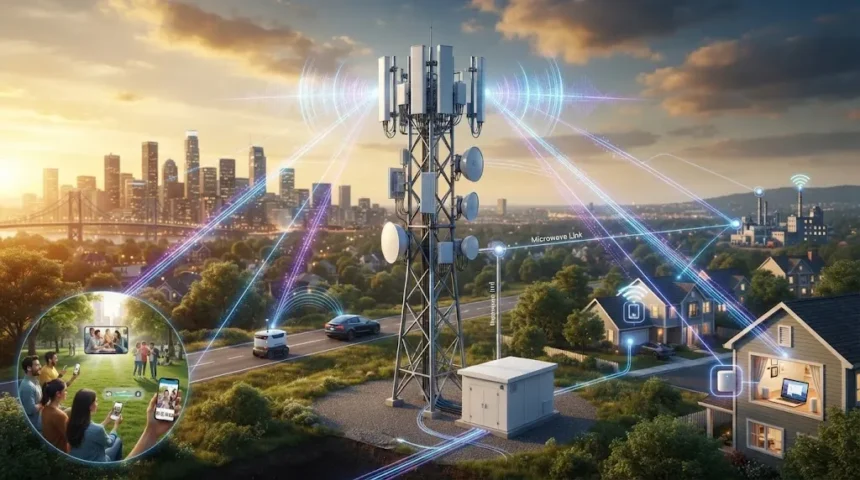
Base Station: How It Works in Wireless Networks
A base station is one of the most important pieces of infrastructure behind modern wireless communication. Whenever you make a mobile call, stream a video over cellular data, send a message, or connect an industrial device to a wireless network, a nearby base station may be handling the radio connection. It acts as the communication bridge between wireless devices and the larger telecommunications network. Base stations transmit and receive radio signals, manage connected devices, allocate network resources, and help users remain connected while moving between locations. Although people often associate them with large cell towers, base stations can also be installed on rooftops, streetlights, buildings, indoor ceilings, and compact poles. Their size and design depend largely on the network they serve.
Modern base stations have evolved considerably as wireless networks have moved from earlier cellular technologies to 4G LTE and 5G networks. Today’s systems can support large numbers of devices, multiple frequency bands, high-speed mobile broadband, low-latency applications, and advanced antenna technologies such as MIMO and beamforming. They also communicate with the operator’s core network through high-capacity backhaul connections, allowing wireless traffic to reach internet services, phone networks, cloud applications, and other users. Understanding how a wireless base station works makes technologies such as cell towers, small cells, 5G gNodeBs, antennas, spectrum, and handovers much easier to understand. This guide explains the complete process in straightforward language while showing how base stations keep wireless networks connected.
What Is a Base Station in a Wireless Network?
A base station is a fixed network installation that communicates wirelessly with mobile phones, tablets, sensors, routers, vehicles, and other compatible wireless devices. In cellular systems, it provides radio coverage to users within a particular geographic area commonly referred to as a cell. The base station receives wireless signals from devices and sends information back to them using assigned radio frequencies. It also connects that local radio traffic to other parts of the telecommunications network. Without base stations, mobile devices would have no nearby infrastructure through which they could access cellular services. In simple terms, your smartphone communicates with the base station, and the base station connects your phone to the wider network.
The term base station can refer to different equipment depending on the wireless technology being discussed. In older GSM cellular systems, the radio equipment was commonly called a Base Transceiver Station, or BTS. Third-generation networks introduced terminology such as NodeB, while 4G LTE uses the term eNodeB, meaning evolved NodeB. In 5G New Radio networks, the corresponding radio access node is generally called a gNodeB, often shortened to gNB. Although their technical architectures differ, all of these systems perform the fundamental job of connecting user equipment to the radio access network. The terminology has changed as network standards have evolved, but the basic relationship between devices and network infrastructure remains recognizable.
A base station should not be confused with the entire cell tower. A cell tower is the physical structure that may support antennas, radio equipment, cables, power systems, and equipment belonging to one or more mobile operators. The base station refers more specifically to the telecommunications equipment responsible for radio communication and network control. Some base stations are installed on traditional towers, but others use antennas attached to rooftops, poles, building facades, stadiums, tunnels, or indoor structures. Modern distributed network designs can separate parts of the base station across different locations. This means a visible antenna may represent only one portion of a much larger radio access system connected through fiber or another high-speed link.
The coverage area served by a base station depends on several factors rather than one fixed distance. Transmission power, antenna height, frequency band, terrain, buildings, trees, network configuration, and environmental conditions can all influence how far radio signals travel effectively. Lower-frequency cellular signals generally travel farther and penetrate many obstacles better than higher-frequency signals, while higher frequencies can provide significant capacity within smaller areas. Urban networks therefore often use many base stations positioned relatively close together. Rural networks may use taller towers and broader cells because users are more widely distributed. Engineers carefully plan these cell locations so users receive enough coverage while radio frequencies are reused efficiently throughout the network.
Base stations are part of the radio access network, commonly abbreviated as RAN. The RAN sits between wireless user devices and the operator’s broader core network, controlling the radio portion of the connection. When your phone connects to cellular service, the base station exchanges signaling information with the device and coordinates access to available network resources. Traffic can then move through backhaul connections toward core network systems that manage mobility, routing, authentication, internet connectivity, and other services. This layered architecture allows operators to serve millions of mobile devices across large geographic regions. The base station therefore performs a local radio function while working continuously with centralized and distributed network components behind the scenes.
How Does a Base Station Work?
The basic process begins when a wireless device searches for compatible network signals in its surrounding area. Cellular base stations regularly transmit information that allows smartphones and other devices to identify available networks and suitable cells. When your device detects an appropriate base station, it evaluates factors such as signal strength, network identity, supported frequency bands, and current network conditions. The phone can then begin procedures required to register or connect with the network. Authentication and security processes help verify whether the device or subscriber is authorized to use the service. Once the necessary signaling is completed, the network can establish the communication resources needed for calls, messaging, internet access, or other services.
Communication between the device and base station takes place through radio waves. Information traveling from the base station toward the user device is generally known as the downlink, while information sent from the device toward the network is called the uplink. When you stream a video, much of the traffic moves through the downlink because large amounts of data are being delivered to your phone. Uploading photographs or conducting certain cloud operations generates more uplink traffic. The base station coordinates how these transmissions use available radio resources so many nearby devices can communicate without creating excessive interference. Sophisticated scheduling systems decide when and how devices can transmit based on factors such as channel conditions, demand, service requirements, and available network capacity.
Radio frequencies are divided into licensed or otherwise allocated portions of the electromagnetic spectrum. Mobile operators use specific frequency bands authorized for cellular communication, and compatible devices are designed to support those bands. The base station uses radio equipment to transmit information through these frequencies while following the technical rules of the network standard. Multiple users can share available spectrum through sophisticated multiplexing and scheduling techniques rather than each requiring a permanently dedicated frequency. Modern LTE and 5G networks dynamically distribute radio resources according to traffic conditions. This efficient sharing allows thousands of users in busy areas to access the network even though available spectrum is limited and extremely valuable.
After the base station receives data from a wireless device, that traffic must travel beyond the local cell. A backhaul network connects the base station or associated radio infrastructure to other parts of the operator’s network. Fiber-optic connections are widely used because they can provide high capacity and low latency, although microwave links and other technologies may also provide backhaul in appropriate locations. From there, traffic passes into core network systems responsible for functions such as routing, authentication, mobility management, policy control, and access to external networks. If you open a website, for example, your request eventually leaves the mobile network and reaches the internet. Response data then follows a return path through the network and base station to your device.
This entire communication cycle can occur in milliseconds without users consciously noticing the underlying steps. Network equipment continually monitors radio quality, interference, device movement, traffic demand, and available capacity while deciding how connections should be managed. If conditions change, the base station may adjust transmission settings or move the device to another frequency resource. When the user travels away from one cell, the network can coordinate a handover to another base station so connectivity continues. Modern wireless networks automate these decisions on a massive scale. The result is the familiar experience of using a phone while walking, driving, or riding public transportation without manually selecting each cell tower encountered along the route.
Key Components of a Wireless Base Station
Antennas are among the most visible components associated with a base station because they transmit and receive electromagnetic radio signals. Traditional cell sites may use large rectangular panel antennas mounted high on towers, rooftops, or poles. The direction and angle of each antenna influence the area it serves, allowing operators to divide coverage into sectors. Many modern sites use advanced antenna arrays capable of supporting multiple-input multiple-output, commonly called MIMO. MIMO technology allows several signal paths to operate simultaneously, helping increase network capacity and improve data performance. In 5G deployments, advanced antennas may include many individual antenna elements that can work together dynamically. Antenna design therefore has a major influence on coverage, speed, capacity, and signal quality.
Radio units generate and process the radio-frequency signals exchanged with user devices. In many modern cell sites, radio equipment is placed relatively close to the antennas to reduce signal losses that would otherwise occur through long radio-frequency cables. These units convert digital information into signals suitable for wireless transmission and perform the reverse operation for incoming signals. They can support specific frequency bands, power levels, and radio technologies depending on the network configuration. A large cell site may contain multiple radio units because operators often serve several frequency bands from one location. Upgrading a cellular network may therefore involve adding new radios and antennas while continuing to operate existing equipment for older technologies.
Another important element is the baseband processing system, which handles many complex digital radio functions. Depending on the network architecture, the baseband unit may process modulation, coding, scheduling, signaling, error correction, and other operations necessary for reliable communication. Traditional deployments often placed baseband equipment inside a cabinet or equipment shelter at the base of a tower. Newer architectures can distribute or virtualize these functions, allowing some processing to occur at centralized or edge computing locations. This evolution helps network operators use computing resources more efficiently and manage large numbers of radio sites. Regardless of physical location, baseband processing remains essential because raw radio signals must be converted into organized digital communication that the network can understand.
Backhaul equipment provides the connection between radio infrastructure and the rest of the telecommunications network. Fiber is often preferred for high-capacity urban and 5G locations because modern radio sites can generate enormous amounts of data. Microwave backhaul remains useful where installing fiber is difficult, expensive, or impractical. Ethernet networking equipment, routers, switches, timing systems, and transport technologies may all form part of the backhaul environment. Precise synchronization is especially important in modern cellular networks because neighboring sites must coordinate radio transmissions accurately. Insufficient backhaul capacity can create a bottleneck even when the radio connection between a device and base station is strong. Good wireless performance therefore depends on both the radio link and the infrastructure behind it.
Power and environmental systems complete the base station infrastructure. Telecommunications equipment requires reliable electricity around the clock, so many sites include backup batteries, generators, or alternative power arrangements for outages. Cooling or ventilation may be necessary because electronic equipment generates heat, particularly in enclosed cabinets or shelters. Monitoring systems can alert network operators when temperatures rise, power fails, equipment malfunctions, or unauthorized access occurs. Lightning protection and grounding are also important because antennas and towers are frequently located in exposed positions. In remote locations, solar power or hybrid power systems may sometimes support telecommunications equipment. These supporting components are less visible to users, but reliable base station operation would be impossible without them.
Base Stations in 4G LTE and 5G Networks
In a 4G LTE network, the primary radio access node is called an eNodeB. Compared with older cellular architectures, LTE simplified parts of the radio access network and gave the eNodeB significant responsibility for managing radio resources. It communicates with user equipment while coordinating scheduling, mobility, and other functions required to maintain efficient connections. The eNodeB also connects to the LTE core network, traditionally known as the Evolved Packet Core. LTE was designed around packet-based communication, making mobile internet access a central part of the network architecture rather than an additional service layered onto voice infrastructure. This design helped enable the high-speed smartphone experience that became standard during the widespread global adoption of 4G.
The 5G equivalent is commonly called the gNodeB, or gNB, which forms a central part of the 5G radio access network. It communicates using 5G New Radio technology and can support a wide variety of deployment scenarios, frequency ranges, antenna systems, and service requirements. 5G base stations are designed to support higher capacity, improved efficiency, lower latency in suitable configurations, and extremely large numbers of connected devices. They may serve smartphones, fixed wireless equipment, industrial systems, sensors, connected vehicles, and other devices. The architecture is also more flexible, allowing network functions to be distributed across different physical or virtual computing platforms. This flexibility makes 5G infrastructure increasingly software-driven compared with many earlier generations.
One highly visible difference between many 4G and 5G deployments involves advanced antenna technology. 5G networks can make extensive use of massive MIMO, where antenna arrays contain many elements that can transmit and receive multiple spatial data streams. These systems can support beamforming, allowing radio energy to be directed more intelligently toward users rather than being distributed equally in every direction. Beamforming can improve signal quality, reduce interference, and increase spectrum efficiency when implemented effectively. LTE also supports MIMO and related techniques, so these concepts are not exclusive to 5G. However, 5G architecture expands their importance, particularly where operators use higher frequencies or need much greater network capacity in densely populated environments.
5G networks can operate across low-band, mid-band, and higher-frequency spectrum, and each range creates different base station requirements. Lower frequencies can provide broad coverage and useful building penetration, making them valuable for widespread service. Mid-band spectrum often offers a balance between coverage and capacity, which makes it important for many modern 5G networks. Much higher frequencies can provide large amounts of bandwidth but typically travel shorter distances and can be more easily affected by physical obstacles. Networks using these frequencies may require denser infrastructure with more closely spaced cells. As a result, there is no single physical appearance for a 5G base station because designs vary substantially depending on spectrum, traffic demand, and deployment goals.
Another major trend is the movement toward cloud-based and virtualized radio access architectures. Instead of keeping every processing function inside dedicated hardware at each tower, operators can separate radio, distributed, and centralized functions across different locations. Concepts such as virtual RAN and Open RAN aim to make parts of the radio access environment more flexible and software-oriented. This can potentially allow operators to use standardized interfaces, centralized management, and general-purpose computing for selected network functions. Traditional integrated base stations remain widely used, so the transition is not simply a replacement of all existing architecture. Future wireless infrastructure will likely combine several deployment models depending on performance, cost, geography, and operational requirements.
Types of Base Stations and Cell Sites
A macrocell base station provides relatively broad cellular coverage and is the type most people associate with traditional cell towers. Macro sites usually operate at higher transmission power than smaller cells and are often installed on tall towers, building rooftops, or other elevated structures. Their larger coverage area makes them useful for highways, suburbs, rural communities, and citywide cellular networks. A single macro site may contain several directional sectors, allowing antennas to divide surrounding areas and reuse radio resources more efficiently. Multiple frequency bands and network generations can operate from the same location. Macro base stations remain essential even as networks become denser because they provide the wide-area coverage layer on which many smaller cells depend.
Small cells are lower-powered cellular base stations designed to cover smaller geographic areas. Operators deploy them where a macrocell alone cannot provide enough capacity, indoor penetration, or consistent coverage. Dense urban streets, shopping districts, transportation hubs, offices, stadiums, and campuses are common environments where small cells can be useful. Because their coverage areas are smaller, multiple units can be placed closer to users and reuse available spectrum more efficiently. Small cells have become particularly important in high-capacity 4G and 5G network strategies. They do not necessarily replace large towers; instead, macro sites and small cells often work together as different layers of the same cellular network.
A microcell generally covers a smaller area than a macrocell but can serve a larger region than very small indoor radio installations. Terminology can vary between vendors and operators, so categories such as macrocell, microcell, picocell, and femtocell should be understood as broad deployment concepts rather than universally fixed sizes. Microcells may be installed on street furniture, shorter poles, building sides, or similar locations where localized coverage is required. They can improve service in busy urban areas where large numbers of users place heavy demands on the network. Lower mounting heights can also position antennas closer to users. Careful radio planning is required so nearby cells provide capacity without creating unnecessary interference with one another.
Picocells are typically designed for relatively small indoor or localized environments such as offices, hotels, shopping centers, hospitals, and transportation facilities. They provide dedicated cellular capacity where signals from outdoor macro sites may be weak or heavily loaded. A building’s concrete walls, metal structures, coated glass, and complex interior layout can significantly reduce outdoor cellular signals before they reach users inside. Installing indoor radio infrastructure brings the network closer to those devices. Large venues may also use distributed antenna systems or more sophisticated indoor cellular designs rather than relying on one small base station. The objective is similar in each case: provide reliable wireless coverage and enough capacity where people are actually using their devices.
Femtocells historically represented very small cellular base stations intended for homes or small businesses, although modern network terminology and deployment strategies have continued to evolve. These devices typically connected back to the mobile operator through an existing broadband internet connection. Their purpose was to improve indoor cellular coverage where the macro network signal was weak. Today, Wi-Fi calling, improved cellular frequencies, indoor small cells, and other technologies can solve some of the same problems. Nevertheless, the femtocell concept demonstrates an important principle of wireless network design: reducing the distance between user equipment and radio infrastructure can greatly improve coverage and capacity. Modern cellular networks increasingly use multiple cell sizes rather than depending exclusively on distant towers.
How Base Stations Manage Coverage, Capacity, and Interference
Coverage describes the geographic area in which users can establish a usable radio connection with a network. A base station’s coverage is shaped by antenna height, radio power, frequency, terrain, buildings, vegetation, and many other factors. Engineers use radio planning tools to estimate how signals will behave before installing new equipment. They may then perform field measurements to verify real-world performance after deployment. Coverage maps therefore represent calculated and measured expectations rather than guaranteeing identical signal quality at every point. Even inside one building, two rooms can experience very different cellular performance because walls, windows, and construction materials affect radio propagation. Effective networks use overlapping cells so users can remain connected despite these variations.
Capacity refers to how much traffic a base station can serve within available spectrum and network resources. A site may provide excellent signal strength but still feel slow when thousands of users are trying to transmit data simultaneously. Stadiums, concerts, business districts, transportation terminals, and festivals frequently create this type of challenge. Operators can increase capacity by adding spectrum, deploying more cells, upgrading antenna systems, improving backhaul, or introducing more efficient radio technologies. Network densification places additional base stations closer to users, allowing the same overall geographic area to be divided into smaller cells. This approach can dramatically increase capacity because spectrum can be reused across locations while each cell serves fewer competing users.
Interference occurs when unwanted radio energy makes it more difficult for receivers to distinguish the intended signal. Cellular networks must manage interference carefully because neighboring cells often reuse the same or nearby frequency resources. If base stations simply transmitted at maximum power in every direction, they could interfere heavily with each other and reduce overall network quality. Engineers therefore adjust antenna orientation, transmission power, frequency planning, scheduling, and other parameters to create a balanced radio environment. Modern networks can also coordinate resource use dynamically. The best-performing network is not necessarily the one with the strongest possible signal everywhere; it is the one that efficiently manages coverage, capacity, and interference together.
Frequency has a major effect on the relationship between coverage and capacity. Lower-frequency radio waves generally propagate farther and can perform better through many obstacles, making low-band spectrum useful for broad coverage and indoor connectivity. Higher frequencies often provide access to wider bandwidths, supporting substantial data capacity, but they may require more closely spaced infrastructure. Mid-band spectrum can offer a useful compromise between these properties. Mobile operators therefore often combine several frequency bands within the same network. Smartphones may switch between them or use multiple carriers simultaneously depending on device capabilities and network configuration. This multi-band strategy allows base stations to provide both extensive geographic coverage and higher capacity where demand is concentrated.
Signal quality also changes as users move, buildings block radio paths, or network traffic increases. Cellular systems continuously measure information about serving and neighboring cells so the network can make better connection decisions. Smartphones report relevant radio measurements, while base stations monitor performance indicators and traffic demand. If another cell offers a more suitable connection, mobility procedures can transfer the device without requiring the user to intervene. Network operators additionally analyze large amounts of performance data to identify weak coverage, congestion, dropped connections, and interference. Optimization therefore continues long after a base station is installed. Wireless networks are dynamic systems that must constantly adapt to user movement, environmental conditions, device capabilities, and changing traffic patterns.
How Handover Keeps Your Phone Connected While Moving
A handover, sometimes called a handoff, occurs when an active mobile connection moves from one cell or base station to another. This is essential because no individual base station can provide unlimited geographic coverage. Imagine making a phone call while driving across a city. As your vehicle moves away from the original cell, its signal becomes weaker while signals from neighboring cells become stronger. The network monitors radio measurements and determines when another cell can provide a more suitable connection. It then coordinates the transfer so communication can continue with little or no noticeable interruption. Without handover technology, mobile sessions would repeatedly disconnect whenever users crossed individual cell boundaries.
The phone plays an important role by measuring signals from both its serving cell and nearby candidate cells. It can report these measurements to the network according to rules established by the cellular system. Signal strength alone is not always enough to determine the best destination because interference, network load, frequency configuration, and mobility policies can also influence the decision. The network may intentionally keep a device on its current cell until certain conditions are satisfied to avoid unnecessary switching. If devices changed cells whenever tiny signal variations occurred, connections could bounce repeatedly between neighboring sites. Handover algorithms therefore balance responsiveness with stability so the radio connection remains efficient.
Handover can also occur between different frequency layers rather than only between neighboring physical towers. A smartphone might move from a high-capacity frequency band to a lower-frequency coverage layer when entering a building or traveling farther from the site. Depending on network architecture and device support, mobility can also involve different cellular technologies. Operators historically needed transitions between 3G, 4G, and other systems as networks evolved. Modern networks increasingly prioritize LTE and 5G combinations, while older technologies are being retired in many regions according to local operator plans. Managing these transitions requires careful coordination because the network must preserve authentication, routing, and ongoing user sessions while changing the underlying radio connection.
High-speed travel creates additional mobility challenges because radio conditions can change extremely quickly. Users on highways and trains may pass through coverage areas much faster than pedestrians, leaving the network less time to prepare each handover. Engineers can tune cell layouts and mobility parameters to reduce dropped connections in these environments. Railway corridors, tunnels, and transportation systems may use dedicated infrastructure to improve consistency. Antenna placement becomes particularly important because physical obstacles can cause sudden changes in signal strength. Modern network equipment can process measurements rapidly and coordinate mobility decisions automatically. Successful handover is one of the reasons users can stream music, navigate with online maps, or participate in calls while traveling across large areas.
Poorly optimized handovers can produce noticeable problems such as dropped calls, stalled video, temporarily lost data sessions, or devices connecting to weaker cells. Too-early handovers may move users before the target cell is ready to provide good service, while late handovers may allow the serving signal to deteriorate excessively. Networks therefore collect performance measurements to identify areas where mobility behavior needs adjustment. Software updates and parameter changes can sometimes improve handover performance without physically modifying tower equipment. In other situations, additional base stations or antennas may be necessary to eliminate a coverage gap. Seamless mobility depends on cooperation between smartphones, base stations, transport networks, and core network functions rather than on a single component.
Why Base Stations Matter for the Future of Wireless Networks
Base stations will remain fundamental as wireless networks support increasing amounts of data and more diverse connected devices. Smartphones continue to demand high-speed connectivity for video, cloud applications, gaming, navigation, and real-time communication. At the same time, cellular networks are increasingly used by security cameras, industrial equipment, smart meters, transportation systems, logistics platforms, and Internet of Things devices. These applications have very different requirements for bandwidth, latency, power consumption, and reliability. Future base station designs therefore need to support more flexible network behavior rather than treating every connection in exactly the same way. Software-controlled radio systems make it possible to optimize resources according to different types of users and services.
Artificial intelligence and automated network management are also becoming increasingly relevant to radio access infrastructure. Modern cellular networks generate enormous amounts of information about traffic patterns, signal quality, interference, equipment health, and user mobility. Automated systems can analyze these patterns and help operators optimize configuration, predict faults, or allocate resources more efficiently. Advanced algorithms may adjust parameters according to changing demand rather than relying entirely on manual engineering decisions. The goal is not simply to increase peak speed but to make networks more efficient and consistent under real-world conditions. As base stations become increasingly software-driven, network performance will depend as much on intelligent control systems as on physical antennas and radios.
Energy efficiency is another major priority because mobile operators operate large numbers of radio sites that consume electricity continuously. Base station equipment must remain available whenever users require connectivity, but network demand changes significantly between busy and quiet periods. More intelligent radio systems can reduce energy consumption by placing selected components into lower-power states when traffic is limited and reactivating resources when demand increases. Newer processors and radio hardware can also improve performance per unit of energy. Renewable power may be valuable for certain remote installations where conventional electricity is expensive or unreliable. Improving energy efficiency can lower operating costs while reducing the environmental impact associated with expanding wireless infrastructure.
Network architecture is likely to continue becoming more distributed, virtualized, and cloud-oriented. Some base station functions that historically required specialized hardware at individual tower locations can increasingly be implemented through software running on shared computing infrastructure. Edge computing can also place processing resources closer to users, potentially reducing latency for applications that require rapid responses. Open interfaces may give operators additional choices when combining equipment and software from different suppliers. These developments do not eliminate physical base stations because radio signals still require antennas and local radio equipment. Instead, they change where intelligence and processing occur within the network, making the boundary between telecommunications equipment and cloud computing increasingly flexible.
Future generations of wireless technology will continue building on the role that base stations already play. Research and standardization work toward technologies beyond 5G is exploring higher efficiency, new spectrum opportunities, more advanced antenna systems, sensing capabilities, artificial intelligence integration, and tighter connections between terrestrial and non-terrestrial networks. Whatever specific features future standards eventually adopt, local radio infrastructure will still be necessary to connect wireless devices with the broader network. Base stations may become smaller, more distributed, more intelligent, and more deeply integrated with computing infrastructure. Understanding today’s base stations therefore provides a useful foundation for understanding tomorrow’s wireless systems. The technology may evolve, but managing radio connectivity, mobility, capacity, and network access will remain essential.
Frequently Asked Questions About Base Stations
What is a base station in simple terms?
A base station is equipment that connects wireless devices such as smartphones to a larger communications network using radio signals. It receives signals from devices, sends signals back to them, and routes their traffic toward the mobile network, internet, or other destinations.
Is a base station the same as a cell tower?
Not exactly. A cell tower is usually the physical structure supporting antennas and telecommunications equipment, while the base station is the electronic and radio equipment responsible for wireless communication and network connectivity.
What is a 5G base station called?
The primary radio access node in a 5G New Radio network is commonly called a gNodeB, or gNB. It communicates with compatible user devices and connects the radio access network to other parts of the 5G network architecture.
How far can a base station transmit?
There is no single fixed distance because coverage depends on frequency, antenna height, transmission power, terrain, buildings, interference, and network design. Large rural macrocells can cover significantly greater distances than small cells installed in dense urban environments.
What does a base station do when you make a phone call?
Your phone first communicates with a nearby base station using radio signals. The base station then connects that communication through the operator’s network while coordinating radio resources, mobility, and other processes required to maintain the call.
Why are multiple base stations needed?
One base station cannot provide unlimited coverage or capacity. Operators deploy many overlapping cells so users can stay connected across large areas while available radio resources are reused efficiently to serve more devices.
What is the difference between a base station and a router?
A cellular base station connects mobile devices through licensed cellular radio technologies such as LTE or 5G, while a typical Wi-Fi router connects nearby devices to a local network using Wi-Fi. Both provide wireless connectivity, but they use different network architectures, spectrum arrangements, coverage models, and management systems.
What is a small cell base station?
A small cell is a low-powered cellular base station designed to provide coverage or additional capacity within a relatively limited area. Small cells are commonly used in dense urban locations, offices, shopping areas, transportation hubs, campuses, and other high-demand environments.
What is MIMO in a base station?
MIMO stands for multiple-input multiple-output and uses multiple antennas or antenna elements to transmit and receive radio signals. It can improve network capacity, reliability, and spectrum efficiency by supporting multiple signal paths and data streams.
How does a phone switch between base stations?
The process is called a handover or handoff. The phone and network measure radio conditions, and when another cell becomes more suitable, the network coordinates the transfer so the connection can continue with minimal interruption.