

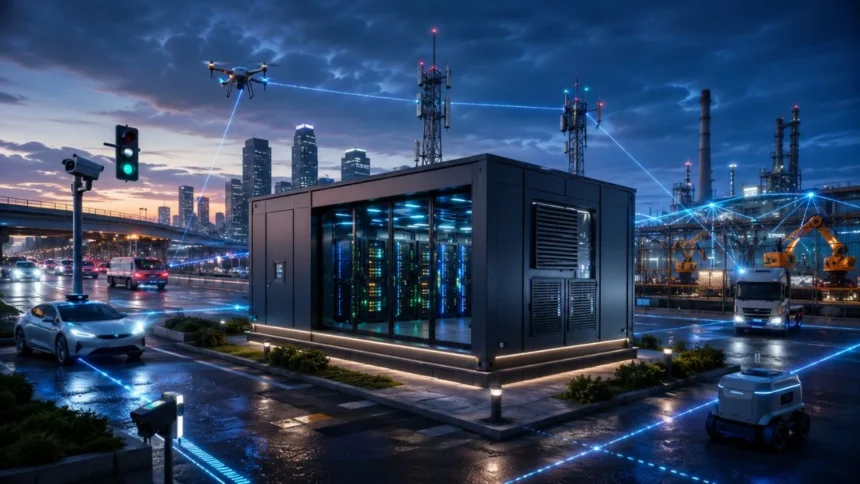
Edge Computing Data Centers: Build Faster Local Processing
Edge computing data centers are smaller, distributed facilities that place computing, storage and networking resources closer to users, devices or the locations where data is generated. Instead of sending every request to a distant central cloud region, organisations can process time-sensitive information locally or at a nearby network site.
This approach can reduce network delay, limit unnecessary data transmission and support applications that need fast or continuous responses. NIST describes edge computing as processing data locally or in a nearby edge data center, while ETSI positions Multi-access Edge Computing as a cloud-capability environment located at the network edge.
Edge data centers can be located inside factories, hospitals, shops, telecommunications facilities, metropolitan areas, transport hubs or remote industrial sites. They range from a few rugged servers inside a cabinet to larger regional facilities containing multiple racks, accelerators, storage systems and resilient network connections.
This guide explains how edge computing data centers work, how they differ from traditional and cloud data centers, and where businesses use them. It also covers latency, 5G, artificial intelligence, IoT, security, cooling, connectivity, management and the main challenges of operating distributed edge infrastructure.
What Is an Edge Data Center?
An edge data center is a computing facility positioned closer to the people, machines or sensors using its services than a conventional central data center. It provides local processing, storage, networking and application capacity while remaining connected to a larger cloud or enterprise environment.
The facility may support one building, industrial site, city, telecommunications network or regional customer base. Some sites operate as near-edge data centers containing substantial computing capacity, while others are micro data centers deployed directly beside machinery, cameras or other operational systems.
Edge computing is better understood as a spectrum than one fixed physical location. Red Hat describes edge architecture as distributed infrastructure extending from core enterprise systems toward near-edge and far-edge devices, with computing occurring wherever data must be collected, processed or used.
The word “edge” therefore depends on the application. A retailer’s edge may be inside each store, a manufacturer’s edge may be on the factory floor, and a telecom operator’s edge may be inside a regional facility close to its radio or fixed-access network.
How Edge Computing Works
A traditional architecture sends most information from devices to a central data center or public cloud. The central platform processes the request, stores the data and sends a response back across the network, which can introduce delay and consume considerable bandwidth.
Edge computing changes this flow by moving selected applications and data closer to their source. An edge server may filter sensor readings, analyse video, run an AI model or control equipment locally, then forward only summaries, alerts or important records to the central cloud.
This does not mean that edge data centers replace the cloud. The cloud may continue to provide central management, long-term storage, large-scale analytics, model training, application delivery and coordination across multiple sites. The edge handles work that benefits from proximity or local continuity.
A Red Hat reference architecture demonstrates this layered approach by processing and normalising sensor telemetry at remote edge locations before forwarding relevant event streams to a core data center for further processing and persistent storage.
Edge Data Centers vs Cloud Data Centers
Cloud data centers usually consolidate enormous quantities of computing and storage inside large regional facilities. This centralisation provides economies of scale, broad service availability and easier resource sharing across many applications and customers.
Edge computing data centers are smaller and more geographically distributed. Their main purpose is not to reproduce every cloud service locally but to place selected capabilities where lower latency, local processing, data control or operational resilience delivers measurable value.
A cloud region may still sit relatively far from a user or industrial site. Microsoft defines an Azure region as one or more data centers connected through a high-capacity, fault-tolerant and low-latency network, typically within a large metropolitan area. Edge zones can extend selected services even closer to particular users or jurisdictions.
Most modern architectures combine both models. The central cloud performs large-scale work and provides unified control, while distributed edge data centers run location-sensitive applications and exchange selected information with the core environment.
Edge Data Center vs Micro Data Center
A micro data center is a compact, self-contained computing environment that may contain servers, storage, networking, power protection, cooling and physical security within one enclosure or a small group of cabinets. It is frequently used as infrastructure for an edge location.
Not every edge data center is a micro data center. A metropolitan edge site may contain numerous racks and operate more like a small regional facility, while a factory edge deployment may consist of only one ruggedised cabinet beside a production line.
Micro data centers are useful where conventional data-center rooms are unavailable. They can bring controlled infrastructure into shops, warehouses, hospitals, mines, telecommunications facilities and remote industrial environments with limited physical space.
The correct size depends on workload demand, redundancy requirements and future growth. Installing too little capacity can create performance problems, while overbuilding hundreds of small sites can increase power, maintenance and capital costs without providing corresponding benefits.
Why Latency Matters
Latency is the time required for data to travel through the network, reach an application, be processed and return a response. Physical distance, network routing, congestion and application design can all affect the delay perceived by a device or user.
Many ordinary websites can tolerate modest network delay, but industrial controls, interactive media, augmented reality, robotics and real-time video analysis may require faster responses. Processing data nearer to the source reduces part of the round-trip journey.
ETSI describes Multi-access Edge Computing environments as providing ultra-low latency, high bandwidth and access to real-time network information. AWS Wavelength similarly places compute and storage inside communications-service-provider networks for applications requiring low latency or greater edge resilience.
Edge infrastructure cannot correct every performance problem. Slow software, overloaded databases and poorly designed networks may still create delays. Organisations should measure the complete response path before assuming that installing a nearby data center will solve the application’s performance issue.
Reduce Bandwidth Usage
Connected cameras, machines and sensors can generate large volumes of raw data. Sending every video frame or measurement to a central cloud may consume considerable network capacity and increase data-transfer or connectivity costs.
An edge computing data center can analyse the raw information locally and forward only what the central system needs. A camera system might send an alert and a short relevant clip instead of continuously uploading every hour of high-resolution footage.
Local filtering can also make central analytics more manageable. Removing duplicate, low-value or routine data at the edge allows the core environment to focus on events that require long-term storage, broader comparison or human attention.
Red Hat notes that edge computing can optimise resources by deploying only the required services and functionality, reducing bandwidth use while allowing remote systems to continue operating when connections to the core data center become unreliable.
Improve Local Resilience
Some businesses cannot stop operating whenever a wide-area internet connection fails. Factories, shops, hospitals, utilities and transport systems may still need local applications, authentication, monitoring or safety controls during temporary network outages.
Edge data centers can keep selected services running locally and synchronise information with the central platform after connectivity returns. This architecture is often described as supporting disconnected, intermittently connected or limited-bandwidth environments.
Google Distributed Cloud is designed for local processing, survivability, low latency and regulatory requirements. Its air-gapped option can operate without connectivity to the public internet, while connected deployments provide cloud-style infrastructure in customer data centers and edge locations.
Resilience still requires careful design. Local databases, identity systems and applications must understand how to operate when central dependencies are unavailable and how to resolve conflicting information after different sites reconnect.
Support Data Residency
Some organisations need information to remain within a particular country, jurisdiction, site or controlled environment. The requirement may arise from legislation, contracts, business policies, customer expectations or the sensitivity of the data being processed.
An edge data center can store or process selected data locally while allowing less sensitive information or aggregated results to move into a central platform. This creates more deployment options than sending every record to the same distant cloud region.
Azure Extended Zones are small-footprint Azure extensions placed in metropolitan areas, industry centres or specific jurisdictions. Microsoft identifies low latency and data residency as key scenarios, with the data plane operating at the extended-zone site while control services remain in the parent region.
Local deployment does not automatically guarantee compliance. Organisations must also consider encryption, backups, administrator access, monitoring records, third-party services and cross-border network paths when determining where data is stored and processed.
Connect Edge Data Centers With 5G
5G networks and edge computing are related but separate technologies. 5G provides mobile connectivity with improved bandwidth and latency characteristics, while edge computing places applications and processing capacity closer to the network’s users and devices.
Telecommunications edge data centers may be located inside carrier facilities, central offices or regional network sites. Applications deployed there can receive traffic without first travelling through a distant central cloud location.
AWS Wavelength extends an AWS virtual private cloud into Wavelength Zones positioned inside communications-service-provider networks. Workloads can run locally for low-latency access while communicating with services operating in the associated AWS Region.
ETSI’s MEC framework extends beyond mobile access and can also support fixed and wireless local-area networks. Its specifications provide a standards-based foundation for exposing edge services and connecting telecommunications, cloud and application ecosystems.
Run AI at the Edge
Artificial intelligence at the edge allows models to analyse information close to where it is generated. Common tasks include object detection, quality inspection, speech processing, predictive maintenance, patient monitoring and the recognition of unusual behaviour.
Local inference can reduce the time between receiving information and taking action. A manufacturing system, for example, may detect a defective item and remove it from the production line without waiting for a response from a distant cloud service.
NVIDIA describes edge AI as running AI applications near users and data sources instead of relying entirely on a central cloud or private data center. Google Distributed Cloud also supports AI-optimised infrastructure and model inference at on-premises and edge sites.
AI workloads can create demanding infrastructure requirements. Graphics processors, model storage, high-speed networking and increased cooling may be needed, while teams must manage model versions, data drift, accuracy and secure updates across numerous locations.
Enable IoT Data Processing
Internet of Things devices collect information from physical environments, including temperature, vibration, movement, location, pressure, energy use and equipment status. A large deployment may contain thousands of devices producing continuous streams of data.
An IoT edge computing architecture places gateways or servers between those devices and the central cloud. These systems can translate protocols, remove duplicate readings, detect anomalies and trigger immediate local actions.
Local processing is particularly useful when machines need rapid responses or produce more data than the available wide-area connection can transport economically. Only selected events, summaries and historical records need to be sent to the central environment.
Red Hat explains that edge computing provides local processing and storage for IoT devices, reducing communication latency and allowing analytics or machine-learning models to support rapid decisions close to the source.
Edge Data Centers in Manufacturing
Factories use edge computing to connect production equipment, cameras, robots, sensors and control systems. Local computing can analyse quality, machine condition, energy consumption and production speed without sending every operational event to a distant data center.
Computer-vision systems may inspect products for defects as they move along a production line. Predictive-maintenance applications can also analyse vibration or temperature readings and warn operators before a machine experiences a serious failure.
Manufacturing sites may need to continue working during intermittent network connectivity. An operational edge platform can preserve essential production applications locally while exchanging reports, models and management data with central systems when connectivity is available.
Red Hat’s edge reference architectures identify manufacturing efficiency, predictive maintenance and AI-supported quality control as use cases that benefit from processing data closer to industrial operations.
Retail Edge Data Centers
Retailers may deploy edge infrastructure inside individual shops, shopping centres or regional distribution sites. Local systems can support checkout, inventory tracking, digital signage, loss prevention and customer analytics.
A store should not necessarily lose its entire operating capability because its cloud connection is temporarily interrupted. Edge servers can allow selected sales, stock and authentication processes to continue before synchronising records with the central system.
Video and sensor data can also be processed locally to identify shelf availability, queues or equipment failures. Keeping high-volume raw data inside the store can reduce bandwidth requirements and provide faster operational alerts.
Google states that its distributed cloud platform can scale from one to thousands of retail locations and support store analytics, faster checkout and predictive analytics through centrally managed edge deployments.
Healthcare Edge Computing
Healthcare organisations generate sensitive and time-critical information through imaging systems, monitoring equipment, laboratories and connected medical devices. Edge computing can allow selected processing to take place inside hospitals, clinics or diagnostic facilities.
Medical-imaging applications may use local acceleration to analyse scans without first transferring very large files across a distant network. Local systems can also support rapid alerts from patient monitors and maintain critical functions during connectivity interruptions.
Healthcare deployments need strict security, access control and lifecycle management. The organisation must protect both patient information and the availability of systems used during diagnosis, treatment and clinical operations.
Red Hat identifies edge medical diagnosis as a reference use case in which AI and machine learning analyse medical imagery close to healthcare facilities, reducing the distance between the data source and the diagnostic workload.
Smart Cities and Transportation
Cities and transport operators collect information from traffic signals, cameras, public transport, parking systems and environmental sensors. Processing some of this data locally can support faster decisions and reduce the volume sent to a central platform.
An edge system may adjust traffic signals, identify an incident or manage passenger information close to the location where the event occurs. Regional edge data centers can coordinate several intersections, stations or transport corridors.
Connected vehicles and interactive mobility applications may also benefit from telecommunications edge infrastructure. Lower network delay can support applications that exchange rapidly changing information between vehicles, users and transport systems.
ETSI identifies multiple edge deployment models extending from on-premises facilities to network-edge sites, while NVIDIA lists smart cities, autonomous systems and real-time operational intelligence among the applications supported by edge computing.
Edge Data Center Architecture
A typical edge computing architecture contains devices, local networking, edge servers, storage, management tools and connections to a central data center or cloud. Workloads are placed at the level that best matches their latency, data and resilience requirements.
The control plane may remain central while application data is processed locally. This arrangement allows one management platform to deploy software, apply policies and monitor geographically separated sites without requiring a complete administrative team at every location.
Red Hat’s distributed compute node model uses central controllers with remote compute and optional storage at individual edge sites. Images and data can be cached locally to avoid repeatedly downloading large resources across wide-area links.
Architecture planning should identify which functions must remain local, which can tolerate cloud latency and which require both. Placing every application at the edge can create unnecessary cost and management complexity, while centralising everything may undermine the reasons for adopting edge computing.
Design the Physical Facility
Edge data center design begins with the expected workload, physical environment and availability target. The facility must provide sufficient compute, storage, networking, power and cooling within a location that may have limited space and no permanent technical staff.
Environmental conditions can be more challenging than those inside a conventional data center. Edge equipment may face dust, vibration, heat, moisture, limited airflow, public access or industrial electrical conditions, requiring suitable cabinets and hardware.
Power protection may include uninterruptible power supplies, redundant feeds, generators or controlled shutdown procedures. The appropriate level depends on whether the site supports customer convenience, financial transactions, industrial production or safety-critical operations.
Capacity planning should include future application growth and hardware refreshes without overbuilding every location. Modular designs can allow additional servers, storage or acceleration to be added only where demand develops.
Cooling Edge Infrastructure
Servers and AI accelerators produce heat that must be removed reliably. A small edge room may not have the advanced cooling systems found in a hyperscale data center, so the thermal design must match the equipment density and surrounding climate.
Some sites can use conventional room cooling, while compact or high-density deployments may need in-row, cabinet-level or liquid-assisted cooling. Filters and sealed cabinets may be necessary in dusty factories, warehouses or outdoor environments.
Cooling failure should generate immediate alerts because remote sites may not have local technicians who notice rising temperatures. Automated workload reduction or a safe shutdown process can help protect equipment when environmental conditions become unsafe.
AI edge data centers require particular attention because accelerators can increase rack density significantly. Infrastructure teams should confirm power and thermal capacity before selecting the computing platform rather than attempting to accommodate the hardware after installation.
Secure Edge Data Centers
Edge environments increase the number of physical and digital locations an organisation must protect. A central data center may have full-time guards and controlled access, while an edge server could be installed inside a shop, factory or remote communications facility.
Security should include locked enclosures, access monitoring, secure boot, encrypted storage, identity controls, network segmentation and centrally managed software updates. Sensitive keys and credentials should not remain exposed on devices that could be stolen or physically accessed.
NIST states that securing the physical platform should form the foundation of a layered data-center and edge-computing security strategy. Hardware-backed technologies such as trusted platform modules, secure enclaves and trusted execution environments can strengthen platform and data protection.
ETSI’s ongoing MEC work includes security, interoperability and API standards for edge clouds. By June 2026, ETSI had published updated Phase 4 terminology, use-case and edge-resource specifications, reflecting the continued development of standardised edge platforms.
Manage Thousands of Edge Sites
Operating one edge data center is relatively straightforward compared with maintaining hundreds or thousands of sites. Manual software installation and site-by-site configuration quickly become expensive, inconsistent and difficult to audit.
A central management platform should automate provisioning, configuration, security policies, updates and application deployment. Administrators also need visibility into hardware health, storage use, network quality, temperature and application performance.
Edge sites must tolerate delayed updates and intermittent connectivity. Deployment tools should support staged rollouts, resumable downloads and automatic recovery so that one unreliable connection does not leave a site in an unusable state.
Google Distributed Cloud supports centrally managed deployment from one to thousands of locations, while Red Hat’s edge architecture emphasises consistent application management, policies and lifecycle control across dispersed clusters.
Monitor Edge Performance
Monitoring should cover both the physical facility and the applications running inside it. Important measures include power, temperature, storage health, network latency, packet loss, service availability and application response time.
Because edge sites may have limited connectivity, monitoring systems should store important events locally and forward them when the network becomes available. Critical alerts may require a separate communication path when the primary connection fails.
Teams should define thresholds according to the purpose of each site. A minor increase in latency may be acceptable for background analytics but unacceptable for an industrial safety response or interactive customer application.
Central dashboards should help operators identify patterns across the complete fleet. Repeated failures at several similar locations may indicate a design, software or environmental issue rather than isolated hardware problems.
Edge Computing Challenges
The largest challenge is operational scale. Distributed data centers multiply the number of networks, devices, power systems and physical locations that require management, security and maintenance.
Edge capacity is also more limited than central-cloud capacity. Applications may need to run within tighter processor, storage and power restrictions, and replacement equipment may take longer to reach remote facilities.
Data consistency creates another challenge. Local systems can continue operating during disconnection, but the organisation needs rules for synchronising changes and resolving conflicts after the connection returns.
Security, cost and skills should be evaluated before deployment. An edge project may reduce latency and bandwidth while increasing hardware, field-service and management expenses, so the business case must measure the complete operational effect.
How to Choose an Edge Location
Begin by identifying the performance problem the location must solve. Measure current application latency, network usage, outage impact and data-residency requirements before deciding where edge infrastructure should be placed.
A suitable location should be close enough to users or data sources to produce a meaningful benefit. It must also provide reliable connectivity, physical security, power, cooling and access for approved maintenance personnel.
Compare on-premises, telecommunications-edge and metropolitan-edge options. AWS Wavelength places resources inside carrier networks, Azure Extended Zones provide small regional footprints, and distributed cloud platforms can extend managed infrastructure into customer facilities.
Select the smallest number of locations that meets the application’s requirements. Unnecessary sites create additional cost and management work, while too few sites may fail to deliver the latency, resilience or jurisdictional coverage expected from the project.
Edge Data Center Trends in 2026
Edge infrastructure in 2026 is increasingly connected with artificial intelligence, private networking, data sovereignty and cloud-native management. Organisations are seeking consistent platforms that can operate across central clouds, private data centers and remote edge locations.
ETSI continued expanding its MEC framework through updated Phase 4 specifications published during 2025 and 2026. These standards address terminology, use cases, edge-resource exploitation and client-facing API gateways, supporting greater interoperability across edge-cloud ecosystems.
Public cloud providers are also extending more services beyond their traditional regions. Azure Extended Zones support selected virtual machines, containers, storage and networking services, while Google Distributed Cloud combines local infrastructure with Kubernetes and AI capabilities.
The direction is not simply toward replacing central cloud regions with small data centers. The emerging model is a coordinated computing continuum in which devices, edge facilities, metropolitan sites and central clouds each handle the work they can perform most efficiently.
Conclusion: Place Computing Where It Adds Value
Edge computing data centers bring processing, storage and networking closer to users and data sources. This proximity can reduce latency, control bandwidth use, support local resilience and help organisations satisfy specific data-location requirements.
Their strongest use cases involve time-sensitive or high-volume data, including manufacturing, retail, healthcare, transportation, telecommunications, AI and IoT. The central cloud still remains important for long-term storage, broad analytics, model training and fleet-wide management.
A successful edge strategy requires more than installing small servers in remote locations. Organisations must plan power, cooling, security, networking, application placement, monitoring and lifecycle management across the complete distributed environment.
Begin with a measurable operational need and select the edge locations that solve it most efficiently. When edge and cloud resources are coordinated carefully, businesses can process information faster without creating unnecessary infrastructure at every possible location.
Frequently Asked Questions
What are edge computing data centers?
Edge computing data centers are distributed facilities that place compute, storage and networking resources near users, devices or data sources. They process selected workloads locally while remaining connected to central cloud or enterprise systems.
What is the main benefit of an edge data center?
The main benefit is proximity. Shorter network paths can reduce latency, improve local resilience and prevent large quantities of raw sensor or video data from being transmitted to a distant cloud.
Is an edge data center the same as a micro data center?
Not always. A micro data center is a compact physical facility often used at the edge. Edge data centers can range from one self-contained cabinet to a larger metropolitan or telecommunications facility.
Does edge computing replace cloud computing?
No. Edge and cloud computing normally work together. The edge handles local, time-sensitive processing, while the cloud provides central management, large-scale analysis, long-term storage and coordination.
What industries use edge data centers?
Manufacturing, telecommunications, healthcare, retail, transport, energy and smart-city organisations commonly use edge infrastructure. Typical applications include AI inference, video analysis, IoT monitoring and industrial automation.