

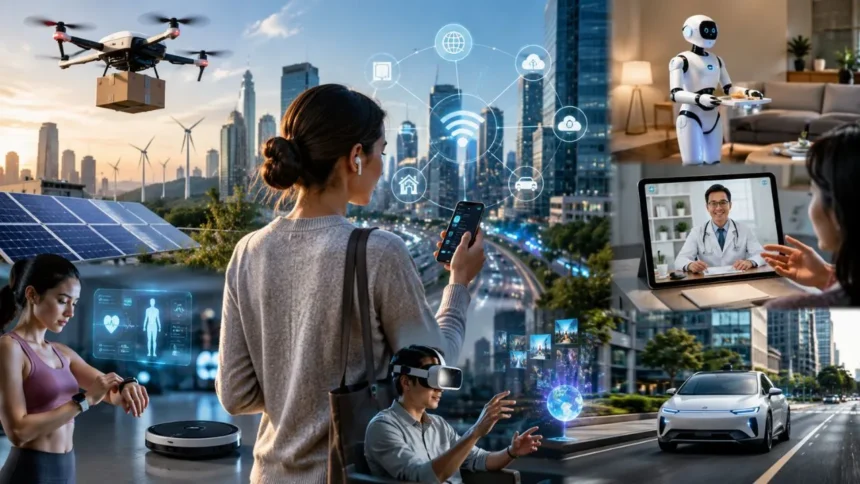
Technology Trends Changing Everyday Life in 2026
Technology no longer feels like something people use only at work or during special tasks. It now shapes how we communicate, shop, travel, manage money, monitor health, and control our homes. Many digital tools have become so familiar that we barely notice how deeply they influence our daily routines.
The most important technology trends are not always the inventions that look the most futuristic. They are often the practical improvements that save a few minutes, reduce effort, improve access, or help people make better decisions. A smarter payment system or health-tracking watch may change daily life more quickly than an experimental machine.
Artificial intelligence, wearable technology, smart home devices, electric vehicles, augmented reality, and digital payments are developing at the same time. These technologies are also becoming more connected, allowing information to move between devices and services. The result is a more personalized and automated digital environment.
However, convenience is only one side of this transformation. People must also think about privacy, cybersecurity, affordability, reliability, and the effect of automation on human skills. Understanding the technology trends changing everyday life helps consumers enjoy their benefits without ignoring the risks.
Why Technology Is Becoming More Personal
Modern technology is becoming more personalized because digital services can learn from a person’s preferences, routines, location, and previous actions. Streaming platforms suggest entertainment, shopping apps recommend products, and navigation tools adjust routes according to traffic. These systems try to reduce the time people spend searching and deciding.
Personalization is also moving beyond simple recommendations. Devices can now adjust lighting, temperature, notifications, exercise goals, and accessibility settings according to individual needs. Instead of expecting every user to follow the same experience, technology increasingly adapts itself to different lifestyles and situations.
This shift is changing what people expect from digital products. Users want technology to understand context, work across several devices, and provide useful information without requiring repeated instructions. A service that remembers preferences and completes routine steps can feel more valuable than one offering many complicated features.
Greater personalization also means that companies may collect more information about users. Location history, voice recordings, health measurements, browsing behavior, and purchasing habits can reveal sensitive details. People therefore need to examine privacy controls and understand what information a device stores, shares, or uses for automated decisions.
Artificial Intelligence Is Moving From Answers to Actions
Artificial intelligence has quickly become one of the biggest technology trends changing everyday life. People already use generative AI to write emails, summarize documents, translate languages, plan meals, learn new skills, and organize ideas. These tools are making advanced digital assistance available to ordinary users.
The next development is the rise of AI agents that can perform multi-step tasks rather than only provide an answer. An AI assistant may compare information, organize files, prepare a report, manage a repeated workflow, or take action through connected tools. This represents a shift from conversational AI toward more practical task completion.
AI is also becoming built into phones, computers, search tools, customer service platforms, and workplace software. Instead of opening a separate application, users may receive AI support while reading, writing, shopping, editing photos, or attending meetings. This integration will make artificial intelligence feel less like a separate product.
Despite its usefulness, AI can produce inaccurate, incomplete, or misleading information. People should review important results, protect confidential data, and avoid allowing automated tools to make high-stakes decisions without oversight. The most effective approach is to treat AI as a capable assistant rather than an unquestionable authority.
Smart Homes Are Becoming Easier to Connect
Smart home technology is moving from individual gadgets toward complete connected systems. Lights, thermostats, locks, cameras, speakers, appliances, and energy monitors can increasingly communicate through shared platforms. This allows users to control several household functions without switching between numerous unrelated applications.
The Matter connectivity standard is helping manufacturers improve compatibility between smart home products. Matter 1.5 expanded support to additional device categories, including cameras, closures, soil sensors, and energy management capabilities. Greater interoperability may make connected home technology easier to install, manage, and expand.
Automation is one of the most useful features of a smart home. Lights can turn off when rooms are empty, doors can send alerts when left open, and thermostats can reduce energy use during certain hours. These small actions can improve comfort, accessibility, security, and household efficiency.
Smart devices can also collect information about routines inside private spaces. Cameras, microphones, sensors, and connected appliances may create security risks when poorly configured or left without updates. NIST recommends planning before buying, enabling authentication, updating devices, and checking privacy settings to create a safer connected home.
Wearable Technology Is Changing Personal Healthcare
Wearable technology has grown beyond basic step counting. Smartwatches, fitness bands, rings, patches, and other connected health devices can monitor movement, sleep patterns, heart rate, temperature changes, and additional wellness indicators. These measurements help people understand patterns that may otherwise remain unnoticed.
The value of health wearables comes from long-term information rather than one isolated measurement. A person may notice changes in sleep, activity, recovery, or resting heart rate over several weeks. This can encourage healthier routines and help users communicate more clearly with qualified healthcare professionals.
Digital health tools are also supporting telemedicine and remote patient monitoring. Healthcare providers may use connected devices to follow certain measurements between appointments, particularly when distance makes regular visits difficult. The World Health Organization continues to examine how wearable devices can be used responsibly in health measurement and population monitoring.
Wearables should not be treated as replacements for medical diagnosis. Consumer devices can produce inaccurate readings because of movement, fit, skin contact, software limitations, or other factors. Users should discuss unusual or worrying results with a healthcare professional instead of relying entirely on an application.
Augmented Reality Is Blending Digital and Physical Spaces
Augmented reality places digital information over a person’s view of the physical world. The technology already appears in navigation, shopping, gaming, education, home design, and mobile camera applications. It can help users understand information by showing it within the environment where it matters.
For example, shoppers may preview furniture inside a room before making a purchase. Travelers can receive directions over a street view, while technicians may see instructions placed beside equipment. Students can explore interactive models that make difficult scientific, medical, or historical concepts easier to understand.
Smart glasses and mixed-reality headsets are expected to make these experiences more natural. Google has described Android XR as a platform connecting artificial intelligence with glasses and headsets, allowing digital assistance to appear within the user’s surroundings. This combination could make computing less dependent on traditional screens.
Widespread adoption will depend on comfort, price, battery life, social acceptance, and privacy. Glasses containing cameras and microphones may make nearby people uncomfortable if recording is unclear. Developers will need to create transparent signals and strong privacy controls before wearable augmented reality becomes an ordinary part of public life.
Digital Payments Are Making Transactions Faster
Digital payments have changed how people purchase products, split bills, send money, and manage everyday expenses. Contactless cards, mobile wallets, QR codes, banking applications, and instant payment systems reduce the need to carry physical cash. Many transactions can now be completed within seconds.
Mobile payment technology can also improve financial access. People who have limited access to traditional banking services may use phones to receive payments, pay bills, or manage small businesses. The Bank for International Settlements notes that smartphone use and mobile internet access have supported the rapid digitalization of retail payments.
Payments are becoming more closely connected with identity verification, loyalty programs, transportation, and online shopping. A phone or wearable device may act as a wallet, ticket, membership card, and authentication tool. This consolidation offers convenience but makes account security increasingly important.
Users should protect payment applications with strong authentication, transaction alerts, and device locks. Unexpected QR codes, urgent payment requests, fake shopping sites, and impersonation messages should be treated cautiously. Faster payment systems can also transfer money to scammers more quickly when users fail to verify a request.
Electric Vehicles Are Reshaping Everyday Travel
Electric vehicles are becoming a more visible part of everyday transportation. Improvements in batteries, charging infrastructure, vehicle choice, and energy management are making electric mobility practical for more drivers. Electric cars are also changing how people think about fuel costs, maintenance, and home energy use.
The International Energy Agency expects global electric car sales to reach approximately 23 million during 2026, representing about 28% of total car sales. Although adoption differs significantly between regions, these figures show that electric vehicles are moving closer to the mainstream global car market.
Electric mobility is not limited to passenger cars. Electric bicycles, scooters, buses, delivery vans, and small urban vehicles are influencing how people travel through crowded cities. These options may reduce short car journeys and provide flexible transportation for commuters who do not need a full-sized vehicle.
Charging access remains an important challenge. Apartment residents, long-distance drivers, and people living in areas with limited infrastructure may find electric vehicles less convenient. Future progress will depend on reliable public chargers, faster charging, affordable models, stronger electrical grids, and responsible battery recycling.
Robotics and Automation Are Entering Ordinary Environments
Robots have been used in factories for decades, but new forms of automation are entering homes, hospitals, restaurants, warehouses, farms, and public spaces. Robot vacuums and lawn tools already handle repetitive household chores. More capable machines may eventually assist with cleaning, carrying objects, and routine maintenance.
In workplaces, automation can complete repetitive physical or digital tasks with greater speed and consistency. Warehouses use robots to move goods, while software automation processes forms, organizes data, and handles repeated administrative steps. These systems can allow workers to focus on judgment, creativity, and personal interaction.
Healthcare and care environments may also benefit from robotics. Machines can move supplies, support rehabilitation exercises, disinfect rooms, or assist people with limited mobility. However, human supervision remains important when technology works around patients, older adults, children, or other vulnerable individuals.
The effect of automation on employment will differ between industries and job roles. Some tasks may disappear, while others will be redesigned or created. Workers will increasingly need adaptable skills that combine technical understanding with communication, problem-solving, emotional intelligence, and professional judgment.
Sustainable Technology Is Changing Energy Use
Sustainable technology is becoming more important as households and businesses try to control energy costs and environmental impact. Solar panels, home batteries, heat pumps, smart thermostats, and energy-monitoring systems provide more control over how electricity is generated, stored, and consumed.
Smart energy tools can identify waste that is difficult to notice through a monthly bill. They may show which appliances use the most electricity or move certain tasks to periods when energy is cheaper. Connected systems can also coordinate heating, cooling, charging, and household battery use.
Technology companies are also under pressure to make devices more durable and repairable. Frequent upgrades create electronic waste and require additional raw materials, manufacturing, and transportation. Longer software support, replaceable components, responsible recycling, and refurbished products can reduce unnecessary consumption.
Not every product marketed as green provides a meaningful environmental benefit. Consumers should look beyond advertising and consider durability, total energy use, repair options, manufacturing, and disposal. Sustainable technology works best when it reduces resource use instead of encouraging people to replace functioning products more frequently.
Cybersecurity Is Becoming an Everyday Responsibility
As more daily activities move online, cybersecurity is no longer a concern only for technology professionals. Personal accounts may contain financial details, private conversations, health information, documents, photographs, and location data. One compromised password can provide access to several connected services.
Phishing attacks are also becoming more convincing. Criminals can use artificial intelligence to create realistic emails, voices, images, and messages that imitate trusted people or organizations. Users must verify unexpected requests through a separate communication channel, particularly when money or sensitive information is involved.
Basic security habits remain highly effective. Unique passwords, password managers, multifactor authentication, software updates, device locks, and secure backups reduce common risks. People should also review application permissions and remove unused services that continue collecting personal information.
Regulation is beginning to address some concerns surrounding artificial intelligence. From August 2, 2026, EU transparency rules require disclosure in specified situations involving AI interaction or generated and manipulated content. These measures reflect a growing demand for clearer identification and more accountable technology.
Technology Is Changing Education and Skill Development
Digital learning has made education more flexible and accessible. Students and professionals can watch lessons, join virtual classes, practise skills, and receive feedback from almost any location. Online resources also allow people to learn at different speeds instead of following one fixed classroom schedule.
Artificial intelligence can provide personalized explanations, generate practice questions, and help learners identify weaknesses. Translation and accessibility tools can support students who face language, hearing, vision, or mobility barriers. These technologies may make education more inclusive when they are designed and used responsibly.
However, easy access to AI-generated answers can weaken learning when users avoid thinking through a problem. Education must focus on understanding, reasoning, research, communication, and source evaluation. Knowing how to question an answer may become as important as remembering the answer itself.
Digital access remains unequal across regions and income groups. Reliable internet, suitable devices, electricity, teacher training, and accessible content are necessary before technology can improve learning fairly. Educational innovation should reduce barriers rather than create better opportunities only for people who can afford the newest tools.
Online Shopping Is Becoming More Interactive
Online shopping is becoming more personalized, visual, and convenient. Recommendation systems use browsing and purchase behavior to suggest relevant products, while virtual tools help shoppers preview clothing, makeup, furniture, and decorations. These features try to reduce uncertainty before a purchase.
Conversational shopping assistants may help users compare features, understand technical specifications, or find products matching a budget. Instead of searching through hundreds of listings, a shopper can describe a need in ordinary language. The quality of the recommendation still depends on accurate information and transparent commercial relationships.
Faster delivery and automated checkout have also changed consumer expectations. People increasingly expect real-time stock information, flexible payment methods, simple returns, and accurate delivery tracking. Retailers are using automation and data analysis to manage these services more efficiently.
Convenience can encourage unnecessary spending or reduce the time people spend evaluating a purchase. Personalized offers, countdown timers, and one-click checkout may create pressure to act quickly. Consumers can protect themselves by comparing prices, checking independent reviews, and allowing time before making expensive decisions.
How Technology Is Changing Communication
Digital communication has become faster, more visual, and less dependent on physical distance. Video calls, messaging platforms, shared documents, and online communities allow people to collaborate across cities and countries. Families, businesses, and social groups can maintain regular contact more easily.
Translation tools are reducing language barriers in written and spoken communication. Real-time captions, voice transcription, and accessibility features can also help people with hearing difficulties or different communication needs. These improvements make digital conversations available to a wider range of users.
AI-generated text and media are changing how messages are created. People can polish writing, summarize discussions, produce images, and adapt content for different audiences. However, automated communication may feel impersonal when it replaces genuine attention, empathy, and individual thought.
Constant connectivity can also create stress. Notifications, group messages, workplace platforms, and social networks may make people feel that they must always be available. Healthy technology use requires boundaries, such as quiet hours, notification controls, screen-free activities, and clear expectations about response times.
The Challenges Behind Rapid Technological Change
New technology often arrives faster than rules, institutions, and social habits can adapt. A useful tool may introduce unexpected effects on privacy, employment, safety, education, or mental well-being. Early excitement should therefore be balanced with careful evaluation and realistic expectations.
Affordability is another challenge. Premium smart devices, electric vehicles, high-speed internet, and advanced healthcare technology may remain unavailable to many people. When important services become digital by default, individuals without reliable access can face additional barriers.
Compatibility and product support also affect long-term value. A connected device may become less useful when a company stops providing updates or closes its service. Consumers should consider software support, repairability, data portability, and offline functions before investing in expensive technology.
People also need time to develop new skills. A poorly understood tool may create more work, confusion, or risk instead of improving daily life. Successful digital transformation requires useful design, clear instructions, human support, and technology that solves a genuine problem.
How to Use New Technology More Wisely
The best technology is not necessarily the newest product. It is the tool that solves a real problem without adding unnecessary cost, complexity, or risk. Before buying a device or joining a service, users should identify exactly what they expect it to improve.
Privacy and security should be considered before setup rather than after an incident. Check whether the manufacturer provides updates, explain how data is used, and offer meaningful controls. Devices requiring unnecessary permissions or permanent cloud access deserve additional caution.
Users should also avoid becoming completely dependent on automation. Important information should be backed up, critical decisions should receive human review, and basic skills should be maintained. Technology is more valuable when it supports human ability instead of removing understanding and control.
Finally, people should review their digital tools regularly. Unused subscriptions, unnecessary notifications, outdated devices, and forgotten accounts can create expense and security risks. A simpler digital environment is often safer, easier to manage, and more useful than one filled with disconnected applications.
Final Thoughts on Technology Trends Changing Everyday Life
The technology trends changing everyday life are making homes, transportation, healthcare, education, communication, and shopping more connected. Artificial intelligence is becoming more capable, wearable devices are collecting richer information, and digital services are increasingly able to respond to personal needs.
These developments can save time, improve access, and create experiences that once seemed impossible. Smart homes can manage energy automatically, digital health tools can reveal useful patterns, and electric mobility can provide new transportation choices. The greatest value comes from improvements that feel practical and inclusive.
At the same time, every new convenience introduces questions about data, security, fairness, reliability, and control. People should understand what technology is doing on their behalf and what information it requires. Trust should come from transparency and responsible design rather than impressive marketing.
The future of everyday technology will not be defined by devices alone. It will be shaped by how people choose, regulate, and use those devices. When innovation supports human needs while respecting safety and privacy, technology can improve daily life without taking control away from the people it serves.
Frequently Asked Questions
What technology trend is having the biggest impact on everyday life?
Artificial intelligence is currently one of the most influential trends because it is being integrated into phones, computers, search tools, workplaces, shopping platforms, and customer services.
How is artificial intelligence changing daily routines?
AI helps people write, research, translate, plan, organize information, and automate repeated tasks. New AI agents can also complete multi-step actions through connected digital tools.
What are examples of technology used in everyday life?
Common examples include smartphones, digital payments, wearable fitness trackers, smart home devices, navigation apps, streaming platforms, electric vehicles, telemedicine, and AI assistants.
Are smart home devices safe to use?
Smart home devices can be used safely when owners choose trusted products, install updates, enable strong authentication, protect Wi-Fi networks, and review privacy and data-sharing settings.
What technology trends will grow in the future?
AI agents, mixed reality, smart glasses, healthcare wearables, home robotics, electric mobility, connected energy systems, and privacy-focused digital services are likely to continue developing.