

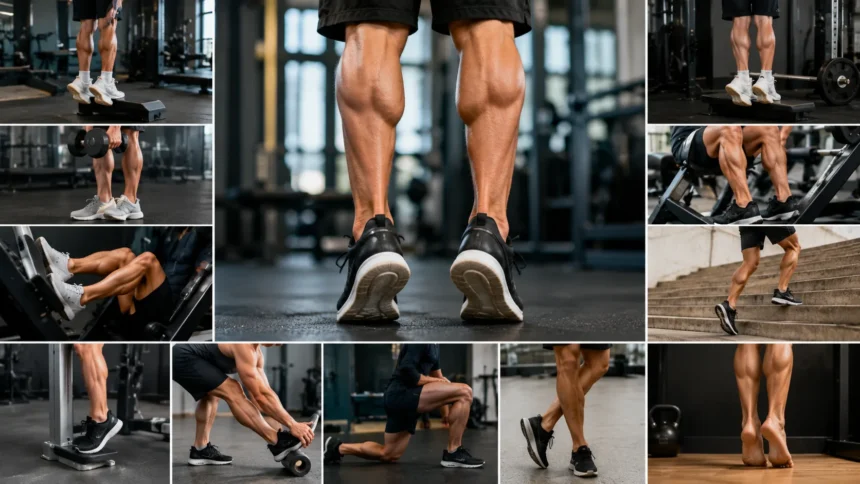
12 Best Calf Exercises to Build Strength and Size
Strong, well-developed calves do more than improve the appearance of your lower legs. They contribute to walking, running, jumping, balance, ankle stability, and force transfer through the lower body. The calf complex is made up primarily of the gastrocnemius and soleus, with the gastrocnemius creating much of the visible shape and the soleus sitting deeper beneath it. Because these muscles work differently depending on knee position, an effective calf routine should include both straight-leg and bent-knee exercises. If your goal is to build strength and size, relying on only one standing calf raise variation is usually not enough.
The best calf exercises challenge the muscles through a full range of motion, allow progressive overload, and fit your training level. Heavy standing calf raises can help build strength in the gastrocnemius, while seated calf raises emphasize the soleus more strongly because the knee is bent. Single-leg variations can expose strength differences, and loaded carries, sled work, and jumping drills can make the calves more athletic. Research on resistance training also consistently supports progressive overload, sufficient weekly training volume, and training close enough to muscular fatigue as key factors in muscle growth. The exercises below combine those principles into a practical calf-training approach.
How the Calf Muscles Work
The calf is not one single muscle, which is why different exercises feel different even when they all involve rising onto the toes. The gastrocnemius is the larger superficial muscle that forms the visible upper portion of the calf. It crosses both the knee and ankle joints, which means its ability to produce force changes depending on whether the knee is straight or bent. When the knee is relatively straight, the gastrocnemius contributes strongly to plantarflexion, the movement that points the foot downward. This is why standing calf raises are usually considered a primary exercise for building visible calf size.
The soleus sits underneath the gastrocnemius and contributes significantly to lower-leg thickness. Unlike the gastrocnemius, it does not cross the knee joint, so bending the knee reduces the mechanical contribution of the gastrocnemius and shifts more emphasis toward the soleus. Seated calf raises are therefore valuable if your goal is complete calf development rather than only the most visible upper portion. A well-rounded routine should train both knee positions. This also helps build endurance because the soleus plays an important role in standing and walking for long periods.
The Achilles tendon connects the calf muscles to the heel and transfers force during walking, running, and jumping. This tendon stores and releases elastic energy, which is one reason calf strength matters for athletic movement. Training the calf through controlled resistance can improve the muscle’s ability to produce force, while explosive activities challenge the muscle-tendon unit differently. However, explosive work should not replace progressive strength training when the main goal is hypertrophy. Jumping and plyometrics are better viewed as complementary athletic training rather than the only route to larger calves.
Ankle range of motion also affects calf training quality. If you perform calf raises from a completely flat surface, you may not reach as much dorsiflexion at the bottom as you would when the forefoot is elevated on a step or machine platform. Allowing the heel to lower under control can create a larger stretch on the calf. Research on resistance training increasingly suggests that training muscles at longer lengths can be useful for hypertrophy, although the exact ideal range varies by movement and muscle. For practical purposes, using a controlled full range of motion is usually better than bouncing through short partial repetitions.
The calves are also active during many compound movements and everyday tasks, which helps explain why they can be stubborn for some lifters. They are exposed to frequent low-level activity during walking and standing, so a small amount of casual calf work may not provide enough new stimulus to force adaptation. That does not mean calves are genetically impossible to grow. It means they usually respond best to intentional loading, sufficient volume, consistent progression, and both heavy and moderate-repetition work.
1. Standing Calf Raises
Standing calf raises are one of the simplest and most effective exercises for building calf size and strength. Because the knees remain relatively straight, the gastrocnemius contributes strongly throughout the movement. You can perform the exercise using a calf-raise machine, Smith machine, barbell, dumbbells, or even body weight. The basic movement is the same: rise onto the balls of your feet by pushing the heels upward, squeeze briefly near the top, and then lower under control. The exercise becomes more effective when you avoid bouncing and allow the heels to descend into a comfortable stretch.
A standing calf-raise machine is especially useful because it stabilizes the upper body and allows progressive loading without requiring much balance. Place the balls of the feet securely on the platform and keep the knees soft rather than aggressively locked. Lower the heels slowly until you feel tension through the calves, then drive through the forefoot to rise as high as you can comfortably control. Do not roll onto the outside edges of the feet. Keeping pressure distributed through the big toe and forefoot helps maintain a cleaner movement path.
The most common mistake is using too much weight and shortening the range of motion. Lifters often load the machine heavily, perform small bouncing repetitions, and assume that heavier weight automatically means better growth. In reality, reducing the load slightly and controlling the stretch can make the calves work far harder. Momentum should not launch the body upward from the bottom position. A deliberate pause can remove the stretch reflex and make the muscle generate more of the force.
Standing calf raises work well in moderate or high repetition ranges. Sets of roughly 6 to 12 repetitions can emphasize heavier strength-oriented loading, while sets of 10 to 20 or even higher can also be effective for hypertrophy. The exact repetition range matters less than whether the sets are challenging and progressively overloaded over time. If you can perform the top end of your target range with excellent form, increase the load gradually. Small increases are often enough because calf exercises can become much harder with only modest additional resistance.
For many people, standing calf raises should be one of the anchor exercises in a calf program. They are easy to track, easy to progress, and can be loaded heavily. Pairing them with a bent-knee movement such as seated calf raises creates more complete development. If you have access to only one calf machine, the standing variation is still highly valuable, but adding a second movement with a different knee angle will usually improve the program.
2. Seated Calf Raises
Seated calf raises are one of the best exercises for emphasizing the soleus. Because the knee stays bent, the gastrocnemius is placed in a shortened position and contributes less force than it does during standing variations. This makes the deeper soleus work harder to plantarflex the ankle. Building the soleus can add noticeable thickness to the lower leg, particularly when viewed from the side. Anyone focused on complete calf development should include a bent-knee variation somewhere in the program.
A seated calf-raise machine is the easiest setup. Sit with the knees bent around 90 degrees and position the balls of the feet on the edge of the foot platform. The pad should rest securely over the thighs without causing unnecessary discomfort. Lower the heels under control until you feel a stretch through the lower calves, then press through the forefoot to raise the heels. Keep the movement at the ankle rather than bouncing the knees or shifting the whole body.
If your gym does not have a seated calf machine, you can use dumbbells or a barbell across the thighs. Place the forefeet on a low plate or block to create room for the heels to move. Padding beneath the weight can make the setup more comfortable. This variation may not allow the same heavy loading as a dedicated machine, but it can still provide a strong stimulus. Single-leg seated raises with a dumbbell can also work well when equipment is limited.
The soleus has a high proportion of fatigue-resistant fibers because of its role in posture and walking, which is one reason many lifters find higher-repetition seated calf work particularly challenging. Sets of 10 to 20 repetitions are common, and some people respond well to even higher ranges. That does not mean the soleus cannot benefit from heavier loading. A mix of moderate and higher repetitions can be useful, provided technique stays controlled and the ankle moves through a meaningful range.
Seated calf raises also pair well with standing calf raises in the same workout. For example, you might perform a heavier standing movement first and then use the seated variation for moderate-to-high repetitions. This allows you to challenge both major calf muscles without requiring a large number of exercises. Over time, increasing load, repetitions, or control can provide the progressive overload needed for growth.
3. Single-Leg Calf Raises
Single-leg calf raises are a highly effective bodyweight exercise for building calf strength while improving balance and side-to-side control. Training one leg at a time forces each calf to support the body independently, making weaknesses harder to hide. Many people discover that one side has noticeably less range of motion or endurance than the other. Addressing those differences can improve symmetry and may support better performance in running, jumping, and lower-body strength training.
To perform the exercise, stand on one foot near a stable wall, rack, or railing. Use the support only for balance rather than pulling yourself upward with the arms. Rise onto the ball of the foot as high as you can, pause briefly, and then lower under control. If possible, perform the movement on a step so the heel can descend below the forefoot at the bottom. Keep the knee mostly straight if you want to emphasize the gastrocnemius.
Bodyweight may be enough for beginners, but the exercise is easy to load once it becomes too comfortable. Hold a dumbbell in the opposite or same-side hand, wear a weighted vest, or use a machine setup. The unilateral design means you usually need much less external weight than with bilateral calf raises. This makes the movement practical for home training. Even a heavy backpack can create a useful challenge when gym equipment is unavailable.
The biggest form mistake is rushing through repetitions. Because balance is more difficult on one leg, people often bounce quickly to avoid wobbling. Slowing the lowering phase and pausing briefly at the top can make the exercise much more effective. If balance becomes the limiting factor before the calf is tired, use stronger external support. The goal is to overload the calf, not prove that you can balance without assistance.
Single-leg calf raises are also useful as an accessory exercise after heavier bilateral work. You can use them for 10 to 20 controlled repetitions per side, stopping when the target muscle is close to fatigue. Start with the weaker side and match the repetitions on the stronger side. This prevents the strength difference from becoming larger over time.
4. Donkey Calf Raises
Donkey calf raises are an old-school exercise that places the hips in a hinged position while keeping the knees relatively straight. The position creates a strong stretch through the gastrocnemius for many lifters, making the exercise especially effective when performed through a full range of motion. Modern gyms may have a donkey calf-raise machine, but the movement can also be reproduced using a belt-squat setup, Smith machine, or resistance machine. The key feature is the hip hinge combined with straight-leg plantarflexion.
To perform the movement, hinge forward at the hips while maintaining a neutral spine and stable support. Position the forefeet on a raised surface with the heels free to move. Lower the heels slowly, pause in the stretched position, and then press upward onto the toes. The hips should remain relatively fixed throughout the set. If the torso moves excessively, the calf may lose tension and the exercise becomes harder to control.
The donkey position may feel more comfortable to some people than standing under a heavily loaded shoulder pad. It can also reduce the sensation of compressive loading through the upper body. However, the setup matters. Avoid awkwardly loading another person onto your back, which is common in old bodybuilding images but unnecessary in a modern training environment. Machines, belts, or controlled resistance options are safer and easier to progress.
Because the exercise allows a large stretch, it works well with moderate repetitions and slower lowering phases. A set of 8 to 15 controlled repetitions can create a strong training stimulus. The bottom position should feel like muscular stretch rather than sharp pain around the Achilles tendon. If the stretch becomes uncomfortable in the tendon or ankle, reduce the range until mobility improves.
Donkey calf raises are not essential, but they can add variety when conventional standing calf raises have become stale. They target the same broad straight-leg calf function from a different body position. Including them in a later training block can provide a new stimulus without needing completely different equipment or programming principles.
5. Smith Machine Calf Raises
Smith machine calf raises are one of the best options for people who want heavy loading with more stability than a free barbell provides. The fixed bar path allows you to focus on plantarflexion without worrying about balancing a bar across the shoulders. Place a sturdy step or weight plate beneath the forefeet so the heels can move through a full range. Position the bar securely across the upper traps, unlock it, and perform controlled calf raises. The movement should feel stable and repeatable from set to set.
The Smith machine is especially useful for progressive overload because adding small weight plates is straightforward. You can also use safety stops to reduce risk if balance becomes difficult. Unlike free-barbell calf raises, you do not need to spend as much energy stabilizing the torso. This can make the calf the true limiting factor. For hypertrophy training, reducing unnecessary stability demands can sometimes help you push the target muscle closer to fatigue.
Foot position can be adjusted slightly, but there is no need to aggressively turn the toes inward or outward in an attempt to isolate tiny sections of the calf. Research does not support dramatic changes in muscle shape from extreme toe angles, and forced positions may feel awkward at the ankle or knee. A natural stance with the toes mostly forward is a reliable starting point. Small comfortable variations are acceptable if they improve feel.
Because the Smith machine allows heavy loads, ego lifting becomes a common problem. It is easy to load far more weight than you can actually move through a meaningful range. Use enough resistance to make the set difficult while preserving a controlled stretch and strong top contraction. If the heels move only a few centimeters, the weight is probably too heavy. Calf growth comes from tension, not from the number of plates on the machine.
This exercise fits well near the beginning of a lower-body workout or as the main calf movement after major compound lifts. Sets of 6 to 12 repetitions can build strength, while moderate sets of 10 to 15 work well for size. Pair it with seated calf raises or another bent-knee movement for a complete routine. The Smith machine’s predictability makes it particularly useful for long-term progression tracking.
6. Leg Press Calf Raises
Leg press calf raises allow you to train the calves heavily without loading the spine or balancing on your feet. Sit in the leg press with the knees mostly straight but not aggressively locked, and place the balls of the feet near the lower portion of the platform. The heels should be free to move. Press the sled by extending the ankles rather than bending and straightening the knees. The setup makes it easy to generate substantial resistance through the calves.
The exercise is especially useful after demanding leg training because the machine supports the torso. You can perform calf work without needing to stabilize a heavy load across the shoulders. This also makes the movement practical for lifters who experience discomfort during standing calf raises. However, foot placement should be secure. The feet must not be positioned so low that they risk slipping from the platform.
Range of motion should remain controlled. Allow the heels to move toward the body until you feel a calf stretch, then press through the forefoot to point the toes away. Avoid bouncing the sled at the bottom. Because the weight can be heavy, uncontrolled ankle motion can place unnecessary stress on the Achilles tendon. Smooth repetitions are more useful than explosive jerking.
The leg press is also convenient for high-repetition work because the body is supported. Sets of 10 to 20 repetitions can create substantial metabolic fatigue without requiring extra balance. You can even use controlled rest-pause techniques after gaining experience, although basic straight sets should come first. Advanced intensity techniques are only useful if the underlying movement quality remains good.
Leg press calf raises can serve as either a primary or secondary straight-leg calf exercise. If you already perform heavy Smith machine raises, you may not need both in the same session. Rotating them across training blocks can provide variation. The important thing is maintaining progressive overload and full-range control rather than collecting as many exercises as possible.
7. Bent-Knee Calf Raises With Dumbbells
Bent-knee calf raises are a practical alternative when a seated calf machine is unavailable. Sit on a bench with the knees bent and the feet positioned on a plate or low block. Place dumbbells securely on the lower thighs near the knees, using padding if needed. Lower the heels beneath the level of the forefoot and then press upward onto the toes. The bent-knee position increases emphasis on the soleus.
One advantage of the dumbbell setup is accessibility. Nearly every gym has a bench, plates, and dumbbells, and the movement can also be done at home. It is easy to train one leg at a time if the available dumbbells are not heavy enough for both legs. Single-leg work also makes it easier to apply substantial relative load without balancing multiple heavy weights. This can be particularly useful for experienced lifters training outside a fully equipped gym.
The main limitation is comfort. Heavy dumbbells can press into the thighs and become painful before the calves are fatigued. A folded towel, pad, or foam cushion can help distribute pressure. If the load becomes too large to position safely, switching to a machine or barbell setup may be better. The exercise should challenge the calves rather than create unnecessary thigh discomfort.
Use a full ankle range while keeping the knees bent throughout the set. Do not bounce the thighs upward to help lift the weight. The motion should occur primarily at the ankle. A brief pause at the top and slower lowering phase can make moderate weights much more difficult. This is useful when equipment limits how heavy you can go.
Bent-knee dumbbell raises work well for 12 to 25 repetitions because heavy loading can become awkward. Higher repetitions do not make the exercise inferior for muscle growth as long as the set becomes challenging. In fact, this can be a useful contrast to heavier standing work earlier in the session. The combination gives the calves both mechanical tension and local fatigue.
8. Farmer’s Walk on Toes
Farmer’s walks on the toes combine calf endurance, balance, grip, and full-body stability. Hold a pair of dumbbells or farmer’s handles, rise onto the balls of the feet, and walk forward while trying to keep the heels elevated. The calves must maintain repeated plantarflexion while the body moves under load. This is very different from a conventional calf raise, making it a useful accessory exercise for athletic strength and endurance. It can also challenge the feet and ankles in a functional way.
Start with lighter weights than you would use for a normal farmer’s walk. Remaining on the toes reduces stability and makes each step more demanding. Take short, controlled steps and keep the torso tall. Avoid allowing the ankles to collapse outward or inward. If balance becomes poor, lower the heels and reset rather than continuing with sloppy steps.
This exercise is not usually the best primary hypertrophy movement because it does not create the same controlled stretch as a calf raise. However, it can add valuable training volume and endurance after heavier work. Carries of 15 to 30 meters are a reasonable starting point. You can gradually increase distance, weight, or total rounds.
Toe walks are also easy to perform without equipment. Walking around a room on the toes for controlled intervals can be surprisingly difficult when done slowly. Adding a weighted vest or light dumbbells increases the challenge. This makes the movement useful for home workouts or warm-ups when machines are unavailable.
Do not use this exercise if staying on the toes causes pain in the forefoot, Achilles tendon, or ankle. The movement should feel muscular, not sharp or unstable. People returning from lower-leg injuries may need a more controlled rehabilitation progression before loaded carries. For healthy lifters, it is an excellent way to make calf training feel more athletic.
9. Jump Rope
Jump rope develops calf endurance, coordination, rhythm, and reactive lower-leg strength. Each small jump requires the calves and Achilles tendon to absorb and produce force repeatedly. This makes jumping rope useful for athletes and anyone who wants stronger calves that perform well during running and jumping. It also provides cardiovascular conditioning. However, it should complement resistance training rather than replace it if the main goal is maximum muscle size.
Beginners should start with low-volume intervals. A few rounds of 30 to 60 seconds can be enough to create significant calf fatigue when jumping technique is efficient. Keep the jumps low and land softly through the forefoot and midfoot rather than leaping excessively high. The wrists should turn the rope while the shoulders remain relaxed. Large jumps waste energy and increase impact unnecessarily.
Surface and footwear matter. A slightly forgiving gym floor or exercise mat is generally preferable to repeated jumping on very hard concrete. Supportive footwear may improve comfort for beginners. People with a history of Achilles tendon problems, stress fractures, or significant ankle pain should progress cautiously. High-frequency jumping creates different stress than controlled calf raises.
Jump rope can be used as a warm-up, conditioning tool, or finisher. If you perform it before heavy calf training, keep the volume moderate so the calves are not already exhausted. If size is the priority, resistance exercises should usually receive your best effort first. Conditioning can then be added afterward or on another day.
The exercise can also reveal poor calf endurance. Someone may be strong on a machine but tire quickly after a minute of continuous jumping. Improving this endurance can support sports and everyday movement. Strength and endurance are related but not identical qualities, which is why combining several training styles can create more complete lower-leg performance.
10. Sled Pushes
Sled pushes train the calves dynamically while also working the quadriceps, glutes, and cardiovascular system. As you drive the sled forward, the ankle repeatedly plantarflexes and the calf contributes to force production with each step. A forward body lean increases the demand on the lower body and makes the movement feel powerful rather than isolated. This is one reason sled work is popular in athletic conditioning. It strengthens movement patterns rather than only one joint.
Use a load that allows consistent forward steps without turning the movement into a slow grind. Drive through the floor and keep the heels naturally elevated as you push. The calves should contribute but should not be the only muscles working. Short heavy pushes develop strength and power, while longer lighter pushes emphasize conditioning. Both can support lower-leg development indirectly.
Sleds are particularly useful because they involve mostly concentric muscle action and create relatively little eccentric soreness compared with some other exercises. This can make them easier to recover from during a demanding training week. However, heavy sled work still creates fatigue and should be programmed thoughtfully. It is not “free” training simply because soreness is lower.
For calf-specific goals, think of sled pushes as an accessory rather than the foundation. They do not provide the same deep loaded stretch that calf raises can. Their value lies in applying calf strength during locomotion. Athletes who run, jump, or change direction may find this particularly useful.
You can perform several 15- to 30-meter pushes after lower-body training or on a conditioning day. Progress by increasing load, distance, or total rounds gradually. If ankle or Achilles discomfort develops, reduce volume and review technique. Athletic exercises should improve capacity rather than produce repetitive overuse pain.
11. Pogo Jumps
Pogo jumps are small, quick jumps performed mostly through the ankles with relatively little knee bend. They train reactive calf stiffness and the ability of the Achilles tendon to store and release energy rapidly. The movement resembles the elastic action used during running and jumping. Unlike slow calf raises, pogo jumps are explosive and rhythm-based. This makes them useful for athletic development and lower-leg springiness.
Stand tall with the feet about hip-width apart and perform small repeated jumps while keeping the knees slightly soft. Think about bouncing from the ankles rather than squatting and jumping. Contact time with the floor should be brief, and the body should remain relatively upright. Begin with low heights and focus on rhythm. The exercise should look light rather than forceful.
Pogo jumps are more advanced than they appear because they place repetitive load on the Achilles tendon and foot. Beginners should start with a few short sets rather than long continuous bouts. Ten to 20 contacts per set may be enough initially. Increase volume gradually as the lower legs adapt. People with active tendon pain should avoid forcing plyometric work.
These jumps are not a replacement for hypertrophy training. Their main benefit is improving reactive strength and tendon behavior. If you want larger calves, heavy and moderate-repetition calf raises should still dominate the program. Pogo jumps can then add a performance element. This combination is especially relevant for field-sport athletes and runners.
Perform pogo jumps when relatively fresh rather than after the calves are completely exhausted. Explosive movements rely on coordination and quick force production, so quality falls when fatigue becomes extreme. A warm-up followed by a few crisp sets works better than using them as a sloppy burnout. Conditioning goals may use different programming, but technical quality should remain the priority.
12. Calf Raises on a Step With a Pause
Calf raises on a step are simple, accessible, and highly effective when performed with strict tempo. Stand with the balls of the feet on the edge of a sturdy step and allow the heels to descend slowly. Pause briefly at the bottom to emphasize the stretched position, then rise as high as possible and pause again at the top. The pauses eliminate much of the bouncing that can make calf raises easier. Even body weight can become challenging with enough control.
This exercise is ideal for home training because it requires almost no equipment. Hold a railing or wall for balance and use the other hand to hold a dumbbell if more resistance is needed. You can also perform it one leg at a time to increase difficulty dramatically. A backpack loaded with books or plates is another practical option. The training principle is the same regardless of equipment.
The bottom pause is especially useful for improving technique. Many lifters reverse the movement immediately after the heel drops, relying heavily on elastic rebound. Pausing for one or two seconds forces the calf to work harder from the stretched position. The top pause also ensures that you are completing the repetition rather than stopping short. This makes the exercise excellent for learning full-range control.
Use moderate-to-high repetitions, such as 10 to 20 or more, depending on resistance. The slower tempo will make the set harder than the number suggests. If you can easily perform 25 or 30 perfect repetitions, add load or switch to a single-leg version. Progression should come from increased difficulty rather than simply adding endless repetitions.
This movement can also serve as a finisher after machine work. Because the equipment demands are minimal, it is easy to add without waiting for another station at a busy gym. A couple of controlled sets can provide a strong final stimulus. Just avoid turning the finisher into uncontrolled bouncing once fatigue builds.
Best Calf Workout for Strength and Size
A practical calf workout does not need all 12 exercises in one session. In fact, trying to perform every variation would create unnecessary volume and make progression difficult to track. Most lifters can build excellent calves with two to four well-chosen exercises repeated consistently for several weeks. The foundation should usually include one straight-leg calf raise and one bent-knee calf raise. Athletic movements can then be added according to goals.
For a strength-and-size session, start with a heavy standing calf raise or Smith machine calf raise. Perform three or four challenging sets in roughly the 6-to-10-repetition range. Follow that with seated calf raises for three or four sets of 10 to 20 repetitions. A single-leg or paused bodyweight variation can then provide one or two additional sets. This structure trains the calves through multiple loading styles without unnecessary complexity.
If athletic performance is also important, add pogo jumps or jump rope on another day or earlier in the workout when the legs are fresh. Sled pushes can work well after lower-body compound exercises. Toe carries can be used as a conditioning finisher. These exercises improve how the calves function during movement but do not need to replace direct hypertrophy work. Separating goals helps each exercise serve a clear purpose.
Training frequency can range from about two to four sessions per week depending on total volume and recovery. Calves often tolerate moderate frequency because they are accustomed to frequent activity, but that does not mean they cannot become overworked. Start with a manageable weekly number of hard sets and increase only if progress stalls and recovery remains good. Soreness is not required for growth, and chronic Achilles irritation is not a sign of productive training.
Track your performance. Record load, repetitions, and exercise variation just as you would for squats or bench press. If the same calf exercise remains at the same weight and repetitions for months, there is little reason to expect continued growth. Progressive overload does not require adding weight every workout, but performance should gradually improve over time. Consistency is more important than constantly changing exercises.
How Many Sets and Reps Should You Do for Calf Growth?
Calf growth responds to the same broad resistance-training principles as other muscles. You need sufficient weekly hard sets, adequate effort, and progressive overload. A useful starting point for many lifters is around 6 to 12 challenging calf sets per week, divided across two or more sessions. Some people may grow with less, while experienced lifters may eventually need more. The correct volume is the amount that allows progress without persistent soreness, declining performance, or tendon irritation.
A wide repetition range can build muscle. Heavy sets of 5 to 10 repetitions can be effective when technique is controlled, while moderate sets of 10 to 20 are extremely practical for calves. Higher-repetition sets can also work, especially for seated raises or bodyweight variations. The important factor is that the set becomes sufficiently challenging. Very easy sets of 30 repetitions that stop far from fatigue provide a weaker stimulus than hard sets performed with good control.
You do not need to reach complete muscular failure on every set. Training reasonably close to failure is usually enough to stimulate hypertrophy while allowing better recovery. On heavy machine calf raises, leaving one or two good repetitions in reserve can be sensible. Smaller bodyweight or seated exercises may occasionally be taken closer to failure safely. Technique should not collapse simply to claim a final repetition.
Rest periods should match the difficulty of the set. Heavy calf raises may benefit from two or three minutes of rest, while lighter accessory work can often be performed with one to two minutes. Extremely short rest may make the calves burn, but it can also reduce the amount of load or repetitions you can perform. Burning sensation alone is not the goal. Productive volume and progression matter more.
Calves can also respond well to variation in loading across the week. One session might use heavier standing work, while another emphasizes seated moderate-repetition work and a single-leg finisher. This provides different stimuli without changing exercises constantly. Keep the main movements long enough to become technically efficient and measurably stronger.
How Often Should You Train Calves?
Training calves two to three times per week is a practical starting point for most people. This frequency allows weekly volume to be divided into manageable sessions rather than forcing all calf work into one long workout. For example, six total hard sets performed twice per week may feel better than 12 sets in one session. More frequent practice can also improve technique. The exact frequency should depend on recovery and the rest of your lower-body program.
People who already run, jump, hike, or play sports need to consider that activity when planning calf training. Sprinting and plyometrics can place substantial stress on the calves and Achilles tendon even if they are not labeled as “calf workouts.” Adding large amounts of heavy calf training on top of high running volume may create more fatigue than expected. Total lower-leg loading matters more than gym sets alone. Athletes should distribute stress across the week rather than stacking everything together.
Some lifters enjoy training calves four or more times per week with small amounts of volume. This can work if each session is short and recovery remains excellent. The calves are active every day during walking, which may help explain why they tolerate frequent loading in some people. However, resistance training adds much greater stress than ordinary walking. High frequency should be earned gradually rather than assumed to be automatically better.
Muscle soreness is one recovery signal, but tendon discomfort deserves even more attention. A mildly sore calf muscle after training is common, while persistent morning stiffness or pain around the Achilles tendon can indicate excessive load. Tendons adapt more slowly than muscles. Reducing volume early is often smarter than pushing until pain becomes severe.
The best frequency is the one that allows your calf performance to improve. If strength, repetitions, and control increase while soreness remains manageable, the schedule is probably working. If performance declines and the calves feel constantly tight, more recovery may be needed. Programming should respond to actual results rather than following a rigid rule.
Common Calf Training Mistakes
The most common mistake is performing partial repetitions. Many people load a calf machine heavily and move only through the middle portion of the range. This avoids the challenging stretched position and often turns the set into a bouncing motion. Lower the heels under control and rise fully whenever your ankle mobility allows. Using slightly less weight with a better range usually creates a stronger training stimulus.
Another mistake is neglecting bent-knee calf work. Standing raises alone emphasize the gastrocnemius but do not fully challenge the soleus in the same way as seated variations. Because the soleus contributes significantly to lower-leg thickness, skipping it can limit overall development. Include at least one bent-knee exercise across the training week. This simple change often makes a calf program more complete.
Bouncing is another common problem. The Achilles tendon stores elastic energy efficiently, which can help you rebound from the bottom without requiring the calf muscles to produce as much active force. Slowing the lowering phase and pausing briefly can reduce this effect. Controlled repetitions may feel harder even with significantly less weight. That is usually a good sign.
Training calves only at the end of a workout when you are exhausted can also limit progress. If calves are a priority, place them earlier in at least one weekly session. You do not need to train them before heavy squats if that would interfere with lower-body performance, but they should not always receive leftover effort. Prioritization matters for stubborn muscle groups.
Finally, many people simply fail to progress. They use the same machine, same weight, and same quick repetitions for months. Treat calf training like any other strength program by recording performance and aiming for measurable improvement. Genetics influence calf shape and size, but training quality still matters. Consistent overload can create progress even when the muscle develops slowly.
Nutrition and Recovery for Bigger Calves
Calves cannot grow optimally without sufficient overall nutrition. Muscle hypertrophy requires energy and amino acids to repair and build tissue after training. A diet containing enough protein supports this process, while adequate total calories make gaining size easier. You do not need an extreme calorie surplus, but consistently undereating can limit progress. Calves are not exempt from the same nutritional principles that apply to the rest of the body.
Protein should be distributed across the day rather than relying on one huge serving after training. Foods such as eggs, dairy, meat, poultry, fish, legumes, soy, and protein supplements can all contribute. The exact requirement varies by body size and goals, but resistance-trained adults commonly benefit from roughly 1.6 grams of protein per kilogram of body weight per day, with somewhat lower or higher intakes also workable. Total daily intake matters more than precise timing.
Carbohydrates support demanding training by helping maintain glycogen stores. Heavy calf raises may not consume the same total energy as a full-body workout, but they usually occur within larger leg sessions. Adequate carbohydrate intake can improve training quality and recovery, especially for athletes who also run or jump. Restrictive dieting may make performance progression more difficult.
Sleep is equally important. Muscle repair, nervous-system recovery, and training readiness all suffer when sleep is consistently poor. Seven to nine hours is a useful general target for many adults, although individual needs vary. If performance repeatedly declines despite good programming, sleep and overall stress should be reviewed before automatically adding more training. More work is not always the solution.
Hydration and electrolytes also influence muscle function, particularly during hot-weather training or long sessions. Calf cramps are not always caused by one simple mineral deficiency, but dehydration and fatigue can contribute. A balanced diet and appropriate fluid intake are more useful than relying on random magnesium supplements without a clear need. Recovery should support the entire training program, not just one muscle group.
Can You Build Calves With Bodyweight Exercises?
Yes, bodyweight calf exercises can build strength and muscle, particularly for beginners and intermediate trainees. Single-leg calf raises, paused step raises, toe walks, jump rope, and pogo jumps can all challenge the lower legs. The main limitation is progressive overload. Once two-legged bodyweight raises become easy, continuing to perform the same exercise for hundreds of repetitions becomes inefficient. Single-leg variations and external resistance solve much of this problem.
Tempo can make bodyweight work harder. Lowering for three seconds, pausing at the bottom, rising under control, and pausing at the top turns a simple calf raise into a much more demanding repetition. This increases time under tension without needing equipment. However, tempo should not become a substitute for progression forever. Eventually, adding load is usually more practical.
Backpacks, water containers, resistance bands, and dumbbells can extend home calf training significantly. A loaded backpack during single-leg step raises can challenge even strong trainees. You can also sit with a heavy object across the thigh for bent-knee raises. Home training does not need expensive machines if loading is creative and safe.
Plyometric exercises such as jump rope can improve calf endurance and athletic qualities, but they should not make up the entire hypertrophy program. A bodyweight routine focused on muscle growth should still include slow, loaded plantarflexion through a meaningful range. Explosive jumping does not provide the same controlled tension. Using both creates a more complete approach.
Consistency is the deciding factor. A simple home routine performed two or three times per week with gradual increases in difficulty can outperform an elaborate gym routine performed inconsistently. Machines are convenient, but they are not magical. Calves respond to tension and progression regardless of where the resistance comes from.
The Bottom Line on the Best Calf Exercises
The 12 best calf exercises are useful because they challenge the lower legs in different ways, but you do not need all of them in one program. Standing calf raises, Smith machine raises, leg press raises, and donkey raises emphasize straight-leg plantarflexion and strongly involve the gastrocnemius. Seated and bent-knee variations place more emphasis on the soleus. Single-leg raises improve symmetry, while jump rope, pogo jumps, sled pushes, and toe carries build more athletic endurance and reactive strength. Choosing exercises based on your goal creates a better routine than trying to perform every variation.
For building size, prioritize controlled resistance exercises that allow progressive overload. Use a full range of motion, lower the heel under control, and avoid bouncing through shortened repetitions. One straight-leg movement and one bent-knee movement can form the foundation of an effective calf workout. Additional exercises should solve a specific need, such as unilateral weakness, conditioning, or athletic performance. More exercise variety is not automatically better.
Calves can grow across a broad range of repetitions. Heavy sets around 6 to 10 reps can build strength, while moderate and higher ranges are highly effective for hypertrophy. Training relatively close to muscular fatigue and gradually improving load or repetitions matters more than finding one magical repetition target. Two to three weekly sessions are a practical starting point for many lifters. Adjust volume according to recovery and performance.
Athletes should remember that running, jumping, and sports already place stress on the calves and Achilles tendon. Add direct resistance work gradually rather than overwhelming the lower legs with high volume. Persistent tendon pain, swelling, or sharp discomfort should not be treated as normal training soreness. Recovery capacity matters as much as workout intensity.
Ultimately, bigger and stronger calves come from the same principles that build every other muscle: good exercise selection, progressive overload, sufficient volume, nutrition, recovery, and consistency. Genetics influence calf shape and how quickly growth appears, but they do not eliminate the value of effective training. Pick two or three movements you can perform well, track your progress, train both straight- and bent-knee positions, and give the program enough time to work.
Frequently Asked Questions
What is the best exercise for bigger calves?
Standing calf raises are one of the best exercises for overall calf size because they allow heavy loading and strongly train the gastrocnemius. Pairing them with seated calf raises creates more complete development by targeting the soleus.
How many calf exercises should I do per workout?
Most people only need two or three calf exercises in one session. One straight-leg variation and one bent-knee variation can provide an excellent foundation.
How often should I train calves for growth?
Training calves around two to three times per week works well for many people. More frequent training can work, but total weekly volume and Achilles tendon recovery should be monitored.
Do high reps build calves?
Yes. Calves can grow with moderate and high repetitions when sets are sufficiently challenging. Heavy lower-rep work and higher-rep work can both be effective when progressive overload is applied.
Why are my calves not growing?
Common reasons include partial repetitions, bouncing, inadequate weekly volume, failing to train the soleus, lack of progressive overload, poor nutrition, and inconsistent training. Genetics can affect the rate and shape of growth, but training quality still matters.
