

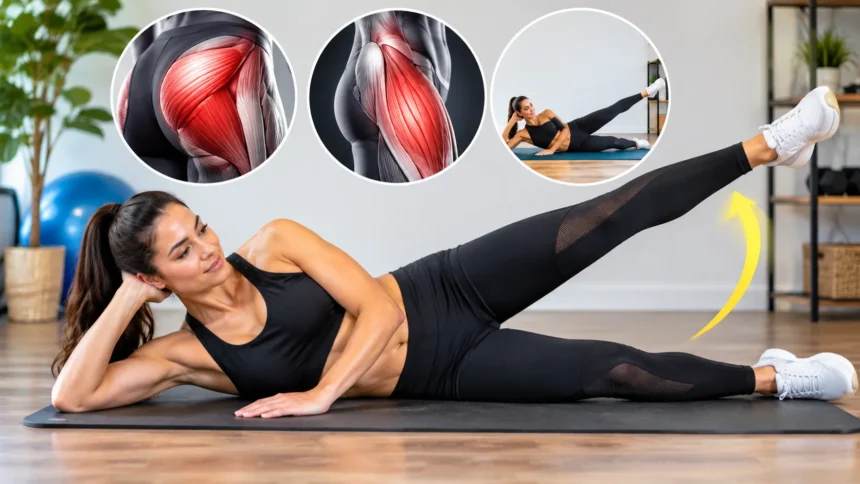
Side lying leg lifts are a simple lower-body exercise that can strengthen the hips, glutes, and outer thighs without requiring complicated equipment. Because the movement is performed while lying on your side, it is accessible for beginners while still being useful for experienced exercisers. Small changes in tempo, range of motion, and resistance can make the exercise surprisingly challenging.
This exercise mainly targets the muscles responsible for moving your leg away from the center of your body. Strong hip muscles can contribute to better lower-body stability, more controlled movement, and improved performance during everyday activities. Side lying leg lifts can also fit easily into home workouts, warm-ups, rehabilitation-style routines, or strength sessions.
Although the movement looks straightforward, technique makes a major difference. Lifting the leg too high, rotating the hips, or rushing repetitions can shift tension away from the muscles you actually want to train. Learning proper form helps you get more value from every repetition while keeping the movement comfortable and controlled.
What Are Side Lying Leg Lifts?
Side lying leg lifts are a bodyweight exercise performed while lying on one side and raising the upper leg toward the ceiling. The movement involves hip abduction, which means moving the leg away from the body’s midline. It primarily challenges the muscles around the outer hip while requiring your core and pelvis to remain stable throughout each repetition.
Unlike many standing exercises, side lying leg lifts reduce the need to balance on one foot. This makes them useful for people who want to focus directly on hip muscle activation without worrying as much about coordination. The floor also gives you a stable base, allowing you to concentrate on moving the leg smoothly rather than simply trying to maintain balance.
The exercise can be performed using only body weight, making it convenient for home workouts or travel routines. As strength improves, you can increase the challenge by adding ankle weights, resistance bands, slower repetitions, pauses, or additional sets. These simple progressions make side lying leg lifts suitable for many different fitness levels.
Muscles Worked During Side Lying Leg Lifts
The gluteus medius is one of the main muscles working during side lying leg lifts. Located along the outer portion of the hip, this muscle helps move your leg sideways and contributes to pelvic stability. Strengthening it can support controlled lower-body movement during activities such as walking, climbing stairs, running, or performing single-leg exercises.
The gluteus minimus also contributes significantly to hip abduction and stability. Although smaller than the gluteus medius, it works alongside surrounding muscles to help control the position of the thigh and pelvis. Your tensor fasciae latae, commonly called the TFL, may also become involved depending on your leg position and overall movement technique.
Several supporting muscles work quietly during the exercise as well. Your abdominal muscles help prevent excessive trunk movement, while the muscles around your lower back and pelvis maintain alignment. Even the bottom leg can contribute to stability, especially when you maintain a strong and controlled side-lying position throughout the entire set.
Benefits of Side Lying Leg Lifts
One major benefit of side lying leg lifts is improved hip strength. Strong muscles around the hips help control the position of your pelvis and legs during movement. Building this strength may make daily actions such as walking, getting out of a chair, using stairs, or moving sideways feel more controlled and stable.
Side lying leg lifts can also improve muscular endurance around the outer hips and glutes. These muscles often need to work repeatedly rather than producing a single powerful contraction. Training them through controlled sets can help prepare your lower body for longer periods of walking, recreational activities, sports, and other exercises that require consistent hip stability.
Another advantage is convenience. You do not need access to a gym, large machines, or heavy weights to perform the exercise effectively. Side lying leg lifts can therefore be added to a short home workout, mobility session, warm-up, or lower-body routine without requiring much space or preparation.
How to Do Side Lying Leg Lifts Correctly
Start by lying on one side with your legs extended and stacked comfortably on top of each other. Support your head using your lower arm or place it on a pillow if that feels more comfortable. Keep your shoulders, hips, knees, and ankles generally aligned while gently engaging your abdominal muscles to stabilize your trunk.
Keeping your upper leg relatively straight, slowly raise it toward the ceiling without allowing your pelvis to roll backward. You only need to lift as high as you can while maintaining good alignment and feeling the muscles along the outer hip working. Pause briefly at the top before lowering your leg slowly back toward the starting position.
Complete your desired number of repetitions before carefully turning over and repeating the movement on the opposite side. Try to keep the speed controlled during both the lifting and lowering phases. Quality repetitions are more useful than lifting the leg extremely high or performing a large number of fast, poorly controlled repetitions.
Common Side Lying Leg Lift Mistakes
One common mistake is lifting the leg too high. Once the leg moves beyond your comfortable hip range, your pelvis may begin rotating or your lower back may compensate for the movement. Instead of focusing on maximum height, stop where you can maintain control and continue feeling tension primarily around the outer hip and glute muscles.
Another mistake is allowing the upper leg to drift too far forward. This can increase involvement from the front of the hip and may reduce the emphasis on the glute muscles. Keeping the leg roughly in line with your body, or slightly behind your torso if comfortable, can often help maintain better glute engagement during the movement.
Rushing through repetitions is another issue that can reduce the effectiveness of side lying leg lifts. Momentum may lift the leg without requiring the target muscles to work as hard. Try using a deliberate rhythm, such as lifting for two seconds, pausing briefly, and lowering for another two or three seconds.
How Many Side Lying Leg Lifts Should You Do?
Beginners can often start with approximately 8 to 12 controlled repetitions on each side. One or two sets may be enough when you are first learning the exercise, particularly if your outer hip muscles fatigue quickly. Focus on maintaining proper alignment rather than trying to reach a specific repetition number at the expense of good form.
As your strength and endurance improve, you may progress toward 12 to 20 repetitions for two or three sets. However, simply performing more repetitions is not always necessary. You can make the exercise more challenging by slowing the movement, adding a pause at the top, increasing resistance, or using slightly more demanding variations.
Your ideal volume also depends on how side lying leg lifts fit into the rest of your workout. If you are already performing squats, lunges, step-ups, bridges, or other glute exercises, fewer repetitions may be sufficient. When side lying leg lifts are your primary hip-strengthening exercise, slightly more volume may be appropriate.
Side Lying Leg Lift Variations to Try
Adding a resistance band is one of the easiest ways to make side lying leg lifts more challenging. Place a loop band around your thighs or ankles and perform the same controlled lifting motion. The resistance increases as your legs separate, requiring the hip abductors and glutes to work harder near the upper portion of the movement.
You can also perform small pulses after reaching the top of the leg lift. Instead of lowering immediately, move your upper leg slightly up and down while maintaining tension around the outer hip. Keep these movements small and controlled because large, fast pulses can encourage your hips and torso to rotate.
Another option is combining side lying leg lifts with other resistance exercises for a more complete routine. For example, lower-body hip work can be paired with upper-body exercises such as a resistance band pull-apart to train different muscle groups within the same session. This approach can create a balanced home workout using minimal equipment.
Tips for Getting Better Results
Think about keeping your hips stacked throughout the exercise rather than allowing your upper hip to fall backward. Maintaining this position helps direct more work toward the muscles surrounding your outer hip. Placing your upper hand gently on your pelvis can make it easier to notice unwanted movement while you lift and lower your leg.
Avoid pointing your toes aggressively toward the ceiling. In many cases, keeping the toes facing forward or slightly downward can help prevent excessive hip rotation and maintain better muscular control. Your exact foot position may vary slightly based on comfort, flexibility, and anatomy, so prioritize a position that allows smooth and pain-free movement.
Breathing normally can also improve your exercise quality. Exhale gently as you raise the leg and inhale as you lower it instead of holding your breath during difficult repetitions. Controlled breathing helps reduce unnecessary tension while encouraging you to maintain a slower, more deliberate movement pattern from beginning to end.
How to Make Side Lying Leg Lifts Harder
A resistance band is usually the most practical progression once standard side lying leg lifts become easy. Start with light resistance and gradually move toward a stronger band as your control improves. Adding too much resistance too quickly can cause you to shorten the movement or compensate by rotating your pelvis, so progression should remain gradual.
Ankle weights offer another way to increase the challenge. Even a relatively light weight can make a noticeable difference because the resistance is positioned farther away from your hip joint. Maintain the same controlled technique you use during bodyweight repetitions and reduce the total number of repetitions if needed when first adding weight.
Tempo can increase difficulty without adding any equipment. Try raising your leg slowly, holding the top position for two or three seconds, and lowering even more slowly. This increases the amount of time your muscles remain under tension, making a familiar exercise considerably harder without requiring heavier resistance or complicated variations.
How to Add Side Lying Leg Lifts to Your Workout
Side lying leg lifts can work well near the beginning of a workout as a glute activation exercise. Performing one or two controlled sets before squats, lunges, or similar lower-body movements can help you become more aware of your hip muscles. However, the exercise should not leave your muscles excessively fatigued before your primary strength exercises.
You can also perform them later in your workout as an accessory exercise. After completing compound movements such as squats, deadlifts, or step-ups, side lying leg lifts allow you to focus more directly on the hip abductors. This position is especially useful when you want additional targeted work without using heavy loads.
For home workouts, side lying leg lifts can be combined with glute bridges, bodyweight squats, bird dogs, clamshells, and other simple exercises. A routine like this can train multiple muscles while requiring very little equipment. Consistency and gradual progression matter more than creating an overly complicated exercise program.
Who Can Benefit From Side Lying Leg Lifts?
Beginners may appreciate side lying leg lifts because the basic movement is relatively easy to understand. There is no heavy equipment to manage, and the floor provides a stable support surface. This allows new exercisers to practice controlled hip movement while gradually building strength around the glutes and outer thighs.
People who spend long periods sitting may also choose to include hip-strengthening exercises in their fitness routines. Extended sitting does not automatically mean your glutes are weak, but regular movement and varied exercise can help keep your hips active. Side lying leg lifts provide one simple option for training muscles that contribute to lower-body stability.
Athletes and experienced exercisers can benefit as well, particularly when the movement is used as accessory work. Strong hip abductors contribute to control during running, jumping, changing direction, and single-leg movements. More advanced users can increase resistance or combine leg lifts with other exercises to create a greater training challenge.
When to Avoid or Modify Side Lying Leg Lifts
Side lying leg lifts should generally feel like muscular effort around the outer hip rather than sharp pain. If the movement causes sudden pain in your hip, knee, back, or another area, stop the exercise instead of forcing yourself through additional repetitions. Exercise discomfort from muscle fatigue is different from pain that feels sharp, unusual, or progressively worse.
People who find lying directly on the hip uncomfortable can place a folded exercise mat, towel, or cushion beneath the body. Slightly bending the bottom leg can also create a more stable position without significantly changing the upper-leg movement. Small adjustments can make the exercise more comfortable while still allowing you to train the target muscles.
If you are recovering from an injury, surgery, or ongoing hip problem, your appropriate exercise selection may be different from someone completing a general fitness routine. A healthcare professional or qualified rehabilitation provider can help determine whether side lying leg lifts are appropriate for your situation. Individual limitations should always take priority over generic exercise recommendations.
Conclusion
Side lying leg lifts are a straightforward but effective exercise for strengthening the glutes, outer hips, and supporting muscles around the pelvis. They require minimal equipment, take up very little space, and can be adjusted for different fitness levels. Their simplicity makes them particularly convenient for home workouts and accessory training.
Proper form is more important than lifting your leg as high as possible. Keep your hips stacked, move at a controlled pace, and focus on feeling the outer hip muscles working throughout each repetition. Slower movement and better control can often produce more useful muscular tension than performing large numbers of rushed repetitions.
As the exercise becomes easier, progress gradually using resistance bands, ankle weights, pauses, or slower tempos. Side lying leg lifts can then remain useful instead of becoming too easy over time. Combined with other lower-body strength exercises and regular movement, they can contribute to a balanced and practical fitness routine.
FAQs
Do side lying leg lifts build glutes?
Yes. Side lying leg lifts primarily work the gluteus medius and gluteus minimus, which are important muscles around the outer hip. Proper positioning and controlled repetitions help keep tension focused on these areas.
How many side lying leg lifts should beginners do?
Beginners can generally start with about 8 to 12 controlled repetitions per side for one or two sets. Increase repetitions or resistance gradually once you can maintain good technique throughout the entire set.
Should my toes point forward during side lying leg lifts?
Keeping your toes mostly forward or slightly downward can help maintain hip alignment and target the outer glutes. Avoid aggressively rotating your toes upward if it causes your pelvis to roll backward.
Can I do side lying leg lifts every day?
They may be performed frequently when the intensity is low, but your muscles still need appropriate recovery. If you use resistance or train close to fatigue, allowing recovery between harder sessions may be more suitable.
Why do I feel side lying leg lifts in the front of my hip?
Your hip flexors or tensor fasciae latae may be contributing more when your leg moves too far forward or your pelvis rotates. Adjusting your position and reducing the lifting height may improve glute engagement.
