

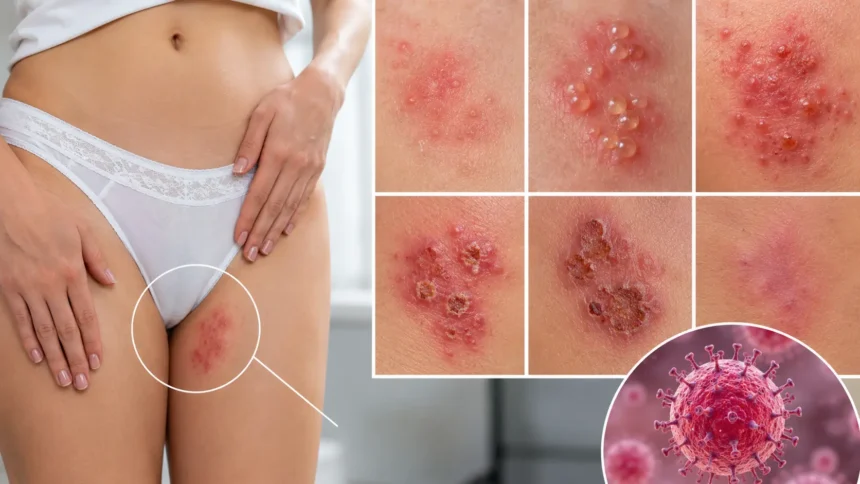
Pictures of Genital Herpes: Signs, Stages & Symptoms
Pictures of genital herpes are often searched by people who notice an unfamiliar bump, blister, sore, or irritated area around the genitals and want to understand what it might be. Genital herpes is caused by herpes simplex virus type 1, known as HSV-1, or herpes simplex virus type 2, known as HSV-2. When symptoms appear, the classic pattern can include small blisters that break open and form painful shallow sores, but real outbreaks are not always this obvious. Mild herpes can resemble an ingrown hair, pimple, razor burn, small crack, or ordinary skin irritation. Some people carry genital HSV without ever noticing clear lesions at all. For that reason, comparing your skin with pictures cannot reliably confirm or rule out genital herpes.
The appearance of genital herpes can also change dramatically from one stage of an outbreak to another. Early symptoms may begin with itching, tingling, burning, or tenderness before visible bumps develop. Blisters may then form and break into ulcers before gradually drying or closing as the skin heals. Lesions can occur on the penis, vulva, vagina, anus, buttocks, thighs, or surrounding genital skin, depending on the site of infection. They may also look different across different skin tones because inflammation is not always bright red on darker skin. Laboratory testing of a fresh blister or sore provides much stronger diagnostic evidence than visual comparison.
What Does Genital Herpes Look Like?
Genital herpes is classically described as one or more small blisters appearing on or around the genitals, anus, or nearby skin. The blisters may occur individually, but they often develop close together and create a clustered appearance. They may contain clear fluid and sit on skin that appears swollen, red, darker, or irritated compared with the surrounding area. Over time, the thin surface of a blister can break, leaving a tender shallow sore underneath. The CDC notes that herpes lesions commonly begin as blisters that later become painful sores and may take a week or longer to heal. The exact number and appearance of lesions vary substantially between individuals.
Not every case produces the textbook cluster shown in medical photographs. Many people have mild symptoms that are mistaken for pimples, ingrown hairs, shaving irritation, or other ordinary skin problems. A mild outbreak may consist of only one small bump, a tiny erosion, or a superficial crack in the skin. Sometimes intact blisters disappear quickly because friction and moisture cause them to rupture before a person notices them. Lesions occurring between folds of genital skin can also be difficult to see without careful examination. CDC guidance specifically notes that classic vesicular or ulcerative lesions are absent in many infected people at the time they are evaluated.
Color varies according to the stage of the outbreak and the person’s natural skin tone. On lighter skin, inflammation around a lesion may appear pink or red, while on darker skin it can look purple, brown, grayish, or simply deeper in color than nearby skin. NHS clinical examples specifically note that herpes sores may appear less visibly red on brown or Black skin. For this reason, searching only for bright-red blisters can cause people with darker skin tones to miss subtle lesions. Swelling, tenderness, blistering, open skin, and progression over time may be more useful clues than color alone. A photograph taken under artificial lighting can make these color differences even harder to interpret accurately.
The location of genital herpes also varies. Lesions can appear on the vulva, vaginal opening, penis, scrotal area, pubic region, perineum, anus, buttocks, or upper thighs. Some infections involve internal vaginal, cervical, urethral, or rectal tissues that cannot be easily seen in an ordinary mirror. A person may therefore experience pain, burning, discharge, or discomfort without finding an obvious external blister. NHS guidance lists genital, anal, thigh, and buttock lesions among possible presentations. Herpes can recur in nearby areas supplied by the same regional nerves rather than always appearing in exactly the same visible spot.
Pictures can be educational when they demonstrate broad patterns, but they should not be treated as diagnostic tests. Syphilis, folliculitis, genital warts, cysts, fungal infections, dermatitis, and traumatic skin irritation can all resemble herpes under certain circumstances. Even healthcare professionals sometimes rely on laboratory testing because visual diagnosis can be difficult. When a fresh blister or ulcer is present, a clinician can take a swab for herpes testing, which is much more informative than deciding whether a photo “looks similar.” Someone experiencing a first unexplained genital sore should therefore consider medical or sexual-health evaluation while the lesion is still fresh.
Stages of a Genital Herpes Outbreak
The first stage of an outbreak may occur before visible lesions develop and is often called the prodrome. A person may notice localized tingling, itching, burning, tenderness, or unusual sensitivity around the genital area. Some people describe nerve-like discomfort extending into the buttocks, hips, or upper thighs before recurring lesions appear. These sensations can begin hours or occasionally longer before visible skin changes. Not everyone experiences a recognizable prodrome, particularly during a first outbreak when the sensations are unfamiliar. Tingling by itself also has many possible causes, so it cannot confirm herpes without additional evidence. For people with established recurrent herpes, however, a familiar prodrome can provide an early warning that lesions may soon develop.
The next visible stage may involve small raised spots or papules. These early bumps can be skin-colored, pink, red, darker than surrounding skin, or difficult to see at all. They may feel unusually tender or itchy and can initially resemble inflamed follicles or shaving bumps. Some then develop into small fluid-filled vesicles, creating the appearance commonly recognized in genital herpes pictures. WHO guidance describes classic first episodes as clusters of papules, vesicles, or ulcerations affecting genital, perianal, or buttock areas. However, the same guidance emphasizes that the classic presentation occurs in only a minority of primary infections.
As the outbreak progresses, fragile blisters may rupture and form shallow ulcers. This stage can be more painful because nerve endings within the irritated skin are exposed and urine or friction can sting significantly. Several nearby lesions may merge into one larger irritated area, especially during a more extensive first outbreak. On moist genital tissues, a lesion may appear primarily as an ulcer without ever showing a clearly visible dry blister stage. WHO guidance specifically notes that mucosal herpes lesions can be ulcerative without initially appearing as recognizable vesicles. This helps explain why real outbreaks can look different from neat diagrams showing each stage separately.
Healing begins as the immune system controls the active episode and new skin develops over the ulcerated area. External lesions in relatively dry areas may crust or form a light scab, while moist genital lesions can simply become shallower and gradually close. Swelling, burning, and tenderness should decrease as healing progresses. Temporary discoloration may remain after the skin surface appears closed, particularly in people prone to post-inflammatory pigmentation. A healed patch can therefore remain darker or lighter than surrounding skin without representing an active blister. Picking crusts or repeatedly touching lesions can create additional irritation and increase the chance of secondary bacterial infection.
The entire progression varies in length, particularly between first and recurrent episodes. CDC historical clinical imagery describes first outbreaks as potentially taking two to four weeks to heal, while modern CDC patient information notes that individual sores may take a week or more to resolve. Recurrent outbreaks are generally shorter and less severe than first recognized episodes. Antiviral treatment can also shorten symptoms when started appropriately. A lesion that remains open, enlarges continuously, produces significant pus, or behaves unlike previous outbreaks deserves reassessment because another skin condition or secondary infection may be involved.
First Genital Herpes Outbreak Symptoms
The first recognized genital herpes episode can be more extensive than later recurrences, although this pattern is not universal. Some people develop multiple painful lesions across both sides of the genital region, while others experience only one small sore. Burning, tenderness, itching, and genital discomfort are common when symptomatic lesions occur. Pain may become especially noticeable while walking, sitting, exercising, or during sexual activity because friction irritates the affected skin. In people with vulvas, lesions close to the urethra can cause considerable stinging during urination. In other cases, the first infection produces such mild symptoms that it is never recognized as herpes at all.
Flu-like symptoms can accompany a first outbreak more often than recurrent episodes. Fever, headache, muscle aches, tiredness, and swollen lymph nodes in the groin may occur as the immune system responds to the infection. CDC patient information lists fever, body aches, and swollen glands among possible symptoms during an initial outbreak. These symptoms are not present in every person and are not specific to herpes because many infections can cause a similar systemic response. The combination of genital ulcers and flu-like symptoms may increase clinical suspicion, but testing remains the best way to clarify the cause.
Painful urination is another possible symptom, particularly when open sores are positioned where urine passes over them. Some people may avoid urinating because they anticipate pain, which can increase discomfort and contribute to dehydration. Unusual genital discharge can occasionally occur as well, especially if vaginal or cervical tissues are involved. NHS guidance lists painful urination and unusual discharge among possible genital herpes symptoms. However, discharge is also associated with gonorrhea, chlamydia, trichomoniasis, bacterial vaginosis, and other conditions. Someone experiencing discharge together with genital sores may therefore need testing for more than one sexually transmitted infection.
The timing of a first obvious outbreak does not reliably show when herpes was acquired. Symptoms can appear relatively soon after exposure, but infection may also remain unnoticed for months or years before someone recognizes their first outbreak. NHS guidance specifically notes that visible symptoms can appear long after infection. This means a new outbreak should not automatically be used to identify which partner transmitted HSV or when transmission happened. Testing can identify HSV-1 or HSV-2 in many cases, but it cannot establish the exact date the infection was acquired. This distinction is particularly important because incorrect assumptions about timing can create unnecessary conflict within relationships.
A suspected first episode is a particularly useful time to seek medical evaluation. Fresh blisters and open sores provide material that can be swabbed for laboratory testing before healing reduces the chance of detecting virus. Early assessment also allows antiviral treatment to begin promptly when appropriate. NHS guidance advises people with suspected genital herpes symptoms to seek sexual-health evaluation as soon as possible and notes that antiviral medication is most useful when started early. Even after several days, however, testing may still help identify the cause. A confirmed diagnosis provides much clearer guidance about recurrence patterns, transmission, and future treatment than repeatedly comparing lesions with online pictures.
Recurrent Genital Herpes Outbreaks
Recurrent genital herpes outbreaks are usually milder and shorter than the first recognized episode. A person who initially had numerous lesions may later experience only one or two small areas of irritation. Tingling or burning can appear before the lesions, allowing experienced patients to recognize the pattern early. The blisters may be small and rupture quickly, sometimes leaving what looks like a tiny crack or superficial abrasion rather than a classic cluster. These subtler outbreaks are particularly easy to confuse with friction, shaving irritation, or an ingrown hair. NHS guidance notes that recurrent episodes usually become less severe and may happen less frequently over time.
HSV type influences recurrence patterns. HSV-2 is more strongly associated with recurrent genital outbreaks and asymptomatic genital shedding than genital HSV-1. CDC treatment guidance states that almost all people with symptomatic first-episode genital HSV-2 subsequently experience recurrent lesions, although the frequency varies substantially between individuals. Genital HSV-1 tends to recur less often and usually produces decreasing genital viral shedding over time. This is one reason laboratory typing can be useful after a diagnosis. The appearance of the lesions cannot reliably distinguish HSV-1 from HSV-2 because both viruses can produce similar blisters and ulcers.
Some people experience several outbreaks each year, while others go years without recognizing another episode. Stress, illness, sleep disruption, local friction, sexual activity, hormonal changes, and other physiological stresses are commonly reported as possible triggers. However, an outbreak can also occur without any obvious trigger at all. Keeping a simple record may help someone with frequent recurrences identify personal patterns, but avoiding every suspected trigger is rarely realistic or necessary. Having an outbreak does not mean someone failed to manage their health correctly. HSV remains latent in nearby nerve tissue and can reactivate periodically despite otherwise healthy habits.
Antiviral medication can be used either when an outbreak begins or continuously as suppressive therapy, depending on individual needs. Episodic therapy works best when started very early, ideally during the prodrome or shortly after lesions appear. Daily suppressive medication can substantially reduce the frequency of recurrent HSV-2 outbreaks and can also lower transmission risk in certain circumstances. CDC guidance states that suppressive therapy can reduce recurrences by roughly 70% to 80% in people with frequent outbreaks. Treatment decisions depend on recurrence frequency, severity, relationships, health history, and personal preference.
A recurrence that suddenly looks very different from previous outbreaks should not automatically be assumed to be herpes. A new painless lump, deep abscess, wart-like growth, persistent ulcer, or pus-filled bump may have another cause. Similarly, herpes treatment that previously worked but no longer seems effective may justify reassessment. People with significant immune suppression can also develop more severe or prolonged lesions than typical healthy adults. Familiarity with one’s usual outbreak pattern is useful, but it should not prevent medical evaluation when something changes. Long-standing HSV does not protect someone from developing unrelated genital skin conditions or other sexually transmitted infections.
Where Genital Herpes Lesions Can Appear
On the vulva, genital herpes can affect the labia, skin surrounding the vaginal opening, perineum, or other nearby tissues. Lesions may be visible as small grouped blisters, shallow ulcers, or subtle fissures. Swelling can sometimes make the affected area feel significantly more uncomfortable than the visible lesions would suggest. Internal vaginal or cervical lesions may not be visible without a clinical examination, meaning external inspection can underestimate the extent of symptoms. Pain while urinating or during sexual activity may occur when irritated tissues are involved. Someone who experiences vaginal symptoms without visible sores should not assume herpes is impossible, especially when there has been a relevant exposure.
On the penis, herpes can appear on the shaft, glans, foreskin, or surrounding pubic and scrotal skin. CDC’s Public Health Image Library includes confirmed cases showing clustered papules or vesiculopapular lesions on both the penile shaft and glans. These images demonstrate that herpes does not always begin as large fluid-filled blisters. Small raised lesions can represent an earlier stage before they become ulcerated. Hair-bearing skin at the base of the penis can make herpes especially difficult to distinguish from folliculitis or shaving bumps. A lesion swab provides more useful confirmation than appearance alone when fresh sores are present.
Perianal and anal herpes can produce painful lesions around the anus, while infection involving internal rectal tissues may cause discomfort during bowel movements. Some people experience rectal pain, discharge, or the sensation of needing to pass stool repeatedly. These symptoms overlap with hemorrhoids, fissures, inflammatory conditions, and other sexually transmitted infections. WHO guidance includes the perianal region and buttocks among classic locations for genital HSV lesions. Because people sometimes assume genital herpes must occur directly on reproductive organs, lesions around the anus or buttocks may be overlooked.
The buttocks and upper thighs can also develop recurrent HSV lesions because the virus becomes latent in regional sensory nerves. Someone may therefore notice a familiar cluster on one buttock rather than directly on the genitals during a recurrence. NHS guidance specifically shows buttock lesions among the possible visible presentations of genital herpes. This pattern should not be confused with the virus spreading randomly through the entire body each time an outbreak occurs. Recurrences generally occur within regions connected to the nerve pathways where the virus remains latent. A new rash far from the usual location can have a different explanation and may deserve separate evaluation.
Lesions can look more or less obvious depending on local moisture, skin thickness, friction, and pigmentation. On dry outer skin, blistering and crusting may be relatively easy to recognize. On mucosal surfaces, lesions can appear primarily as shallow ulcers or raw irritated areas without a dry scab. Darker skin may show less obvious redness, while post-inflammatory pigmentation can remain after the outbreak has healed. These variations make online comparisons particularly unreliable when photos show only one body type or skin tone. A diagnosis should be based on clinical context and testing rather than whether someone’s lesions precisely match a single reference image.
Conditions That Can Look Like Genital Herpes
Ingrown hairs are among the conditions most commonly confused with genital herpes. They often develop after shaving or waxing when a hair curls back into the skin and creates an inflamed bump. An ingrown hair may contain visible pus or have a trapped hair at its center, while classic herpes more often produces delicate blisters that become shallow ulcers. However, early herpes bumps can look extremely similar, and ingrown hairs can themselves become infected. Squeezing either type of lesion can worsen inflammation and make diagnosis more difficult. If a suspicious bump changes rapidly from a raised spot into a painful open sore, herpes becomes one possibility that deserves consideration.
Folliculitis can also resemble herpes because it produces inflamed bumps around hair follicles. These lesions are often pustular and may be associated with sweating, friction, shaving, bacterial infection, or occlusive clothing. Folliculitis commonly affects areas where individual hairs can be seen emerging from the center of bumps. Herpes lesions do not need to follow visible hair follicles and often appear clustered. Still, CDC emphasizes that mild herpes symptoms can be mistaken for pimples or ingrown hairs, demonstrating how much real-world overlap exists. A swab of a fresh suspicious lesion can prevent unnecessary guessing.
Syphilis is particularly important because it can also produce genital ulcers but requires completely different treatment. WHO describes primary syphilis as typically presenting with a solitary painless ulcer, while herpes more commonly produces painful vesicles or ulcers. Real cases do not always follow these textbook distinctions perfectly, so absence of pain does not reliably exclude either condition. Several sexually transmitted infections can also occur simultaneously. Someone presenting with a genital ulcer may therefore need broader STI testing rather than a herpes test alone.
Genital warts caused by human papillomavirus usually look different from herpes because they tend to form persistent raised or textured growths rather than short-lived fluid-filled blisters. Warts may be flat, smooth, rough, or clustered and often remain present for weeks or months without breaking into painful shallow ulcers. Molluscum contagiosum can create small smooth bumps with a central depression and may also be mistaken for herpes by people unfamiliar with genital skin conditions. Neither condition typically follows the blister-to-ulcer-to-healing cycle associated with symptomatic HSV. A healthcare professional can often distinguish these patterns clinically, although testing or additional evaluation may sometimes be needed.
Contact dermatitis, yeast-related irritation, friction injuries, cysts, and normal anatomical structures can also create considerable anxiety. Soap, lubricants, condoms, fragrances, detergents, or hair-removal products can cause itching, burning, swelling, and superficial skin damage. Normal Fordyce spots, visible glands, pearly penile papules, or vestibular papillomatosis may also be mistaken for sexually transmitted infections despite being harmless. A useful clue is whether the finding has remained unchanged for months or years rather than appearing suddenly and progressing through several stages. Still, persistent uncertainty is better resolved through clinical examination than through increasingly alarming image searches.
How Genital Herpes Is Diagnosed
Testing a fresh blister or ulcer is generally the most direct way to diagnose symptomatic genital herpes. A clinician uses a swab to collect material from the lesion and sends it for laboratory testing. CDC guidance states that lesion-based nucleic acid amplification tests, including PCR-type methods, are among the most sensitive approaches for detecting HSV. These tests can usually determine whether HSV-1 or HSV-2 is present. Typing matters because genital HSV-2 tends to recur and shed more frequently than genital HSV-1. Testing works best when lesions are fresh rather than already crusted or almost completely healed.
Timing is important because the amount of detectable virus can decline as the lesion heals. A person who waits until every sore has disappeared may miss the easiest opportunity for direct lesion testing. NHS guidance explains that clinicians commonly take a swab from an active blister or sore and that testing generally requires visible lesions. If another outbreak appears after an inconclusive evaluation, seeking testing early in the episode can provide better information. A negative result from an old healing lesion does not always completely rule out HSV. The clinician interprets the result in combination with appearance, history, and test type.
Blood tests detect antibodies against HSV rather than virus directly from an active sore. They may be useful in selected situations, such as when someone has recurrent suspicious symptoms but no fresh lesion available for testing or when a sexual partner has genital herpes. CDC does not recommend routine herpes blood testing for everyone without symptoms because false-positive results and interpretation problems can occur. A positive blood result also cannot identify when someone became infected or which partner transmitted the virus. HSV-1 antibodies are particularly difficult to interpret anatomically because they may result from an oral infection acquired years earlier.
Testing immediately after a recent exposure can also be misleading because antibodies need time to develop. CDC notes that it may take up to 16 weeks or longer after exposure for currently available tests to detect infection reliably. Someone who tests negative several days after an exposure therefore should not assume infection has definitely been excluded. If a fresh blister develops, lesion testing can provide a more direct route to diagnosis. Otherwise, a healthcare professional can advise whether and when repeat antibody testing is worthwhile. The most appropriate test depends on symptoms, timing, partner history, and previous HSV results.
Clinical diagnosis alone remains imperfect because many people do not have classic lesions when they seek care. CDC treatment guidelines specifically state that diagnosis can be difficult because the characteristic painful vesicular or ulcerative lesions are absent in many infected people during examination. This reinforces the limits of trying to diagnose yourself through pictures. A clinician has the advantage of examining texture, distribution, tenderness, medical history, and associated symptoms while also arranging laboratory testing. Someone should therefore treat images as educational references rather than proof. The goal of testing is not only to label the sore but also to provide accurate counseling, treatment, and transmission guidance.
Healing, Treatment and Reducing Transmission
There is currently no cure that completely removes herpes simplex virus from the body. After infection, HSV establishes latency in nerve tissue and can reactivate periodically. Antiviral medicines such as acyclovir, valacyclovir, and famciclovir can reduce symptoms, shorten outbreaks, and help manage recurrence. They do not eliminate the virus permanently. WHO describes HSV as a lifelong viral infection for which antiviral treatment can suppress symptoms but does not provide a cure. Understanding this distinction helps prevent misleading expectations from supplements or products advertised as permanent herpes cures.
During an active outbreak, reducing friction can make the area more comfortable while lesions heal. Loose clothing may be more comfortable than tight underwear or clothing that repeatedly rubs against sores. NHS guidance recommends keeping the area clean with plain or salt water, using wrapped cool packs for discomfort, and avoiding direct irritation of the lesions. People should wash their hands after touching affected skin or applying any treatment. Picking at blisters or scabs can make the area more irritated and increase the chance of bacterial infection.
Sexual contact involving affected skin should generally be avoided from the beginning of prodromal tingling or itching until sores have completely healed. HSV is particularly transmissible when active lesions are present, but transmission can also occur when no symptoms are visible because asymptomatic viral shedding occurs. Condoms reduce risk but cannot completely eliminate it because herpes can affect skin not covered by a condom. This is why communication between partners matters even outside visible outbreaks. CDC notes that people can transmit genital herpes without knowing they have the infection or while they have no obvious symptoms.
Suppressive antiviral treatment may be considered for people who experience frequent or troublesome recurrent HSV-2 outbreaks. Daily treatment can substantially reduce recurrence frequency and can lower the chance of transmitting HSV-2 to susceptible partners in certain circumstances. The decision to use daily suppression is individualized rather than based on one universal outbreak number. Some people prefer episodic medication taken only when symptoms begin, while others value reducing recurrences and transmission risk through daily therapy. A healthcare professional can review medication options, kidney function, pregnancy, other medicines, and the person’s outbreak history before recommending a strategy.
Herpes diagnosis can also have an emotional impact that is separate from physical symptoms. People may initially worry about relationships, stigma, sexual health, or whether outbreaks will remain severe indefinitely. In reality, most people learn to manage the infection, and recurrent episodes commonly become less frequent or less severe over time. WHO emphasizes that genital herpes is widespread globally, with hundreds of millions of adults living with genital HSV infections. Accurate information, treatment, communication, and realistic understanding of transmission usually make the condition more manageable than alarming online images suggest.
When Genital Herpes Symptoms Need Medical Attention
A first suspected outbreak should generally be assessed by a healthcare professional or sexual-health clinic. Testing is easiest while fresh sores are still visible, and early antiviral treatment may reduce the severity or duration of symptoms. Extensive lesions, severe pain, fever, or difficulty carrying out normal activities make evaluation especially important. A clinician can also test for other infections that cause genital sores, including syphilis. Someone should not assume that every painful genital ulcer is HSV simply because the appearance resembles an online picture. Accurate diagnosis is particularly valuable the first time symptoms occur.
Difficulty urinating requires prompt attention, especially when severe swelling or pain makes it impossible to pass urine normally. Some people avoid urinating because sores sting intensely, but prolonged inability to empty the bladder can create additional medical problems. WHO clinical guidance recognizes urinary retention as a possible complication of significant genital herpes. Severe dehydration can also develop if someone deliberately stops drinking to reduce urination. A healthcare professional can help manage pain and determine whether additional intervention is required.
Eye symptoms require urgent evaluation if herpes may have been transferred to the eye. Pain, significant redness, light sensitivity, blurred vision, or an inability to keep the eye open can indicate a potentially serious corneal infection. People should avoid touching genital lesions and then rubbing their eyes and should wash their hands thoroughly after any contact with affected skin. Herpes involving the eye is different from a routine genital recurrence and can threaten vision if not treated appropriately. Severe headache, neck stiffness, confusion, or neurological symptoms also deserve urgent medical evaluation because HSV can rarely produce more serious complications.
Pregnancy makes genital herpes particularly important because transmission around childbirth can cause neonatal herpes. A pregnant person with known genital herpes should inform their obstetric team, even when no lesions are currently present. A new suspected first infection during pregnancy deserves prompt medical discussion because timing influences management and newborn risk. The healthcare team may consider antiviral treatment and examine for lesions near delivery. Decisions about labor and delivery depend on the clinical circumstances rather than simply whether someone has ever had HSV. Genital herpes is manageable during pregnancy, but it should not be handled without professional guidance.
People with weakened immune systems should also seek care earlier if they develop genital lesions. Significant immune suppression can allow outbreaks to become more extensive, prolonged, or difficult to heal. Anyone with sores that remain open for an unusually long time, repeatedly become infected, or spread extensively should be evaluated regardless of immune status. Likewise, a lesion that continuously enlarges, bleeds, produces substantial pus, or looks very different from previous confirmed herpes episodes may have another cause. Familiarity with HSV is useful, but it should never prevent reassessment when the pattern changes.
Frequently Asked Questions About Genital Herpes Pictures
What does genital herpes usually look like?
Genital herpes often appears as one or more small blisters that break open and become painful shallow sores around the genitals, anus, buttocks, or nearby skin. Mild cases can resemble pimples, ingrown hairs, fissures, or ordinary irritation, so appearance alone cannot confirm the diagnosis.
What are the stages of genital herpes?
An outbreak may begin with tingling, itching, or burning, followed by raised bumps or fluid-filled blisters. The lesions can then rupture into ulcers before gradually drying, closing, and healing.
Can genital herpes look like a pimple or ingrown hair?
Yes. The CDC notes that mild genital herpes symptoms are commonly mistaken for pimples or ingrown hairs, particularly when only one or two lesions appear.
How can I know whether a genital sore is herpes?
The most reliable approach is clinical evaluation and appropriate testing rather than comparing pictures. A fresh blister or sore can often be swabbed for HSV testing, while blood tests may be useful in selected situations when lesions are not present.
Do genital herpes sores always appear in clusters?
No. Clusters of blisters are a classic presentation, but some people develop a single lesion, tiny fissures, mild irritation, or no recognizable sores at all. Many HSV infections remain unrecognized because symptoms are absent or too subtle to look like textbook herpes.
