
Idaho Shooting: What Happened in Twin Falls and What We Know
A deadly shooting in Twin Falls, Idaho, on August 1, 2026, turned a busy Saturday afternoon into a scene of fear, confusion, and loss. The attack occurred in the area of a newly opened In-N-Out Burger restaurant at Canyon Park West, where customers, workers, motorists, and visitors were present. Police described the location as a crowded commercial area.
Authorities responded after receiving a report of an active shooter at approximately 2:29 p.m. Emergency teams secured the surrounding streets, assisted injured people, and began moving witnesses away from danger. The suspected gunman was later found dead near the scene, and police said there was no continuing threat to the wider community.
Early reports indicated that at least three people had died and several others had been injured. Initial injury totals varied as hospitals, police, and other agencies worked to confirm information. Officials had also not immediately clarified whether the suspected shooter was included in the first reported fatality count.
The Twin Falls shooting remains under active investigation, meaning some details may change as evidence is reviewed. The suspect’s identity, motive, movements, and relationship to the victims had not been publicly confirmed in the earliest updates. This analysis focuses on verified information while clearly separating established facts from unanswered questions.
What Happened During the Twin Falls Idaho Shooting?
The Idaho shooting began near the In-N-Out Burger restaurant in the Canyon Park West commercial area. Police received reports describing an active shooter, prompting an urgent response from the Twin Falls Police Department and law enforcement agencies from surrounding communities. Customers and workers attempted to escape or take shelter as gunfire was reported.
The restaurant was located in a particularly busy area near shops, roads, the Twin Falls Visitor Center, and the Perrine Bridge. Hundreds of people may have been in the wider commercial district when the incident began. This created a difficult environment for emergency responders because they had to locate the shooter while protecting and evacuating a large number of people.
Witness accounts described a person carrying a long rifle and moving through the restaurant or parking area. Some witnesses reported that shots were fired toward vehicles and parts of the drive-through area. Investigators had not yet publicly confirmed every movement, target, or exchange of gunfire described in early interviews and social media videos.
Police eventually located the suspected shooter dead in an area near the restaurant. Authorities announced that they believed the danger to the public had ended, although the scene remained closed for evidence collection. Officers continued interviewing witnesses and asked anyone with relevant information or recordings to contact the department.
A Timeline of the August 1 Idaho Shooting
The first confirmed public point in the timeline came at approximately 2:29 p.m. on Saturday, August 1, when Twin Falls officers were dispatched to reports of an active shooter. Emergency calls likely came from multiple people because the attack unfolded in a crowded public area. Responders approached the scene while civilians attempted to flee.
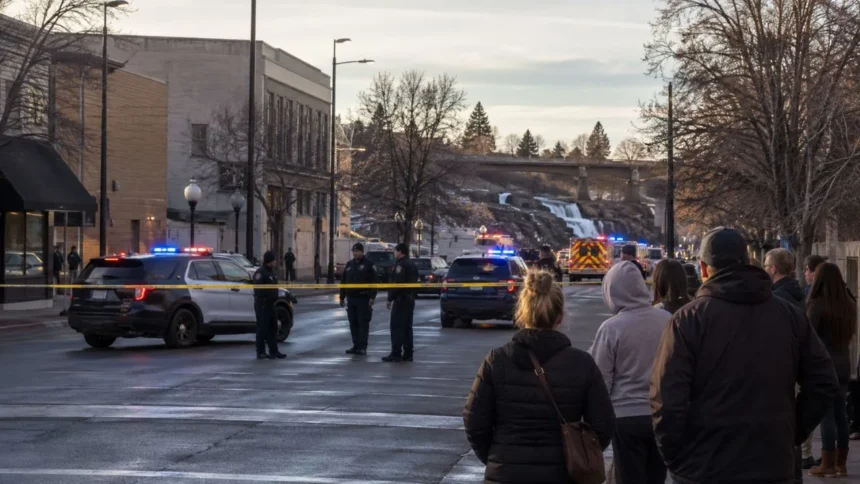
Police established a large safety perimeter around the restaurant and nearby businesses. Roads were closed, access to the area was restricted, and traffic across the Perrine Bridge was temporarily affected. These actions allowed officers and medical teams to enter the scene without creating additional risks from vehicles or large crowds.
Within roughly an hour, officials determined that the suspected shooter was no longer an active threat. The suspect was found dead near the restaurant, but authorities did not immediately explain how the death occurred. Investigators then shifted from an active emergency response to victim care, witness interviews, scene documentation, and evidence recovery.
Later in the evening, the Perrine Bridge reopened while the area immediately surrounding the restaurant remained restricted. Police continued processing the scene and notifying the families of victims. Additional updates were delayed because authorities needed to confirm identities, reconcile casualty figures, and avoid releasing inaccurate information.
How Many People Were Killed or Injured?
Initial reports stated that at least three people had died in the Twin Falls shooting. The suspected gunman was also confirmed dead, although early statements did not consistently explain whether he was included in that total. This uncertainty led different news organizations to describe the number of deaths in slightly different ways.
Reports about the number of injured people also varied during the first hours. Some updates referred to at least five injured individuals, while later accounts placed the number at seven. Several victims were transported to St. Luke’s Magic Valley Medical Center, and some were reportedly in critical condition.
Changing casualty figures are common during complex emergency situations. One agency may count only people transported by emergency vehicles, while another may include individuals who reached medical care independently. Police must also separate gunshot injuries from other medical problems caused by panic, falls, or the evacuation.
The most responsible description during the early investigation is that at least three people were reported dead and multiple others were injured. The final number should come from law enforcement and medical authorities after identities and conditions are confirmed. Publishing an unverified total can create additional pain for families waiting for official information.
What Is Known About the Victims?
Authorities did not immediately release the names, ages, or detailed information about the people killed and injured. Officers first needed to identify each person and notify close family members. This process can take time, especially when victims are taken to different medical areas or personal identification is not immediately available.
In-N-Out confirmed that one of its employees was among those killed. The restaurant had opened shortly before the attack, meaning the staff had been working through a busy period of public interest and customer traffic. Other victims reportedly included customers or people who were present in the surrounding commercial area.
The decision to delay names is not a lack of transparency. Families should hear about the death or serious injury of a loved one directly from authorities rather than through a news alert, photograph, or social media post. Investigators may also need to protect details that could help them reconstruct the sequence of events.
Responsible discussion of the Idaho shooting should keep attention on the people affected rather than turning the suspected gunman into the central figure. The victims were workers, customers, relatives, friends, and community members. Their lives and the experiences of survivors are more important than speculation about the attacker.
What Is Known About the Suspected Shooter?
Police confirmed that the suspected shooter was male and was found dead near the scene. His identity had not been officially released during the earliest public updates. Authorities warned people not to spread names circulating online because social media claims had not been verified by investigators.
The suspect’s age, residence, background, and connection to the restaurant were also initially unknown. Police had not established whether he selected particular victims, targeted the business, or chose the location for another reason. Witness impressions that the shooting appeared random were important leads, but they were not final investigative conclusions.
Investigators will examine the suspect’s vehicle, devices, communications, recent activities, and possible connections to anyone at the scene. They may also review how the weapon was obtained and whether other people knew about a plan. These steps are necessary before authorities can responsibly describe a motive.
The absence of an immediate motive should not be filled with rumors about politics, mental health, employment, personal relationships, or ideology. Early assumptions can wrongly identify innocent people and distort the investigation. A credible explanation must be based on evidence rather than the speed at which a theory spreads online.
What Witnesses Reported From the Scene
Witnesses described an extremely fast and chaotic event involving loud gunfire, fleeing customers, and emergency vehicles arriving from different directions. People inside and around the restaurant attempted to hide, move injured individuals, or reach safer areas. Nearby businesses also began lockdown procedures as information about the shooting spread.
One witness reported seeing a person with an AR-style rifle near the drive-through. Witnesses also described an armed civilian firing toward the suspected gunman. Investigators had not immediately confirmed the complete sequence, whether the civilian struck the shooter, or how that exchange affected the outcome.
Video recordings from phones, vehicles, surveillance cameras, and nearby businesses may provide more reliable timing than memory alone. People experiencing a traumatic event can remember sounds, directions, or sequences differently. This does not mean witnesses are dishonest; it reflects how the brain responds during extreme danger.
Investigators will compare witness statements with physical evidence before announcing conclusions. Bullet paths, cartridge cases, medical findings, digital timestamps, and surveillance footage can reveal where shots originated. The final reconstruction may therefore differ from the first accounts posted online immediately after the Idaho shooting.
How Law Enforcement Responded
Twin Falls police responded with support from surrounding law enforcement agencies, emergency medical teams, firefighters, dispatchers, and hospital personnel. The first priority was to find and stop the active threat. At the same time, other responders had to reach injured people and direct civilians away from exposed areas.
Officers closed nearby roads and restricted access to the commercial district. The temporary closure of the Perrine Bridge demonstrated how widely the emergency affected local movement. Although such closures can create traffic disruption, they prevent motorists from entering a dangerous area and give emergency vehicles clearer routes.
After the suspect was located and the immediate threat ended, the response entered an investigative phase. Officers created a controlled perimeter, marked evidence, photographed the scene, and began identifying witnesses. The large number of potential witnesses made this process particularly demanding.
Police later stated that no ongoing threat remained, but they continued asking the public to avoid the area. A secured scene can remain closed long after the danger has passed because moving an object or entering a restricted location may damage evidence. Public cooperation is therefore essential during both the emergency and investigation.
Why the Scene Was So Difficult to Manage
The shooting occurred in a high-traffic retail area rather than an isolated location. The restaurant, surrounding shops, public roads, visitor facilities, and nearby bridge brought together customers, workers, tourists, and motorists. Responders had to determine which people were victims, witnesses, possible suspects, or individuals simply trying to leave.
The presence of more than one armed person created another challenge. Witnesses described a civilian with a handgun responding to the rifle-carrying attacker. Arriving officers must quickly distinguish an attacker from a lawful armed bystander, which can be extremely difficult during a rapidly unfolding incident.
Multiple reports, videos, and emergency calls may also contain conflicting descriptions. One caller may see only a portion of the event, while another hears shots without seeing who fired them. Dispatchers must communicate this incomplete information to officers who are making immediate life-or-death decisions.
Medical response was equally complex because injured people may have been spread across the restaurant, parking lot, vehicles, and surrounding spaces. Paramedics needed safe access before beginning treatment. Hospitals then had to prepare for several patients arriving close together with potentially serious injuries.
The Significance of the Armed Bystander Report
The reported involvement of an armed civilian became one of the most discussed parts of the Twin Falls shooting. A witness said a man with a pistol fired toward the suspected gunman. However, investigators had not yet publicly confirmed the civilian’s identity, exact actions, or effect on the attack.
It is possible that the intervention distracted or confronted the shooter, but that conclusion should not be stated as fact without forensic evidence. Investigators must determine who fired each recovered round and whether the civilian’s actions caused any injuries. Video alone may not reveal the complete exchange.
The account may also become relevant to how responding officers approached the scene. Police receiving reports of multiple armed people cannot automatically know which person began the attack. This is one reason civilians are generally advised to follow police commands immediately and avoid holding a weapon when officers arrive.
A detailed incident analysis should neither glorify nor condemn the bystander before the facts are known. The important question is what the physical evidence shows. Public debate about armed intervention should come after investigators establish the sequence rather than using incomplete information to support a predetermined argument.
Why Early Reports Contained Conflicting Information
Breaking news develops before officials have completed their work. During the Idaho shooting, social media users shared videos, descriptions, casualty numbers, and possible identities almost immediately. Some of that information came from real witnesses, but other posts repeated assumptions or removed claims from their original context.
The difference between five and seven reported injuries is one example of how figures may change. A spokesperson may receive an early hospital count while officers are still locating victims. Another report may include people who arrived at medical facilities later or whose injuries were not initially apparent.
Fatality totals can also cause confusion when the attacker is dead. One official may say three people died and mean three victims, while another may use a total that includes the shooter. Unless the statement clearly separates victims from the suspect, readers may reasonably interpret it in different ways.
Accurate reporting should therefore use words such as “at least,” “according to the latest official update,” and “authorities had not yet clarified.” These phrases are not signs of weak journalism. They show that the writer understands the limits of available information and is not presenting a developing figure as final.
How Misinformation Complicated the Situation
Twin Falls police specifically warned the public about misinformation concerning the suspect’s identity. False names can spread rapidly after a major shooting because users compare unclear images with personal profiles. An innocent person may then face harassment, threats, or public suspicion before authorities correct the claim.
Edited video clips can create a similar problem. A short recording may show a person holding a weapon but omit the events that occurred beforehand. Without context, viewers may wrongly identify an armed bystander, police officer, or fleeing individual as the attacker.
Old photographs and videos from unrelated incidents may also be reposted as current footage. Accounts seeking attention can exploit public fear by using dramatic captions that have not been confirmed. Repetition makes a claim appear credible even when every post comes from the same unreliable source.
Readers should prioritize statements from the Twin Falls Police Department and established news organizations with reporters at the scene. Screenshots without dates, anonymous claims, and posts naming a suspect without official confirmation should be treated cautiously. Sharing less information is better than spreading a harmful falsehood.
What Investigators Will Examine Next
Investigators will begin by creating a detailed map of the scene. They will document where victims, weapons, vehicles, cartridge cases, and damaged objects were found. This evidence helps establish the shooter’s path, the direction of gunfire, and the order in which different parts of the attack occurred.
Digital evidence will also play an important role. Surveillance cameras from the restaurant and surrounding businesses may show the suspect arriving, moving through the area, or interacting with other people. Mobile phone recordings can provide additional angles and precise timestamps when investigators verify their authenticity.
Authorities will examine the suspected shooter’s background to understand whether warning signs or preparations existed. Search histories, messages, purchases, travel, and recent personal events may provide relevant information. Investigators must distinguish genuine evidence of planning from ordinary behavior that appears suspicious only after the attack.
The medical and forensic findings will help determine how each person was injured and which weapon fired particular rounds. This may be especially important because a civilian reportedly returned fire. A complete reconstruction could take weeks or months even when the broad outline appears clear.
The Unanswered Question of Motive
A motive explains why a person committed an act, but it is often one of the last major facts investigators can confirm. The Twin Falls police chief said authorities were still working to identify the shooter and determine his motivations. No verified explanation had been released during the initial reporting period.
Investigators may consider whether the restaurant, an employee, a customer, or the general public was targeted. They may also examine personal grievances, ideological beliefs, previous threats, or signs of a crisis. Considering a possibility is not the same as finding evidence that it caused the attack.
A person can also have several overlapping reasons that do not fit into one simple category. Public explanations often seek a clear answer, but human behavior can involve resentment, planning, personal instability, and opportunity at the same time. Investigators must avoid forcing evidence into an attractive but incomplete theory.
Until authorities release substantiated findings, the motive should be described as unknown. Articles should not diagnose the shooter or blame a particular community based on rumors. The lack of an immediate answer is frustrating, but an inaccurate explanation can create further harm and distract from verified facts.
The Impact on In-N-Out Employees and Customers
The restaurant had opened shortly before the attack, attracting significant local attention and heavy customer traffic. Employees were working in a demanding environment when the shooting began. One worker was later confirmed among those killed, while reports suggested that other employees may have been injured or directly witnessed the violence.
Workers who were not physically injured may still experience serious emotional effects. Hearing gunfire, seeing injured colleagues, hiding from danger, or helping people escape can lead to anxiety, sleep problems, fear, and difficulty returning to work. Trauma responses may emerge immediately or develop over time.
Customers and motorists were also placed in sudden danger during an ordinary activity. A routine meal, shopping trip, or drive through the area became a life-threatening event. This loss of normality is one reason public shootings can affect people who were not physically present.
The company will need to cooperate with investigators while supporting employees and affected families. Decisions about reopening should consider emotional readiness as well as physical repairs. Returning to the location may be difficult for workers, survivors, and community members who associate it with the attack.
How the Shooting Affected the Twin Falls Community
Twin Falls is closely connected to the wider Magic Valley region, so a tragedy in a busy public space can affect families across neighboring communities. Residents may know victims, witnesses, first responders, medical workers, or restaurant employees. The impact extends far beyond the boundaries of the taped-off scene.
Community members may respond with vigils, donations, counseling services, and practical support for affected families. These efforts can reduce isolation and give people a constructive way to express grief. However, organizers should confirm family wishes before using victims’ names or collecting money in their honor.
Parents may also need to discuss the shooting with children who heard about it through school friends, social media, or television. Age-appropriate explanations should focus on safety, acknowledge fear, and avoid unnecessary graphic details. Reassurance should be honest rather than promising that frightening events can never happen.
Long-term recovery is unlikely to follow one timeline. Some people may return to normal routines quickly, while others need extended professional support. Community healing should make space for grief without allowing the suspected shooter’s image or story to overshadow the people whose lives were harmed.
The Emotional Effect on Witnesses and First Responders
Witnessing a shooting can produce intense physical and emotional reactions. Survivors may repeatedly remember sounds, images, or decisions made during the emergency. They may also feel guilt about surviving, leaving someone behind, or being unable to help, even when they were not responsible for what happened.
First responders face a different but equally serious burden. Officers, paramedics, firefighters, dispatchers, medical teams, and emergency staff must function professionally while seeing severe injuries and distressed families. Their role does not prevent them from experiencing trauma after the immediate crisis ends.
Employers and public agencies should make confidential mental health support available rather than waiting for people to request it. Peer-support programs, professional counseling, schedule flexibility, and follow-up contact can help. Support is most effective when it continues after public attention moves elsewhere.
Community members can assist by avoiding demands for graphic witness accounts. Survivors should decide when and whether to share their experiences. Public curiosity does not outweigh a person’s need for privacy, emotional stability, and control over a traumatic memory.
What Responsible News Coverage Should Prioritize
Coverage of the Idaho shooting should lead with confirmed facts, public-safety information, and the effect on victims. Reports should clearly state when the casualty count, motive, or identity remains uncertain. Updating a story as information changes is more responsible than pretending the first report was complete.
Journalists should also avoid repeatedly showing disturbing footage or giving unnecessary attention to the suspected shooter. Excessive focus on the attacker can cause distress and unintentionally create notoriety. Victim-centered reporting provides useful information without turning violence into entertainment.
Witness claims should be attributed and described as preliminary until investigators verify them. A person may accurately report what they saw from one position while missing important events elsewhere. Careful attribution protects both the witness and the audience from overconfidence.
Headlines should not exaggerate casualty totals, describe unverified heroism, or present rumors as a major breakthrough. Strong search visibility does not require sensational language. Accuracy, clarity, empathy, and timely updates build more lasting reader trust than shock-based reporting.
What the Public Should Watch for Next
The next major update may identify the victims after their families have been notified. Authorities may also clarify the total number of people killed and injured, including whether the suspected gunman was counted in early figures. Medical conditions may change as injured people receive treatment.
Police are also expected to release more information about the suspect. This could include his identity, age, residence, connection to Twin Falls, and possible relationship to the restaurant or victims. Each fact should be evaluated separately rather than used to support an unconfirmed theory.
Investigators may later explain how the suspect died and whether the armed civilian played a direct role. Forensic testing will be necessary to separate rounds fired from different weapons. Any public description released before that analysis should be considered preliminary.
A motive may take longer to establish because it depends on digital records, interviews, and evidence of planning. Readers should expect periods without major updates. Silence during an investigation does not necessarily mean that authorities have stopped making progress.
Lessons About Public Safety Without Creating Fear
Public shootings are frightening partly because they occur without warning during familiar activities. People may respond by avoiding restaurants, shopping centers, or community events. While temporary anxiety is understandable, constant fear can prevent individuals from returning to normal life.
Basic situational awareness can be useful without requiring people to treat every stranger as a threat. In a genuine emergency, individuals should move away from the danger when a safe route exists, find secure shelter when escape is impossible, silence phones, and follow instructions from police.
People should avoid returning to a restricted area to record videos or check on vehicles. Additional crowds can block emergency access and place more individuals at risk. Those who leave safely can help by providing clear information to dispatchers and preserving relevant photographs or recordings for investigators.
The responsibility for a shooting belongs to the person who carried it out, not to victims who failed to react perfectly. Emergency decisions are made under extreme stress and with limited information. Public-safety education should provide options without blaming people for their responses during a traumatic event.
Why Accuracy Matters in a Developing Investigation
The Twin Falls Idaho shooting attracted immediate national attention because it involved a busy restaurant, multiple victims, and widely shared video. High public interest increases pressure to publish details quickly. It also increases the damage caused by an inaccurate name, casualty figure, or motive.
Incorrect information can interfere with police work by generating false tips and distracting investigators. It can also cause panic among people trying to locate relatives. Families may see rumors about a loved one before receiving reliable information from authorities or hospitals.
Search engines and social platforms may continue displaying outdated early reports after officials correct them. Publishers should update headlines, timestamps, and opening paragraphs when major facts change. A visible correction is more trustworthy than quietly leaving contradictory versions online.
For readers, the safest approach is to check the date and update time of every report. Details published during the first hour may no longer reflect the known facts. The most recent verified update should take priority over the most dramatic post.
Final Thoughts on the Twin Falls Idaho Shooting
The August 1 Idaho shooting left multiple people dead or injured and deeply affected the Twin Falls community. It began near a busy In-N-Out Burger restaurant and triggered a large emergency response. Police later found the suspected shooter dead and announced that no continuing threat remained.
Important details were still unresolved during the first day of the investigation. Authorities had not publicly established a motive, released the suspect’s identity, or fully clarified the changing casualty count. Witness reports provided valuable information, but many parts of the sequence still required forensic confirmation.
The incident should be covered with accuracy, empathy, and patience. Speculation about the shooter or victims does not help the investigation and may harm innocent people. Verified updates from police and established reporting should remain the foundation of public understanding.
As the investigation continues, attention should remain on the victims, survivors, families, workers, witnesses, and responders. Their recovery will continue long after the crime scene reopens. The most responsible response is to support those affected while allowing investigators to establish what happened.
Frequently Asked Questions
When did the Twin Falls Idaho shooting happen?
The shooting happened on Saturday, August 1, 2026. Twin Falls police said officers responded to the area near the In-N-Out Burger at approximately 2:29 p.m.
How many people died in the Idaho shooting?
Early reports indicated that at least three people had died, and the suspected shooter was also dead. Officials initially did not clarify whether the gunman was included in the reported total.
How many people were injured in Twin Falls?
Several people were injured, with initial reports placing the number between five and seven. Some injuries were described as critical, and the total remained subject to official confirmation.
Is there still a threat in Twin Falls?
Police stated that the suspected shooter was deceased and there was no ongoing threat to the public. The immediate area remained restricted while investigators processed the scene.
What was the motive for the Idaho shooting?
The motive had not been publicly confirmed during the initial investigation. Police were examining the suspect’s identity, background, possible connections, digital records, and actions before the shooting.