

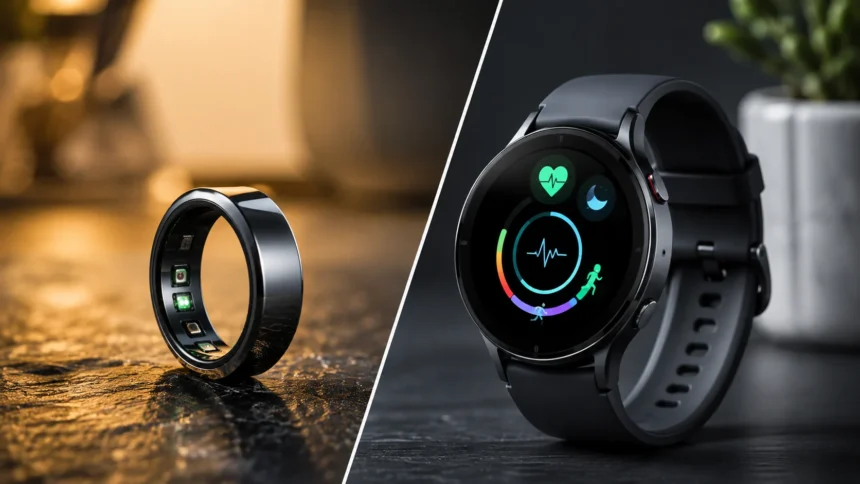
Smart Rings vs Smartwatches
Wearable technology has become a practical way to monitor daily activity, sleep, recovery, heart rate, workouts, and general wellness without constantly checking a phone. Two of the most popular wearable formats are smartwatches and smart rings. Both collect useful health and activity information, but they approach the experience very differently. A smartwatch places a small interactive screen on your wrist, while a smart ring focuses on discreet background tracking with very little direct interaction.
The smart rings vs smartwatches debate therefore involves much more than deciding which device is smaller. Smartwatches are designed to combine health tracking with notifications, apps, exercise tools, communication features, and everyday digital convenience. Smart rings generally remove the screen and concentrate more heavily on passive health monitoring, sleep, recovery, and long-term trends. Popular current rings such as Oura Ring 4 and Samsung Galaxy Ring illustrate this screenless approach, while modern watches continue to combine health sensors with interactive displays.
Neither category is automatically better for everyone. A runner who wants pace information during a workout may value a smartwatch display, while someone primarily interested in sleep and recovery may prefer wearing a lightweight ring overnight. Battery life, comfort, smartphone compatibility, subscription costs, workout requirements, and personal style can all influence the decision.
This guide compares smart rings and smartwatches across design, health monitoring, sleep tracking, workouts, battery life, notifications, comfort, accuracy, pricing, and everyday practicality. By understanding what each wearable does best, you can choose a device based on how you actually plan to use it instead of simply buying whichever category appears more fashionable.
What Is a Smart Ring?
A smart ring is a compact wearable device designed to fit around a finger while containing miniature sensors and electronics. Unlike most smartwatches, it generally does not use a conventional interactive screen. The ring collects information quietly in the background and sends the data to a companion smartphone app where users can review trends, scores, graphs, and personalized insights.
Modern smart rings can monitor several wellness signals depending on the model. Oura Ring 4, for example, tracks heart rate around the clock and uses sensors for heart-rate variability, temperature trends, movement, respiration during sleep, and blood-oxygen-related measurements. Samsung’s Galaxy Ring similarly focuses on health, activity, sleep, and energy-related insights through its connected health platform.
The lack of a screen is central to the smart-ring experience. Instead of constantly presenting alerts or workout statistics, the ring is intended to remain relatively unobtrusive. Users typically check their phone later to understand what the device collected. This can make the category appealing to people who want health tracking but do not want another bright display competing for their attention.
Smart rings are also designed around continuous wear. Their small size makes them relatively easy to leave on through work, everyday activity, and sleep, although comfort varies by finger shape, ring size, and personal preference. Because sensor contact depends heavily on fit, choosing the correct ring size is an important part of getting useful data.
What Is a Smartwatch?
A smartwatch is a wearable computer designed around a wrist-mounted display. It combines health and fitness sensors with interactive features such as notifications, apps, timers, navigation, music controls, calls, messages, and workout information. Depending on the model, some smartwatches can perform many basic tasks without requiring the user to immediately reach for a smartphone.
Health and fitness monitoring remains a major part of modern smartwatch design. Watches can track heart rate, workouts, movement, sleep, and other wellness metrics depending on their hardware and software. Apple Watch, for example, can estimate time spent in different sleep stages, including REM, Core, and Deep sleep, while other smartwatch ecosystems provide similar health-focused dashboards.
The display gives smartwatches an important advantage during active use. Runners can glance at pace or distance, gym users can follow workout timers, and everyday users can view notifications or calendar information without opening a phone. This makes the smartwatch a more interactive category than the typical smart ring.
That interactivity also creates tradeoffs. A larger screen and more active functionality can require more frequent charging and may feel more noticeable on the body, particularly during sleep. Current battery life varies widely across watch models; for example, Apple lists up to 24 hours for Apple Watch Series 11 and up to 42 hours for Apple Watch Ultra 3 under its stated usage conditions.
Smart Rings vs Smartwatches: The Biggest Difference
The biggest difference between a smart ring and smartwatch is how actively you interact with the device. A smartwatch is designed to provide information immediately on your wrist. You can check notifications, control music, view workout data, run apps, set timers, or respond to certain alerts without opening your phone.
A smart ring takes almost the opposite approach. It primarily collects information rather than presenting it constantly. Most detailed analysis happens inside the phone app later, making the ring feel more like a quiet health sensor than a miniature smartphone. This distinction can strongly influence which device feels more comfortable in daily life.
Smartwatches are therefore generally better suited to people who want both health data and digital utility. Someone who wants navigation prompts, live workout metrics, notifications, and quick controls may find a ring too limited. The screen is not simply a design difference; it changes the entire way the device fits into everyday routines.
Smart rings are better suited to people who deliberately want fewer interruptions. If your main goal is tracking sleep, recovery, movement, and general wellness trends without wearing another screen, a ring may provide a cleaner experience. Choosing between them starts with deciding whether you want your wearable to actively assist you throughout the day or quietly measure what your body is doing.
Which Is Better for Sleep Tracking?
Sleep tracking is one of the strongest reasons many people consider a smart ring. Rings are small, screenless, and generally designed for continuous wear, which can make them less intrusive in bed than a larger wrist device. Because sleep monitoring depends on consistently wearing the device overnight, comfort can have a meaningful impact on how complete your data becomes.
Oura has made sleep and recovery a central part of its product experience, while Samsung also promotes continuous sleep measurement through Galaxy Ring. Oura Ring 4 includes detailed sleep analysis and overnight heart-rate-variability and respiration measurements, while Galaxy Ring analyzes body patterns including sleep through Samsung Health.
Smartwatches can also provide detailed sleep tracking. Apple Watch estimates REM, Core, and Deep sleep stages, and recent watchOS versions can provide a sleep score based on factors such as duration, consistency, and awake periods. The major difference is not necessarily whether watches can track sleep, but whether you personally find wearing a watch overnight comfortable enough to do so consistently.
For people whose highest priority is overnight comfort and passive recovery tracking, a smart ring often has the practical advantage. For users who already enjoy sleeping in their smartwatch and want their sleep data integrated with a broader fitness device, purchasing a separate ring may be unnecessary. Consistency of wear matters more than choosing a category simply because it is marketed for sleep.
Which Is Better for Fitness and Workouts?
Smartwatches generally have the advantage for active exercise because they can present live information during a workout. A runner can check time, distance, heart rate, or pace without stopping to use a phone, while gym users can follow intervals and workout timers directly from the wrist. This immediate feedback is difficult for a screenless ring to replicate.
The smartwatch interface can also make workout control easier. Users can start and stop sessions, select exercise modes, change music, or review activity information directly from the device. For structured training, these interactions can be more valuable than passive tracking alone because athletes often need information while the activity is happening.
Smart rings can still track activity and movement, and current models include activity-oriented heart-rate features. Oura Ring 4, for example, uses movement sensors and continuous heart-rate measurements as part of its health and activity system. The limitation is that the detailed information is usually reviewed later through the app rather than displayed live on the ring.
If fitness training is your main reason for buying a wearable, a smartwatch will generally provide the more complete experience. If you exercise casually but care more about recovery, sleep, stress, and long-term health patterns, a ring may cover what you need without adding a wrist display. Some users even combine both categories for different parts of the day.
Heart Rate and Health Monitoring
Both smart rings and smartwatches can monitor heart rate, but they collect measurements from different locations. Smartwatches use sensors positioned against the wrist, while rings place sensors against the finger. In either case, secure contact with the skin is important because movement, fit, and sensor positioning can influence readings.
Smart rings benefit from being worn tightly around a finger, which can provide a stable site for certain optical and temperature measurements. Oura Ring 4, for example, combines green and infrared photoplethysmography sensors with temperature, movement, and blood-oxygen-related sensing.
Smartwatches may include broader health functionality depending on the model and ecosystem. Their larger physical design provides more space for hardware, while the display allows users to interact with health applications immediately. This can make a smartwatch more flexible for people who want a wider collection of health and fitness tools rather than primarily passive measurement.
Consumers should remember that wellness wearables are not substitutes for professional medical diagnosis. Health metrics are most useful when interpreted as trends and personal information within the intended capabilities of the device. If a wearable indicates something concerning or you have symptoms, medical evaluation should take priority over interpreting consumer-device data on your own.
Smart Rings vs Smartwatches for Recovery Tracking
Recovery tracking attempts to help users understand how prepared their body may be for physical or mental strain. Devices may combine sleep information, resting heart rate, heart-rate variability, temperature patterns, recent activity, and other measurements to produce readiness or recovery-oriented insights.
Smart rings have become particularly associated with this category because they are designed to collect measurements continuously without demanding much interaction. Wearing the same ring during the day and overnight can provide the app with a more continuous picture of activity and rest. Oura, for example, positions sleep, activity, stress, heart health, and other trends as part of its broader wellness insights.
Smartwatches can provide similar types of health and fitness context depending on their software ecosystem. Their strength is that recovery information can sit alongside workout tracking, navigation, communication, and other wrist-based features. This may be preferable for someone who wants one device handling nearly everything.
A smart ring may feel more focused if recovery is your priority. Instead of becoming another digital interface, it stays mostly invisible and leaves interpretation to the phone app. The ideal choice depends on whether you want recovery data as the central experience or as one feature within a much broader smartwatch platform.
Battery Life: Smart Rings Usually Have an Advantage
Battery life is one of the clearest practical differences between these categories. Because smart rings do not continuously power large interactive screens, many current rings can run for several days before needing a recharge. Oura says Ring 4 can achieve approximately five to eight days under its stated testing conditions, while Samsung lists up to seven days for certain Galaxy Ring sizes.
This longer battery cycle can make continuous health tracking easier. A device that needs charging less often has fewer opportunities to miss overnight sleep or daily activity information. For people who dislike adding another device to a daily charging routine, the difference can be significant.
Smartwatch battery life varies much more widely because displays, apps, GPS, cellular connections, and active workouts consume substantial power. Some watches need relatively frequent charging, while larger endurance-focused models last longer. Apple’s current lineup illustrates this range, with Series 11 rated up to 24 hours and Ultra 3 up to 42 hours under the company’s described usage scenarios.
Battery specifications should always be viewed as estimates because real usage varies with features, workouts, display behavior, connectivity, device age, and settings. Even so, people who primarily want passive health monitoring with less frequent charging will generally find the smart-ring format attractive.
Comfort and Everyday Wear
Comfort is subjective, but form factor creates meaningful differences. A smart ring is dramatically smaller than a watch and does not cover a large area of skin. For someone who already wears traditional jewelry or dislikes wrist devices, the ring may disappear into daily life more naturally.
Sleep can highlight the comfort difference even more. Some people barely notice a watch overnight, while others dislike feeling a larger device against the wrist or pillow. A properly fitted ring can feel less intrusive, although people who are not accustomed to rings may experience the opposite.
Certain activities can make rings less convenient. Weightlifting, gripping heavy tools, or working with equipment can make a rigid metal ring uncomfortable, and some users may prefer removing it during those activities. A wrist-based device can sometimes avoid direct pressure from gripping, although watches can also interfere with specific sports or work environments.
The best wearable is the one you will actually continue wearing. A device with excellent sensors provides little value if it remains on a bedside table because it feels uncomfortable. Consider your sleep habits, exercise style, job, clothing, jewelry preferences, and tolerance for wrist or finger wear before deciding.
Notifications and Communication
Smartwatches win easily when notifications matter. Their screens can display calls, messages, reminders, calendar events, app alerts, and other information without requiring the phone to leave your pocket. Depending on the model, users may also be able to respond, take calls, or perform other actions directly from the wrist.
For busy professionals, this can be extremely convenient. A quick glance may reveal whether a message requires immediate attention without interrupting a meeting or activity to check a phone. Navigation prompts and timers can provide similar convenience throughout the day.
The disadvantage is that constant notifications can become distracting. A watch may reduce the number of times you pick up a phone while simultaneously creating another stream of alerts directly on your body. Users who are trying to reduce digital interruptions may find this frustrating.
Smart rings largely avoid this issue because they are usually not built around screen-based communication. This limitation can become an advantage for people who want health insights without another notification center. If digital convenience matters more, choose a smartwatch; if digital quiet matters more, a ring may be preferable.
Screen vs Screenless Design
A smartwatch screen creates enormous functionality. Users can read data, interact with applications, check timers, access controls, and view workout information immediately. The display transforms the watch from a health tracker into a more general-purpose wearable computer.
The same display also requires attention. Screens consume power, increase device size, and create temptation to interact. For people who already feel overwhelmed by phones, tablets, and computers, adding another screen may feel unnecessary rather than convenient.
Smart rings intentionally remove that layer. The wearable becomes primarily a sensor, while the phone becomes the place for analysis. This design separates data collection from data consumption, which can make health tracking feel less intrusive.
Neither approach is universally better. Some users want immediate information, while others prefer data to remain invisible until they intentionally review it. Ask yourself whether seeing information instantly is essential or whether checking a health app once or twice a day would be enough.
Smart Rings Can Be More Discreet
A smart ring looks much closer to ordinary jewelry than typical wearable technology. This can make it appealing for formal settings, professional environments, or users who dislike the sporty appearance of many wrist devices. A ring can collect data while attracting relatively little attention.
This discretion also allows users to continue wearing traditional watches. Someone who loves mechanical or luxury watches does not need to replace them with a digital device simply to gain health tracking. The smart ring can provide the technology while the wrist remains available for preferred jewelry.
Smartwatches make a more obvious visual statement because the display is designed to be seen and interacted with. Custom bands and watch faces can change the appearance, but the device still looks recognizably technological.
Personal style therefore matters more than it might initially seem. If you want technology to become part of your visible daily accessories, a smartwatch provides greater customization. If you want the technology to remain subtle, a smart ring has a clear design advantage.
Smartwatches Offer More Standalone Features
Smartwatches can perform many functions that have little to do with health tracking. Timers, alarms, weather information, music controls, navigation, contactless functions, apps, messaging, and other features can make the watch useful even for someone who rarely reviews wellness trends.
This versatility means a smartwatch can sometimes reduce how often you use your phone. Quick interactions can happen directly on the wrist, which may be valuable during exercise, commuting, cooking, or other situations where holding a phone is inconvenient.
Smart rings generally require the connected phone application for meaningful interaction. The ring itself is mainly responsible for collecting information rather than becoming an independent computing interface. If your phone is unavailable, you may not be able to review insights immediately even if the ring continues collecting data.
For users who want a wearable to function as a genuine extension of their smartphone, the smartwatch is the stronger choice. Smart rings should instead be viewed as highly focused wellness wearables rather than miniature replacements for smartwatches.
Smartphone Compatibility Matters
Compatibility should be checked carefully before purchasing either device. Wearables often work best within particular smartphone and health ecosystems, and some features may require specific operating systems or companion applications. A device that looks perfect on paper may become frustrating if it does not integrate well with the phone you already use.
Samsung states that Galaxy Ring requires an Android smartphone meeting specified software and memory requirements along with Samsung’s wearable and health apps. This makes ecosystem compatibility an especially important part of ring selection.
Smartwatches can have similar ecosystem limitations. Certain models are designed primarily around specific phone platforms and may provide reduced functionality or no support elsewhere. Before purchasing, check not only whether basic pairing works but whether the health features you care about are actually available with your phone.
Think about long-term compatibility as well. If you expect to change smartphone platforms soon, an ecosystem-specific wearable may become less attractive. The best wearable should fit into your existing technology rather than forcing you to rebuild everything around it.
Battery Charging and Data Gaps
Charging habits affect the quality of long-term wearable data because no device can measure you while it is sitting on a charger. A wearable requiring frequent charging creates more opportunities to miss workouts, sleep sessions, or recovery information if you forget to put it back on.
Smart rings reduce this problem by stretching charging intervals across several days in many current models. Oura Ring 4’s five-to-eight-day stated battery range and Galaxy Ring’s up-to-seven-day range make it practical to choose a short charging window occasionally instead of building charging into every day.
Watch users can compensate by creating routines. Charging while showering, getting ready in the morning, or sitting at a desk can keep the device available for sleep and exercise. Fast-charging features on some watches can also make shorter charging sessions more practical.
Your willingness to manage charging should influence the purchase. Someone highly organized may have no issue maintaining a smartwatch routine, while another person may repeatedly discover the battery is low just before bed. Longer battery life becomes especially valuable when you know charging is a habit you dislike.
Which Device Is Better for Stress Tracking?
Stress-oriented insights generally rely on patterns such as heart rate, heart-rate variability, activity, sleep, and other physiological signals rather than directly measuring how stressed someone feels emotionally. Both rings and watches can contribute useful information, although interpretation differs among manufacturers.
Smart rings can be appealing for stress and recovery analysis because continuous background wear supports a long-term view of physiological changes. Oura explicitly includes stress among its health and wellness insights alongside sleep, activity, heart health, and recovery-related information.
Smartwatches may combine stress-related information with guided breathing, mindfulness applications, movement reminders, or immediate alerts depending on the ecosystem. The screen allows the device to become part of the response rather than simply measuring the underlying signals.
If you mainly want to review trends and understand how sleep, recovery, and daily habits may relate to physiological stress, a ring can be attractive. If you also want interactive wellness tools directly on your wrist, a smartwatch offers greater functionality.
Which Is Better for Tracking Steps and Daily Activity?
Both categories can monitor everyday movement, although the experience differs. Smart rings use internal motion sensors to estimate activity and movement, while smartwatches combine wrist-based motion sensing with their broader fitness systems. Oura Ring 4, for example, includes an accelerometer for continuous movement and activity tracking.
For someone simply interested in whether they are moving enough during the day, either device may provide useful trend information. The ring keeps the process mostly invisible, whereas the watch can show progress immediately on the wrist.
Smartwatches can provide more motivation for people who respond positively to real-time goals, reminders, or activity displays. Seeing progress throughout the day may encourage someone to walk more or complete a planned workout.
Smart rings suit people who prefer to review activity retrospectively. Rather than constantly checking progress, you can let the ring collect information and evaluate the day later. Your behavioral preferences may therefore matter more than the technical difference.
Which Is Better for Running?
For serious or structured running, a smartwatch generally provides the more useful experience. Runners often want live pace, elapsed time, distance, heart rate, workout intervals, and route information during the session. A screen allows those metrics to be viewed without stopping.
Many smartwatch designs are built specifically around exercise and outdoor use, with controls intended to remain accessible while moving. Watches may also integrate GPS and training features more directly than smart rings, depending on the specific device.
A ring can still contribute useful post-workout recovery information, resting measurements, and overall activity trends. Someone who already carries a phone or uses another running computer may not need their ring to provide live exercise statistics.
Competitive athletes may even find the categories complementary rather than mutually exclusive. The watch can handle workout interaction, while the ring can prioritize overnight recovery and passive health trends. Whether that additional data justifies owning two wearables depends on budget and personal interest.
Which Is Better for Gym and Strength Training?
Strength training exposes one of the practical weaknesses of smart rings. Gripping barbells, dumbbells, kettlebells, or machines can press a rigid ring between the hand and equipment, which may feel uncomfortable. Many lifters therefore prefer removing rings during heavier sessions.
Removing the ring creates a temporary tracking gap, although the importance of that gap depends on what you expect from the device. If your primary interest is sleep and recovery, missing detailed sensor data during a lifting session may not be particularly important.
Smartwatches remain on the wrist and can often track strength-training sessions without interfering directly with grip. They can also display timers and workout information, making them more practical during structured gym training.
For someone whose main fitness activity is strength training, a smartwatch is generally the more convenient single-device choice. A ring can still be valuable as a complementary recovery wearable, but its finger placement should be considered carefully before purchasing.
Smart Ring Sizing Is More Important
Smartwatch fit can usually be adjusted easily by changing the strap position. Smart rings are less forgiving because the device itself must fit the finger correctly. A ring that is too loose may move excessively, while one that is too tight can become uncomfortable as fingers naturally change size throughout the day.
Many smart-ring companies therefore use sizing kits or recommend trying sample sizes before ordering the final device. This additional step can feel inconvenient, but it helps ensure sensor placement and long-term comfort are appropriate.
Finger size can vary with temperature, activity, hydration, and time of day. The ring should remain secure without becoming painfully tight during normal fluctuations. Users should follow the manufacturer’s sizing guidance rather than assuming their traditional jewelry size will always translate perfectly.
Smartwatch buyers still need to consider strap comfort and case size, but sizing is usually easier to adjust after purchase. If convenience of fitting matters, the watch category has an advantage.
Durability and Daily Practicality
Both smart rings and watches are designed for regular use, but they experience different types of wear. Rings frequently contact door handles, desks, gym equipment, bags, and other hard surfaces because hands interact directly with the environment. Scratches can therefore become a cosmetic concern.
Watches are more exposed to impacts around the wrist but are somewhat removed from direct gripping. Larger watch faces can still strike walls, furniture, or exercise equipment, and bands may show wear over time.
Water resistance also matters for people who plan to shower, swim, or exercise while wearing a device. Specifications differ by product, so users should check the rating and manufacturer’s usage guidance rather than assuming every wearable can handle the same conditions.
Think about your occupation as well. People working with machinery, heavy tools, medical gloves, food preparation, or hands-on trades may find one form factor substantially more practical than the other. Lifestyle should influence durability decisions just as much as technical specifications.
Smart Rings and Smartwatches Can Work Together
You do not necessarily have to choose one category forever. Some people use a smartwatch during workouts and daytime activities but prefer a ring for sleep and passive health monitoring. This approach combines the strengths of both formats, although it increases cost and creates another device to manage.
Samsung officially supports using Galaxy Ring alongside compatible Galaxy watches. When both are worn, Samsung says the watch can become the primary device for certain measurements while some ring features temporarily reduce activity to conserve power.
Using two wearables may also create overlapping information. Before purchasing both, ask whether the additional device provides genuinely useful insights or simply duplicates data you already receive. More measurements do not automatically lead to better health decisions.
For enthusiastic athletes, data-focused users, or people who strongly dislike sleeping in a watch, the combination can make sense. For most casual users, one carefully chosen wearable will probably provide enough information without additional cost or complexity.
Price and Long-Term Cost
Purchase price is only one part of wearable cost. Buyers should consider accessories, charging equipment, replacement bands, membership plans, and potential future upgrades. A ring that appears affordable initially may include ongoing software costs, while another device may include most core functions without a recurring subscription.
Oura, for example, connects some of its detailed experience to an active membership, so anyone comparing long-term ownership should include that recurring expense rather than evaluating only hardware price.
Smartwatches may encourage spending on replacement straps, cellular plans, apps, or more frequent upgrades depending on the model. However, their broader functionality can potentially replace some tasks performed by other fitness or notification devices.
The best value depends on which features you actually use. Paying for advanced workout tools is wasteful if you only care about sleep, while buying a dedicated recovery ring may not make sense if your smartwatch already provides all the health insights you regularly review.
Privacy and Health Data
Wearables can collect sensitive information about sleep, heart rate, activity, temperature trends, location, and other aspects of daily life. Before choosing a device, review how the manufacturer handles health information, account security, cloud storage, connected applications, and data-sharing settings.
Strong account protection matters because the value of health tracking depends on collecting information over long periods. Use a unique password and multifactor authentication when the service supports it. Review connected third-party applications periodically and remove access that is no longer necessary.
Consider how much integration you genuinely need. Connecting every fitness, nutrition, health, and lifestyle service may create convenience, but it can also distribute personal information across more platforms. Use integrations deliberately rather than automatically accepting every connection request.
Privacy should be part of the buying decision alongside battery life and sensor features. A wearable remains close to your body almost continuously, so understanding how its information is managed is a reasonable part of evaluating long-term ownership.
Who Should Choose a Smart Ring?
A smart ring is particularly suitable for someone whose main priorities are sleep, recovery, passive health tracking, and longer battery life. If you want a wearable collecting information without constantly asking for your attention, the ring format is naturally appealing.
It can also be a strong choice if you dislike sleeping with a watch or already wear a traditional watch you do not want to replace. The finger-based form factor allows health tracking to coexist with another watch on the wrist without creating a double-watch setup.
People who want fewer notifications may appreciate the absence of a screen. The ring provides digital measurement without creating another surface for messages and alerts. This can make it easier to separate wellness tracking from general technology use.
A ring is less ideal if you need live workout metrics, extensive apps, navigation, or message interaction. Before buying, make sure your expectations match what a screenless wearable is designed to do.
Who Should Choose a Smartwatch?
A smartwatch is the better choice for users who want one wearable to combine fitness tracking with everyday digital convenience. Notifications, timers, applications, workout data, navigation, and media controls make the category much more versatile than a typical smart ring.
Athletes who need information during training will generally benefit from the display. Runners, cyclists, gym users, and people following structured workouts can access information immediately rather than checking a smartphone later.
Smartwatches are also useful for people who regularly leave their phone in a pocket or bag but still want quick access to basic information. The ability to glance at an incoming message or timer can be surprisingly convenient in everyday life.
The tradeoff is greater device size, more frequent interaction, and potentially more frequent charging. If those disadvantages do not bother you, the broader functionality often makes a smartwatch the stronger all-purpose wearable.
Smart Ring vs Smartwatch: Which Is Better Overall?
There is no universal winner because smart rings and smartwatches solve slightly different problems. Smartwatches offer greater functionality, stronger workout interaction, visible information, notifications, and everyday digital convenience. They are better all-purpose wearable devices for users who want active interaction.
Smart rings are more specialized. Their strengths are discreet design, passive monitoring, sleep comfort, recovery-oriented tracking, and generally longer battery life. They are attractive to people who want technology collecting information in the background rather than demanding attention throughout the day. Current ring battery claims from Oura and Samsung also illustrate why the category appeals to users seeking multi-day wear.
If your priorities are running, navigation, calls, messages, apps, and workout control, choose a smartwatch. If your priorities are sleep, recovery, subtle design, and less frequent charging, consider a smart ring. If you already own one category, first determine whether the other provides enough new value to justify another device.
The most important question is not which technology is objectively more advanced. It is which wearable fits naturally into your routine. A simpler ring worn consistently may provide more useful long-term information than a feature-packed watch you frequently remove, while an interactive smartwatch can be far more valuable for someone who actively uses its tools throughout every day.
Final Thoughts
The smart rings vs smartwatches comparison ultimately comes down to passive tracking versus active interaction. Smart rings are compact, subtle, and focused primarily on monitoring your body without becoming another screen. Smartwatches combine health tracking with a broader digital experience that includes fitness tools, notifications, apps, and immediate information.
For sleep and recovery-focused users, the ring has several practical advantages. Current leading models emphasize continuous health tracking and multi-day battery life, reducing the need for frequent charging and making overnight use easier.
For workouts and everyday digital convenience, the smartwatch remains more capable. A screen allows live exercise statistics, controls, reminders, and other functions that a screenless ring simply cannot provide. Modern smartwatches also offer increasingly detailed sleep and wellness information, meaning rings do not have a monopoly on health tracking.
Before buying, decide which features you will realistically use every week. Think about sleep comfort, exercise habits, charging tolerance, phone compatibility, notifications, design preferences, and long-term cost. The best wearable is not the one with the longest specification list—it is the one that fits your routine well enough that you continue using it.
Frequently Asked Questions
Are smart rings better than smartwatches?
Smart rings can be better for discreet health monitoring, sleep, recovery, comfort, and multi-day battery life. Smartwatches are usually better for workouts, live metrics, notifications, apps, navigation, and broader everyday functionality.
Are smart rings good for sleep tracking?
Yes, sleep tracking is a major focus of leading smart rings. Devices such as Oura Ring 4 and Galaxy Ring are designed for continuous wear and provide sleep-related insights through their companion applications.
Do smart rings have better battery life than smartwatches?
Many current smart rings last several days per charge. Oura Ring 4 is rated at approximately five to eight days under stated conditions, while certain Galaxy Ring sizes are rated for up to seven days. Actual results vary with usage.
Can a smart ring replace a smartwatch?
A smart ring can replace a smartwatch if you mainly want passive health, sleep, and recovery tracking. It is less suitable as a complete replacement if you depend on notifications, apps, live workout information, or other screen-based features.
Can you wear a smart ring and smartwatch together?
Yes. Some users combine the two, using the watch for workouts and interactive features while relying on the ring for passive or overnight tracking. Samsung officially supports combining Galaxy Ring with compatible Galaxy watches.